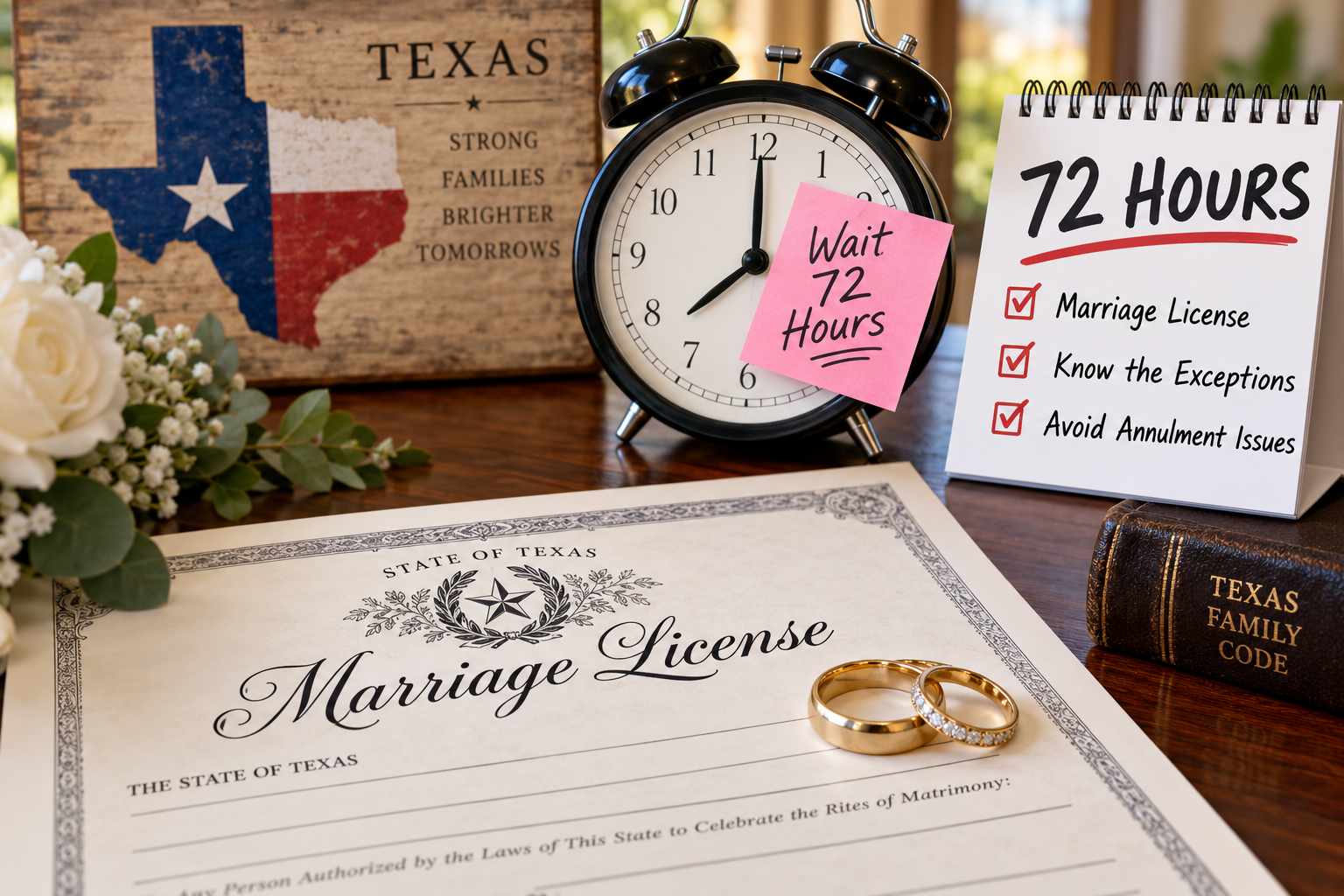
Getting a marriage license does not necessarily mean a Texas couple can immediately walk across the street and get married.
Texas law generally imposes a 72-hour waiting period between the issuance of a marriage license and the marriage ceremony.
Like many rules in Texas family law, however, the answer becomes more interesting once the exceptions are considered. Certain applicants do not have to wait, a judge or justice may waive the waiting period for good cause, and marrying in violation of the rule can even create a statutory basis for annulment.
For couples planning a wedding on a tight schedule, those details can matter considerably.
What Is the 72-Hour Marriage Waiting Period in Texas?
Texas Family Code § 2.204(a) states:
“Except as provided by this section, a marriage ceremony may not take place during the 72-hour period immediately following the issuance of the marriage license.”
The basic rule is therefore straightforward.
A couple ordinarily cannot obtain a Texas marriage license and immediately have the marriage ceremony performed. They must wait until the statutory 72-hour period has passed.
This is different from another waiting period that sometimes causes confusion: Texas generally also restricts remarriage during the first 30 days after a divorce becomes final.
The 72-hour rule concerns the issuance of the new marriage license. The 30-day rule concerns a recently divorced person's ability to marry someone else.
Depending on the circumstances, both rules may therefore need to be considered.
Who Does Not Have to Wait 72 Hours?
The Texas Legislature created several exceptions.
Under Texas Family Code § 2.204(b), the 72-hour waiting period does not apply to an applicant who:
- is an active-duty member of the United States armed forces;
- performs work for the United States Department of Defense as an employee or contractor;
- obtains a written judicial waiver; or
- completes a qualifying premarital education course and provides the appropriate completion certificate within the statutory time requirements.
In other words, the 72-hour rule is the default, but it is not absolute.
For some couples, Texas law specifically allows the marriage ceremony to occur sooner.
Can a Judge Waive the 72-Hour Waiting Period?
Yes.
Texas Family Code § 2.204(c) permits an applicant to request a written waiver from several categories of judicial officers.
The statute provides, in part:
“If the judge, associate judge, or justice finds that there is good cause for the marriage to take place during the period, the judge, associate judge, or justice shall sign the waiver.”
This is a particularly interesting provision because the statute uses “shall” once good cause is found.
The applicant still has to obtain the waiver, however. A couple should not simply decide for themselves that their circumstances constitute good cause and ignore the waiting period.
The statute identifies the judicial officers authorized to issue a waiver, including certain judges with family-law jurisdiction, county judges, appellate judges, associate judges, and justices of the peace.
Does Premarital Education Eliminate the Waiting Period?
It can.
Texas Family Code § 2.204 provides an exception for an applicant who completes the premarital education course described by Family Code § 2.013 and provides the county clerk with a completion certificate showing that the course was completed no more than one year before the marriage-license application was filed.
This creates an interesting incentive within Texas marriage law.
The Legislature did not merely create a mandatory waiting period. It also provided a statutory route around that waiting period for couples who complete qualifying premarital education.
For couples who already intended to complete such a course, the exception can therefore have a practical scheduling benefit.
What Happens If You Get Married Before the 72 Hours Are Up?
Here is where the rule becomes much more unusual.
Texas law does not merely tell couples to wait. It separately addresses what can happen when a marriage ceremony occurs in violation of the waiting-period requirement.
Texas Family Code § 6.110(a) provides:
“The court may grant an annulment of a marriage to a party to the marriage if the marriage ceremony took place in violation of Section 2.204 during the 72-hour period immediately following the issuance of the marriage license.”
Thus, violating the 72-hour waiting period can provide a statutory ground for annulment.
That does not mean the marriage automatically disappears the moment someone discovers that the ceremony occurred too soon.
The statute says the court “may grant an annulment.”
A judicial proceeding is therefore involved, and Texas law places a remarkably short deadline on this particular annulment claim.
How Long Do You Have to Seek an Annulment?
Not long.
Texas Family Code § 6.110(b) states:
“A suit may not be brought under this section after the 30th day after the date of the marriage.”
That is an extraordinarily short limitations period compared with many legal claims.
Suppose, for example, a couple obtains a marriage license Monday afternoon and improperly holds the ceremony Tuesday morning without qualifying for an exception or obtaining a waiver.
One spouse may potentially seek annulment under § 6.110.
But that particular statutory ground does not remain available indefinitely. Once the 30th day after the marriage has passed, a suit cannot be brought under § 6.110.
That does not necessarily determine whether some entirely different ground for annulment or divorce might exist. It simply means the special annulment provision based on violation of the 72-hour waiting period has its own unusually short deadline.
Does Marrying Too Soon Automatically Make the Marriage Void?
No.
This distinction is important.
Texas family law distinguishes between marriages that are voidand marriages that may be annulled.
Section 6.110 does not state that a marriage celebrated during the prohibited 72-hour period is automatically void. Instead, it authorizes a court to grant an annulment if the statutory requirements are satisfied.
That distinction has substantial legal consequences.
A procedural violation surrounding the timing of the ceremony should therefore not be casually treated as though no marriage ever existed.
Is an Annulment the Same as a Divorce?
Not exactly.
Both proceedings can result in the parties no longer being married, but they rest on different legal concepts.
A divorce generally terminates an existing marriage.
An annulment is based on circumstances surrounding the formation of the marriage that Texas law recognizes as grounds for setting it aside.
The Texas Family Code contains several grounds for annulment, and the 72-hour marriage-license violation is one of the more technical and easily overlooked examples.
That is also why someone facing this situation should pay careful attention to the specific statutory provision involved. Different annulment grounds can have different requirements and deadlines.
What If Someone Dies Before an Annulment Is Filed?
Texas law adds another wrinkle.
Family Code § 6.111 generally provides that, subject to a separate Estates Code exception:
“a marriage subject to annulment may not be challenged in a proceeding instituted after the death of either party to the marriage.”
This illustrates why the difference between a void marriage and a voidable marriage can become extremely important.
Questions about whether a marriage legally existed can affect inheritance rights, homestead rights, property characterization, probate proceedings, and other significant legal interests.
The law therefore does not necessarily permit someone to wait until a spouse dies and then raise an annulment theory that could have been pursued during the spouses' lifetimes.
Can You Get a Marriage License and Get Married the Same Day in Texas?
Sometimes—but not ordinarily.
The default Texas rule requires the couple to wait 72 hours after the marriage license is issued before the ceremony occurs.
A same-day marriage may nevertheless be possible if a statutory exception applies, such as:
- an applicable military or Department of Defense exception;
- completion of qualifying premarital education; or
- obtaining a written judicial waiver based on good cause.
Couples planning a rapid wedding should determine whether an exception actually applies rather than simply assuming that possession of the marriage license means the ceremony can immediately occur.
Why Does Texas Have a 72-Hour Waiting Period?
Whatever one thinks about the policy behind marriage waiting periods, the practical purpose is easy to understand: Texas generally inserts a brief interval between obtaining the legal authorization to marry and actually conducting the ceremony.
But the statutory scheme is more flexible than a simple three-day prohibition.
The Legislature simultaneously recognizes circumstances in which waiting serves little purpose—particularly certain military circumstances, qualifying premarital education, and situations in which a judicial officer finds good cause for a waiver.
The result is a rule that sounds absolute until the rest of the statute is read.
The Bottom Line
Texas couples generally must wait 72 hours after a marriage license is issued before the marriage ceremony takes place.
But Texas Family Code § 2.204 contains important exceptions, including certain military and Department of Defense circumstances, qualifying premarital education, and judicial waivers for good cause.
Perhaps most surprisingly, Texas Family Code § 6.110 expressly provides that a marriage ceremony performed in violation of the 72-hour waiting period can be grounds for annulment.
That annulment remedy comes with a catch: the suit must be brought no later than the 30th day after the marriage.
So although obtaining a marriage license may feel like the final legal step before the wedding, Texas law sometimes says otherwise.
When the timing of a marriage, recent divorce, validity of a ceremony, or possible annulment is legally important, reviewing the exact statutory requirements before acting can prevent a seemingly minor scheduling decision from creating a surprisingly complicated family-law problem.
This article is for general informational purposes only and does not constitute legal advice. Marriage, annulment, divorce, and probate issues can depend heavily on the particular facts and applicable law.
At David C. Barsalou, Attorney at Law, PLLC, we help clients navigate business, family, tax, estate planning, and real estate matters ranging from document drafting to litigation with clarity and confidence. If you’d like guidance on your situation, schedule a consultation today. Call us at (713) 397-4678, email barsalou.law@gmail.com, or reach us through our Contact Page. We’re here to help you take the next step.
