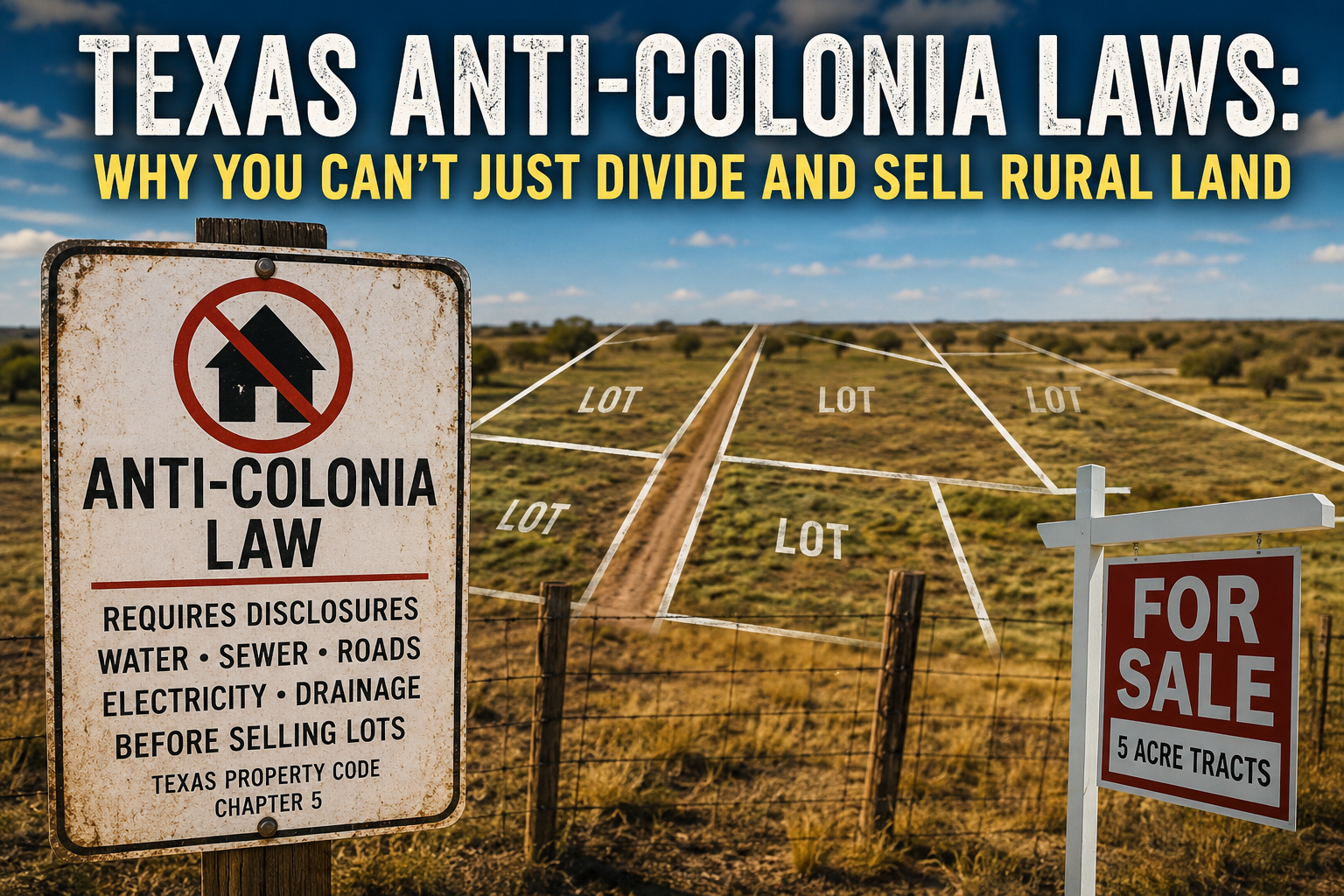
Many Texans assume that if they own a large tract of land, they can simply divide it into smaller lots and sell those lots to buyers. In many parts of Texas, however, that assumption can create serious legal problems.
Texas has enacted a series of laws commonly referred to as the "anti-colonia" laws. These statutes were designed to prevent the creation of substandard residential developments lacking basic infrastructure such as water, sewer service, drainage, and paved roads.
Although these laws originated from concerns along the Texas-Mexico border, they can affect landowners, developers, investors, and buyers throughout significant portions of the state.
What Is a Colonia?
A "colonia" generally refers to an unincorporated residential development that lacks adequate infrastructure and basic public services.
Historically, some developers sold small rural lots to low-income purchasers without providing potable water, wastewater disposal systems, proper drainage, or paved roads. Buyers often discovered too late that their property could not be legally developed or safely occupied.
In response, Texas adopted strict subdivision regulations.
The Law
Texas Property Code § 5.071(a) provides:
"A subdivider may not sell or offer to sell a lot under a contract for deed in a subdivision unless the subdivider complies with this subchapter."
The anti-colonia provisions are primarily found in Texas Property Code Chapter 5, Subchapter B and related provisions of the Texas Local Government Code.
The statutes impose extensive disclosure and infrastructure requirements before certain subdivided lots may be sold.
For example, Texas Property Code § 5.076 requires a seller to provide detailed disclosures regarding:
- Water service;
- Sewer service;
- Electricity;
- Road access;
- Floodplain status;
- Property taxes; and
- Ownership issues.
Failure to comply can expose a seller to substantial liability.
Why These Laws Matter Outside the Border Region
Many people assume anti-colonia laws only apply near the Rio Grande Valley.
That is not always true.
Certain provisions apply based upon the location of the property, county population, and the nature of the subdivision. Additionally, county subdivision regulations throughout Texas have become significantly stricter over time.
A landowner who attempts to divide a 20-acre tract into multiple residential lots may discover that county approval, platting requirements, utility certifications, and road standards apply before any sales occur.
In other words, what appears to be a simple real estate transaction may actually trigger a complex regulatory framework.
The Quirky Problem: "Seller Financing" Can Create Unexpected Liability
One of the most interesting aspects of Texas anti-colonia law is its historic focus on contracts for deed.
Before the Legislature intervened, some developers sold undeveloped lots through installment contracts rather than traditional mortgages. Buyers would make payments for years without receiving a deed.
Texas responded by imposing extensive consumer protections.
Today, Texas Property Code § 5.079 provides:
"A seller who violates this subchapter is liable to the purchaser."
Depending upon the violation, remedies may include statutory damages, cancellation rights, attorney's fees, and other relief.
Ironically, many small landowners attempting informal seller-financing arrangements are completely unaware that these rules exist.
Common Litigation Issues
Disputes frequently arise concerning:
- Failure to disclose utility limitations;
- Lack of legal road access;
- Inadequate wastewater systems;
- Misrepresentations regarding development potential;
- Defective plats;
- Contract-for-deed violations;
- Boundary disputes involving improperly divided tracts; and
- Rescission claims by purchasers.
These cases often involve a mixture of contract law, real estate law, consumer protection principles, and local government regulations.
What Buyers Should Investigate Before Purchasing Rural Land
Before purchasing subdivided rural property, buyers should verify:
- Whether the property has been properly platted;
- Whether water service is legally available;
- Whether wastewater permits can be obtained;
- Whether the property lies in a floodplain;
- Whether legal access exists;
- Whether county subdivision requirements have been satisfied; and
- Whether the seller has complied with all required statutory disclosures.
A surprisingly inexpensive tract of land may become very expensive if basic infrastructure cannot legally be installed.
What Sellers Should Know
Property owners considering the subdivision of rural acreage should consult legal counsel before marketing lots.
The cost of compliance is often far less than the cost of defending a lawsuit or facing regulatory enforcement later.
The anti-colonia laws reflect a simple public policy: Texas wants residential land to be safe, accessible, and capable of supporting basic human habitation.
What appears to be a straightforward land sale can therefore implicate a highly specialized area of Texas real estate law that many people never encounter until it is too late.
Conclusion
Texas anti-colonia laws are among the most unusual real estate statutes in the state. While originally aimed at preventing substandard border-area developments, these laws continue to affect landowners, developers, investors, and rural property purchasers today.
Anyone considering the purchase, sale, or subdivision of rural land should understand that dividing property is often far more complicated than drawing lines on a survey. Compliance with Texas subdivision and disclosure requirements can determine whether a transaction becomes a successful investment—or an expensive legal problem.
At David C. Barsalou, Attorney at Law, PLLC, we help clients navigate business, family, tax, estate planning, and real estate matters ranging from document drafting to litigation with clarity and confidence. If you’d like guidance on your situation, schedule a consultation today. Call us at (713) 397-4678, email barsalou.law@gmail.com, or reach us through our Contact Page. We’re here to help you take the next step.
