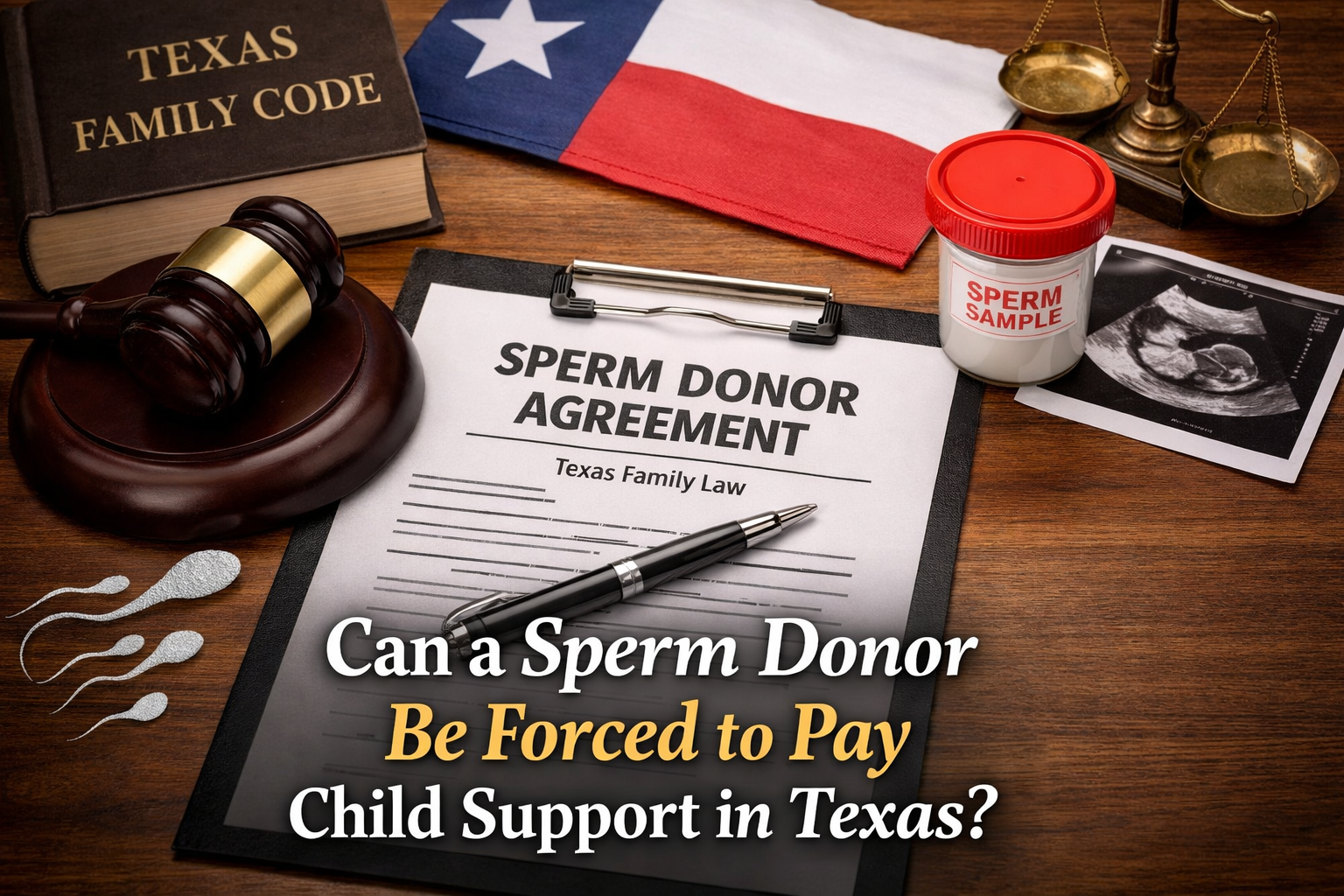
Many people assume that if a man agrees to donate sperm to help a woman conceive, he can simply sign an agreement giving up parental rights. In Texas, however, the legal rules are much more specific.
Under Texas law, whether a sperm donor is considered the legal father of a child depends heavily on how the donation occurs. If the process is not handled properly, a man who intended to be only a donor could still be considered the child’s legal parent—with potential child support obligations and parental rights.
This article explains how sperm donation works under Texas law and why the method of conception matters.
Texas Law on Sperm Donors and Assisted Reproduction
Texas follows the Uniform Parentage Act, which addresses children conceived through assisted reproduction.
Under Texas Family Code § 160.702:
“A donor is not a parent of a child conceived by means of assisted reproduction.”
At first glance, this seems straightforward. If someone donates sperm, they are not the parent. However, the statute works together with another provision that defines what a “donor” actually is.
How Texas Defines a “Donor”
The Texas Family Code defines a donor in Texas Family Code § 160.102(6) as:
“An individual who provides sperm or eggs to a licensed physician for use in assisted reproduction.”
This definition is critical. In Texas, the law generally treats a man as a sperm donor only if the sperm is provided to a licensed physician or fertility clinic for use in assisted reproduction.
If that requirement is not met, the legal analysis may change significantly.
The Legal Risk of “At-Home” Sperm Donation
In many situations, a woman and a known donor may attempt at-home insemination without involving a medical provider. While this may seem simple, it can create legal risk.
If sperm is given directly to a woman without going through a physician, Texas courts may determine that the man does not qualify as a statutory donor under the Family Code.
In that situation, the man could potentially be treated as the legal father of the child, which could expose him to:
- Child support obligations
- Custody or visitation disputes
- Legal parentage claims
In other words, the law may treat the situation the same way as any other biological parent-child relationship.
Are Private Sperm Donor Agreements Enforceable?
Some people attempt to avoid these issues by signing a private sperm donor agreement stating that the donor will not be the father.
While such agreements can help show the intent of the parties, they do not necessarily override Texas parentage laws. Courts primarily look to the statutory framework in the Texas Family Code when determining parentage.
Because of this, a private agreement alone may not fully eliminate the risk that a donor could later be considered a legal parent.
The Safest Way to Structure a Sperm Donation in Texas
For individuals who want to pursue a known donor arrangement, the safest approach generally includes:
- Using a licensed physician or fertility clinic to perform the assisted reproduction.
- Entering a written sperm donor agreement before the procedure.
- Consulting a Texas family law attorney regarding parentage issues.
Taking these steps helps align the situation with the protections contained in the Texas Uniform Parentage Act.
Why Legal Advice Matters in Assisted Reproduction
Family formation through assisted reproduction is becoming increasingly common, but the legal rules surrounding parentage are still evolving.
A poorly structured arrangement can create unexpected legal consequences years later, particularly when disputes arise over custody, visitation, or financial support.
Anyone considering a known donor arrangement in Texas should carefully review the legal framework before proceeding.
Speak With a Texas Family Law Attorney
If you have questions about assisted reproduction, sperm donor agreements, or parentage law in Texas, it is important to understand how the Texas Family Code applies to your situation.
An experienced attorney can help you evaluate the risks and structure an arrangement that protects the parties involved.
At David C. Barsalou, Attorney at Law, PLLC, we help clients navigate business, family, tax, estate planning, and real estate matters ranging from document drafting to litigation with clarity and confidence. If you’d like guidance on your situation, schedule a consultation today. Call us at (713) 397-4678, email barsalou.law@gmail.com, or reach us through our Contact Page. We’re here to help you take the next step.