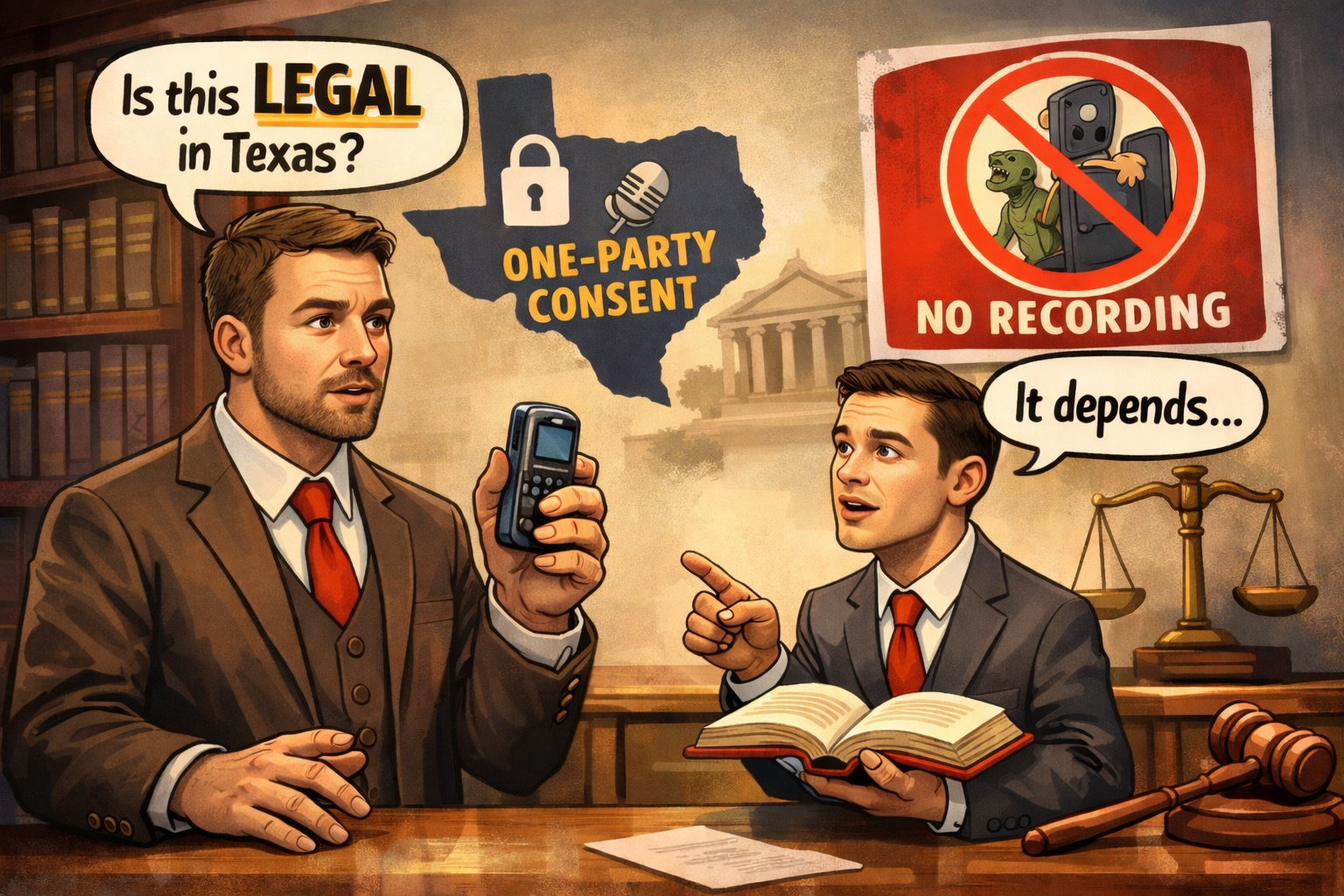
Understanding Texas’s One-Party Consent Law
Recording conversations has never been easier — or more legally dangerous. With smartphones, smart doorbells, dash cams, and business call-recording software everywhere, Texans frequently ask a simple question with serious consequences:
Is it legal to record a conversation in Texas?
The short answer: sometimes — and context matters.
The long answer is below.
Texas Is a “One-Party Consent” State — But That’s Not the Whole Story
Texas follows a one-party consent rule for recording conversations. This means that only one person involved in the conversation needs to consent to the recording — and that person can be you.
Under Texas Penal Code § 16.02, it is generally lawful to record:
- A phone call you are participating in, or
- An in-person conversation you are part of,
without telling the other participants
So long as you are a party to the communication, recording it is usually legal.
When Recording a Conversation Is Illegal in Texas
Texas’s one-party consent rule does not give blanket permission to record everything. Recording becomes illegal when:
1. You Are Not a Party to the Conversation
Secretly recording other people’s conversations — when you are not involved — is illegal and may constitute wiretapping.
Examples:
- Recording two coworkers talking without participating
- Placing a hidden recording device in a room you are not in
- Intercepting phone calls between third parties
These actions can expose you to criminal charges and civil liability.
2. There Is a Reasonable Expectation of Privacy
Even if you are physically present, recording may still be unlawful if:
- The other party has a reasonable expectation of privacy, and
- You are using deceptive or intrusive methods
Bathrooms, bedrooms, medical offices, and similar settings carry heightened legal risk.
3. The Recording Is Used for an Illegal Purpose
Even a legally made recording can become problematic if it is used for:
- Extortion
- Harassment
- Blackmail
- Invasion of privacy
- Stalking or coercion
How a recording is used matters just as much as how it was made.
Recording Phone Calls in Texas
Phone calls are treated the same way as in-person conversations under Texas law.
You may legally record a phone call if you are one of the participants.
You may not record calls between other people without consent.
Important note: federal law also applies, but it mirrors Texas’s one-party consent framework in most situations.
Can Recordings Be Used in Court?
Sometimes — but not always.
Even a legal recording may be excluded from evidence if:
- It violates evidentiary rules
- It was edited or altered
- It lacks proper authentication
- It was obtained deceptively in a civil or family dispute
Courts often scrutinize recordings closely, especially in divorce, custody, employment, and business litigation.
Recording in Divorce, Custody, and Family Law Cases
This issue comes up constantly in family law matters.
Common mistakes include:
- Recording a spouse without understanding escalation risks
- Recording children improperly
- Attempting to “trap” someone into saying something damaging
While recording may be legal, it can backfire strategically in court and inflame an already volatile situation.
Civil Liability Risks Beyond Criminal Law
Even if prosecutors decline charges, a recording can still trigger:
- Civil invasion-of-privacy claims
- Intentional infliction of emotional distress claims
- Employment law violations
- Contractual confidentiality breaches
Legality does not equal immunity.
Bottom Line: Legal ≠ Safe
Texas’s one-party consent law makes recording easier — but not risk-free.
Before recording:
- Ask why you are recording
- Consider how it might be used against you
- Understand that judges do not like “gotcha” tactics
If a dispute is already legal or headed that way, get legal advice first.
Need Guidance on Evidence or Recording Issues?
Recording laws intersect with family law, employment disputes, business litigation, and civil lawsuits. A short consultation can prevent a long and expensive mistake.
At David C. Barsalou, Attorney at Law, PLLC, we help clients navigate business, family, tax, estate planning, and real estate matters ranging from document drafting to litigation with clarity and confidence. If you’d like guidance on your situation, schedule a consultation today. Call us at (713) 397-4678, email barsalou.law@gmail.com, or reach us through our Contact Page. We’re here to help you take the next step.
