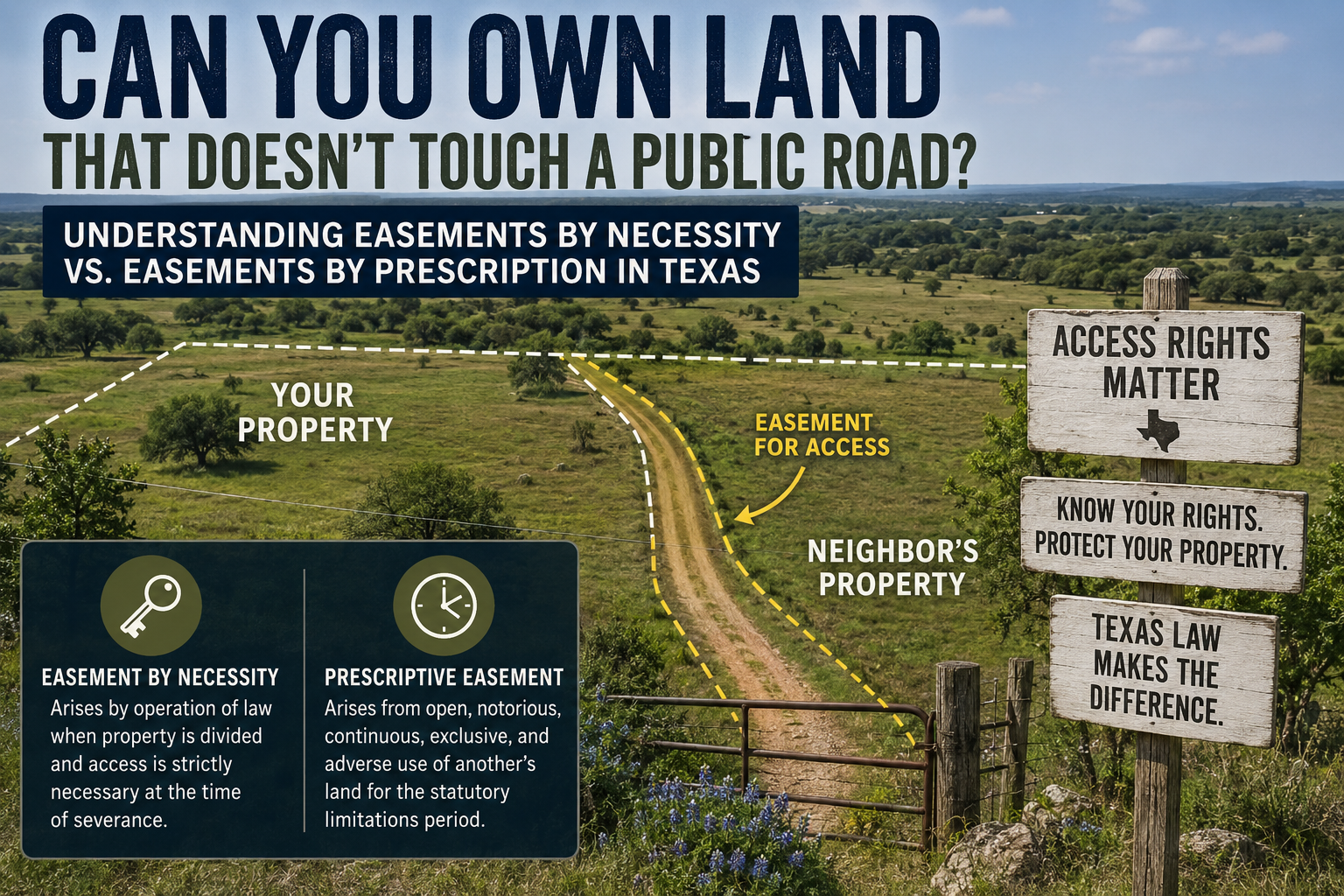
Many Texas landowners assume that if a property has no road access, the law automatically grants them the right to cross a neighbor's land. That is not always true. Texas law recognizes several different types of easements, and confusing one for another can cost thousands of dollars—or even make property effectively unusable.
One of the most misunderstood distinctions in Texas property law is the difference between an easement by necessity and an easement by prescription. Although both may allow someone to cross another person's property, they arise in entirely different ways.
Understanding the distinction is critical before buying rural property, settling an estate, or becoming involved in a boundary dispute.
What Is an Easement?
An easement is a nonpossessory interest that allows one person to use another person's land for a limited purpose without owning it.
Common examples include:
- Driveways
- Utility lines
- Shared private roads
- Access to otherwise landlocked property
- Drainage facilities
Some easements are created by written deed, while others arise entirely by operation of law.
Easements by Necessity
An easement by necessity exists because public policy generally disfavors creating landlocked parcels.
Texas Property Code § 5.001 provides:
"An estate in land that is conveyed or devised is a fee simple unless the estate is limited by express words or unless a lesser estate is conveyed or devised by construction or operation of law."
Although the statute addresses conveyances generally, Texas courts have long recognized that an easement by necessity may arise by operation of law when property is divided.
Generally speaking, the claimant must establish:
- Common ownership of both parcels before severance;
- Division of the property into separate tracts; and
- Strict necessity for access at the time of severance.
The necessity generally must exist when the property was divided, not merely because access later became inconvenient.
Easements by Prescription Are Completely Different
A prescriptive easement does not depend upon necessity.
Instead, it resembles adverse possession—but applies only to a right of use rather than ownership.
The claimant generally must prove open, notorious, continuous, exclusive, and adverse use of another's land for the applicable limitations period.
Texas Civil Practice and Remedies Code § 16.026 provides in part:
"A person must bring suit not later than 10 years after the day the cause of action accrues to recover real property held in peaceable and adverse possession by another who cultivates, uses, or enjoys the property."
While this statute governs adverse possession itself, Texas courts frequently use the same concepts when analyzing prescriptive easement claims.
Permission Usually Defeats a Prescriptive Easement
One of the biggest misconceptions is that using a neighbor's driveway for many years automatically creates legal rights.
Usually it does not.
If the use was:
- permitted,
- friendly,
- neighborly,
- or revocable,
then the use generally is not adverse, and no prescriptive rights arise.
The distinction between permission and adverse use often becomes the central issue in litigation.
A Common Probate Problem
This issue frequently appears after someone inherits rural property.
Imagine this situation:
Grandfather owned two adjoining ranches.
He later sold one tract but continued using the same dirt road across the neighboring property for decades.
Years later, his heirs inherit the remaining tract.
Questions immediately arise:
- Was there an implied easement?
- Was it merely permissive?
- Has a prescriptive easement developed?
- Did necessity exist when the parcels were first divided?
Each theory involves different legal elements and different evidence.
Why Buyers Should Care
A parcel without legal access may be worth dramatically less than one with documented ingress and egress rights.
Before purchasing rural Texas property, buyers should determine:
- whether access is by recorded easement,
- whether the access road crosses neighboring property,
- whether title documents reference the easement,
- whether litigation has occurred concerning access,
- and whether access depends solely upon a neighbor's goodwill.
A title policy may not cure every access problem.
Litigation Often Turns on Old Facts
Unlike many lawsuits that focus on recent events, easement litigation often requires examining history that is decades old.
Evidence may include:
- historical deeds,
- aerial photographs,
- county survey records,
- testimony from longtime neighbors,
- fence locations,
- old roadway alignments,
- probate records,
- and prior conveyances.
Sometimes the most important witness is someone who remembers how the property was used forty years ago.
Practical Advice
If you discover that your property lacks obvious legal access, avoid assuming you automatically possess easement rights.
Likewise, if someone has crossed your property for years, do not assume they have acquired permanent legal rights.
Texas law distinguishes sharply between:
- written easements,
- implied easements,
- easements by necessity,
- prescriptive easements,
- and merely permissive use.
Each carries different legal requirements.
Because access rights can substantially affect property value, obtaining legal advice before litigation—or before purchasing the property—is often far less expensive than trying to resolve the issue afterward.
Conclusion
Texas easement law is far more nuanced than most property owners realize. Two roads may look identical on the ground, yet one may be protected by a recorded deed, another by necessity, another by prescription, and another by nothing more than a neighbor's courtesy.
Understanding the legal source of an access right can determine whether property remains usable, marketable, and valuable—or becomes the subject of expensive litigation.
At David C. Barsalou, Attorney at Law, PLLC, we help clients navigate business, family, tax, estate planning, and real estate matters ranging from document drafting to litigation with clarity and confidence. If you’d like guidance on your situation, schedule a consultation today. Call us at (713) 397-4678, email barsalou.law@gmail.com, or reach us through our Contact Page. We’re here to help you take the next step.
