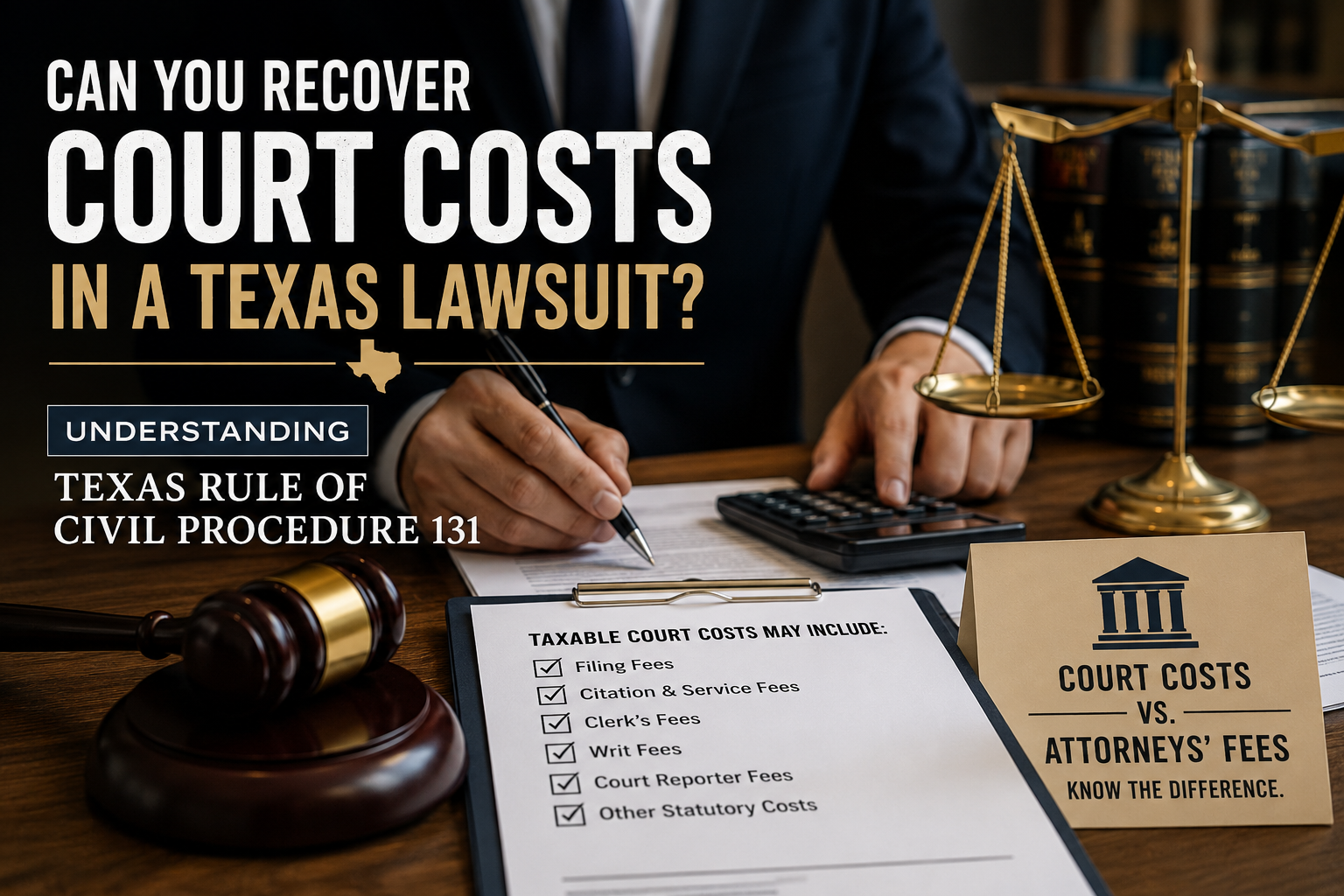
When people win a lawsuit, they often assume the losing party must reimburse every dollar they spent pursuing the case. Texas law is more nuanced than that. Although the prevailing party will often recover court costs, that does not necessarily include attorneys' fees, expert witness fees, or every litigation expense incurred during the lawsuit.
Understanding the difference can help parties better evaluate settlement offers, litigation strategy, and the true financial consequences of filing—or defending—a lawsuit.
Texas Rule of Civil Procedure 131
Texas follows a general rule that the successful party is entitled to recover court costs.
Texas Rule of Civil Procedure 131 provides:
"The successful party to a suit shall recover of his adversary all costs incurred therein, except where otherwise provided."
Although this rule appears straightforward, determining what qualifies as a "successful party" and what qualifies as "costs" can become surprisingly technical.
Who Is the "Successful Party"?
Generally, the successful party is the litigant who obtains a favorable judgment on the primary dispute.
In many cases, identifying the successful party is easy:
- A plaintiff wins a money judgment.
- A defendant obtains a take-nothing judgment.
- A landlord prevails in an eviction case.
- A party successfully defends against all claims.
More complicated cases may involve mixed results, partial victories, multiple parties, or competing claims. In those situations, courts have discretion to determine which party, if any, should recover taxable costs.
What Are Court Costs?
Court costs are not the same thing as litigation expenses generally.
Examples commonly include:
- Filing fees
- Citation and service fees
- Clerk's fees
- Fees for issuance of writs
- Certain statutory court reporter charges
- Other costs specifically authorized by statute or rule
These costs are generally taxed by the clerk and included in the judgment.
Court Costs Are Different from Attorneys' Fees
One of the most common misconceptions is that winning automatically requires the losing side to pay the winner's attorney.
That is simply not the rule in Texas.
Texas generally follows the American Rule, meaning each side ordinarily pays its own attorneys unless a contract or statute provides otherwise.
For example, attorneys' fees may be recoverable under statutes such as:
- Texas Civil Practice and Remedies Code Chapter 38 (certain contract claims)
- The Texas Deceptive Trade Practices Act
- Various provisions of the Texas Property Code
- Certain provisions of the Texas Family Code
- Other specific statutory causes of action
Winning a lawsuit alone does not automatically shift attorney fees.
Can the Court Award Costs Differently?
Yes.
Texas Rule of Civil Procedure 141 provides an important exception.
Rule 141 states:
"The court may, for good cause, to be stated on the record, adjudge the costs otherwise than as provided by law or these rules."
This means that even though Rule 131 creates the general rule, a trial court may allocate costs differently if it states good cause on the record.
Because Rule 141 is an exception to the general rule, courts generally require a legitimate justification before departing from Rule 131.
Why Court Costs Matter During Settlement
Court costs are often modest compared to attorney fees, but they still affect settlement negotiations.
Suppose:
- Filing fees total several hundred dollars.
- Service fees are incurred for multiple defendants.
- Numerous clerk and court costs accumulate during lengthy litigation.
Those amounts can become meaningful, especially in smaller cases such as landlord-tenant disputes, debt collection matters, or Justice Court appeals.
Understanding who will likely bear those costs helps both parties evaluate the economic reality of continuing litigation.
Practical Considerations
If you expect to recover court costs, make sure:
- Filing fees are properly reflected in the clerk's record.
- Service fees are documented.
- Statutory costs are properly requested.
- The final judgment accurately awards taxable costs.
Likewise, if you are defending a lawsuit, remember that even if the damages at issue are relatively small, losing may also result in responsibility for taxable court costs.
Conclusion
Texas Rule of Civil Procedure 131 establishes a simple default rule: the successful party generally recovers court costs. However, understanding what qualifies as recoverable costs—and recognizing that attorneys' fees are a separate issue—can significantly affect litigation strategy.
Whether you are considering filing suit, defending a claim, or negotiating a settlement, understanding the distinction between court costs and attorneys' fees can help you make more informed legal and financial decisions.
Disclaimer: This article is intended for general educational purposes only and does not constitute legal advice. Every case presents unique facts and legal issues. If you have questions regarding litigation, court costs, or civil procedure in Texas, consult an attorney regarding your specific circumstances.
At David C. Barsalou, Attorney at Law, PLLC, we help clients navigate business, family, tax, estate planning, and real estate matters ranging from document drafting to litigation with clarity and confidence. If you’d like guidance on your situation, schedule a consultation today. Call us at (713) 397-4678, email barsalou.law@gmail.com, or reach us through our Contact Page. We’re here to help you take the next step.