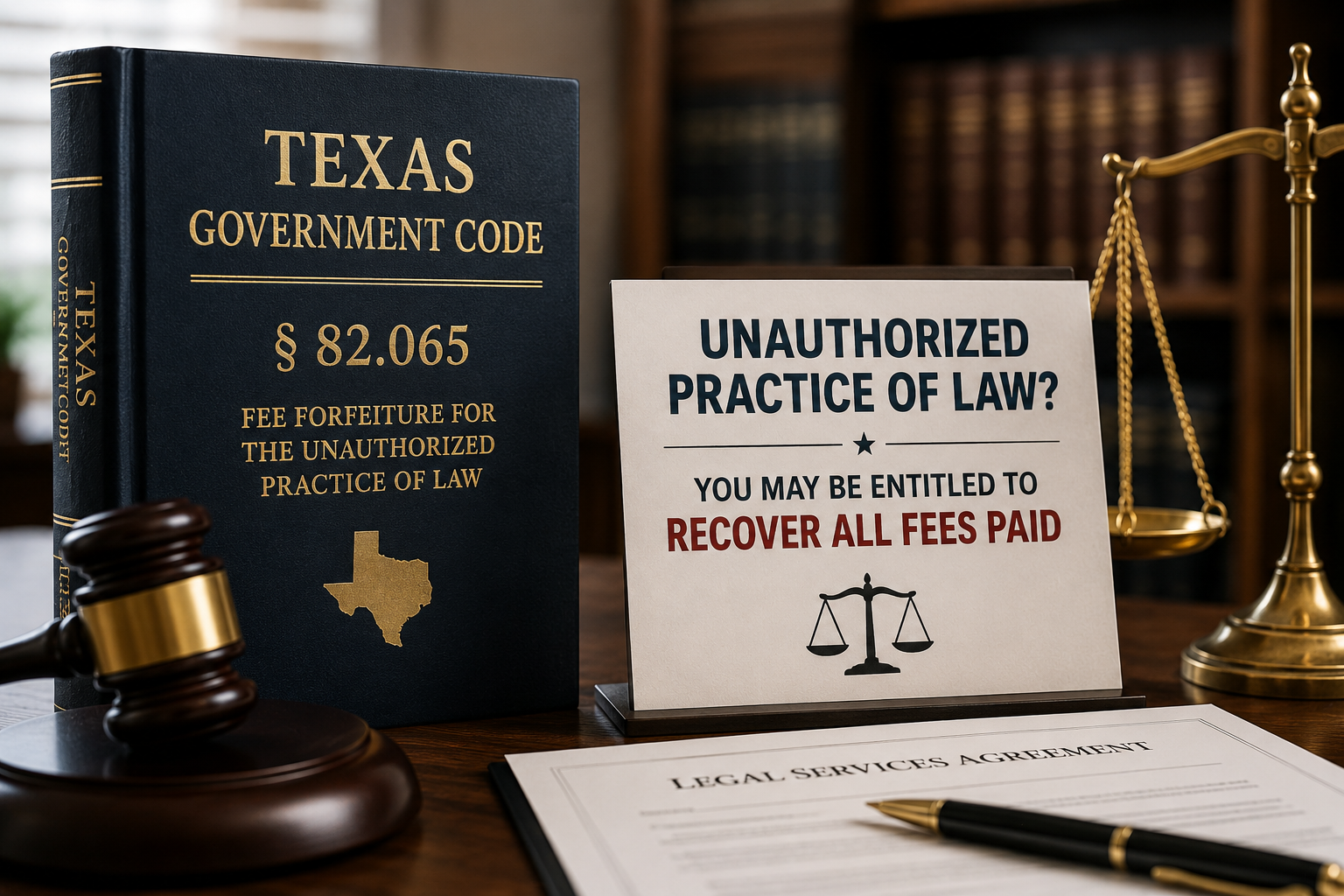
Most people know that practicing law without a license is illegal. What many Texans do not realize is that Texas law also provides a civil remedy that may allow a person to recover fees paid to someone who was not legally authorized to practice law.
This little-known statute appears in the Texas Government Code and can have significant consequences in business disputes, contract litigation, estate planning, real estate transactions, and other legal matters where someone improperly holds themselves out as a lawyer.
If you paid someone for legal services and later discovered they were not authorized to provide those services, Texas law may provide a remedy.
The Statute
Texas Government Code § 82.065 provides:
"A person who, with the person's consent, receives legal services from an individual who is not licensed to practice law in this state or otherwise authorized to provide legal services as required by the laws of this state may recover all fees paid to that individual for the legal services if the person did not know that the individual was not licensed or authorized to provide the services."
This statute creates an independent civil cause of action for fee recovery under the circumstances described by the Legislature.
What Must Be Proven?
Although every case depends upon its specific facts, the statute generally requires proof that:
- legal services were provided;
- the individual was not licensed or otherwise authorized to perform those services under Texas law;
- the client consented to receiving the services;
- the client paid fees; and
- the client did not know the individual lacked authority to practice law.
The statute focuses on protecting consumers who reasonably believed they were hiring someone legally authorized to provide legal representation or legal advice.
What Counts as the Practice of Law?
This question is often more complicated than people expect.
Texas does not limit the practice of law to appearing in court. Activities that may constitute the practice of law can include:
- drafting legal documents;
- giving legal advice regarding legal rights;
- negotiating legal claims on another person's behalf;
- preparing pleadings;
- interpreting legal obligations under contracts; and
- representing another person before a tribunal.
Whether particular conduct constitutes the unauthorized practice of law often depends on the specific facts and applicable Texas authority.
Who Is Authorized Besides Texas Attorneys?
The statute refers not only to licensed Texas attorneys but also to individuals who are "otherwise authorized" under Texas law.
Examples may include:
- attorneys admitted pro hac vice in a particular case;
- certain government attorneys;
- federally authorized practitioners in limited administrative proceedings;
- other individuals specifically authorized by statute or court rule.
Simply because someone is not a member of the State Bar of Texas does not automatically mean every legal-related activity they perform constitutes unauthorized practice.
Common Situations Where the Issue Arises
Unauthorized practice issues frequently appear in situations involving:
- document preparation businesses;
- immigration consulting;
- probate assistance;
- business formation services;
- real estate document drafting;
- litigation consulting that crosses into legal advice;
- online legal service providers.
The line between providing information and giving individualized legal advice can become important.
Can the Client Recover Every Dollar Paid?
Under § 82.065, the Legislature expressly authorizes recovery of "all fees paid" under the circumstances described by the statute.
However, every lawsuit still presents factual and legal questions regarding:
- whether the services actually constituted legal services;
- whether the individual was authorized;
- whether the client knew of the lack of authorization;
- whether the payments were actually for legal services rather than other consulting work.
These issues frequently become disputed in litigation.
Does This Apply to Businesses?
Yes.
The statute is not limited to individual consumers. Businesses that unknowingly pay unauthorized persons for legal services may also have potential claims depending upon the facts.
This can arise in commercial transactions, contract negotiations, corporate governance matters, and regulatory compliance work.
Why This Matters
Hiring someone who lacks legal authority can create problems beyond simply losing money.
Improperly drafted documents may later become the subject of litigation. Real estate transactions can become clouded. Estate planning documents may require correction. Businesses may discover that important agreements were prepared by someone who should never have been providing legal advice in the first place.
Recovering fees may only be one part of resolving the larger legal dispute.
Final Thoughts
Texas Government Code § 82.065 is one of those statutes that many Texans—and even many business owners—have never heard of until a dispute arises. It provides an important consumer protection by allowing recovery of fees paid to individuals who unlawfully provide legal services when the client did not know the individual lacked authorization.
If you believe you paid someone for legal services who was not authorized to practice law in Texas, or if you are defending against such a claim, experienced legal counsel can evaluate whether the statute applies and what additional remedies or defenses may exist under Texas law.
Disclaimer: This article is provided for informational purposes only and does not constitute legal advice. Every case depends upon its unique facts and applicable law. Reading this article does not create an attorney-client relationship.
At David C. Barsalou, Attorney at Law, PLLC, we help clients navigate business, family, tax, estate planning, and real estate matters ranging from document drafting to litigation with clarity and confidence. If you’d like guidance on your situation, schedule a consultation today. Call us at (713) 397-4678, email barsalou.law@gmail.com, or reach us through our Contact Page. We’re here to help you take the next step.