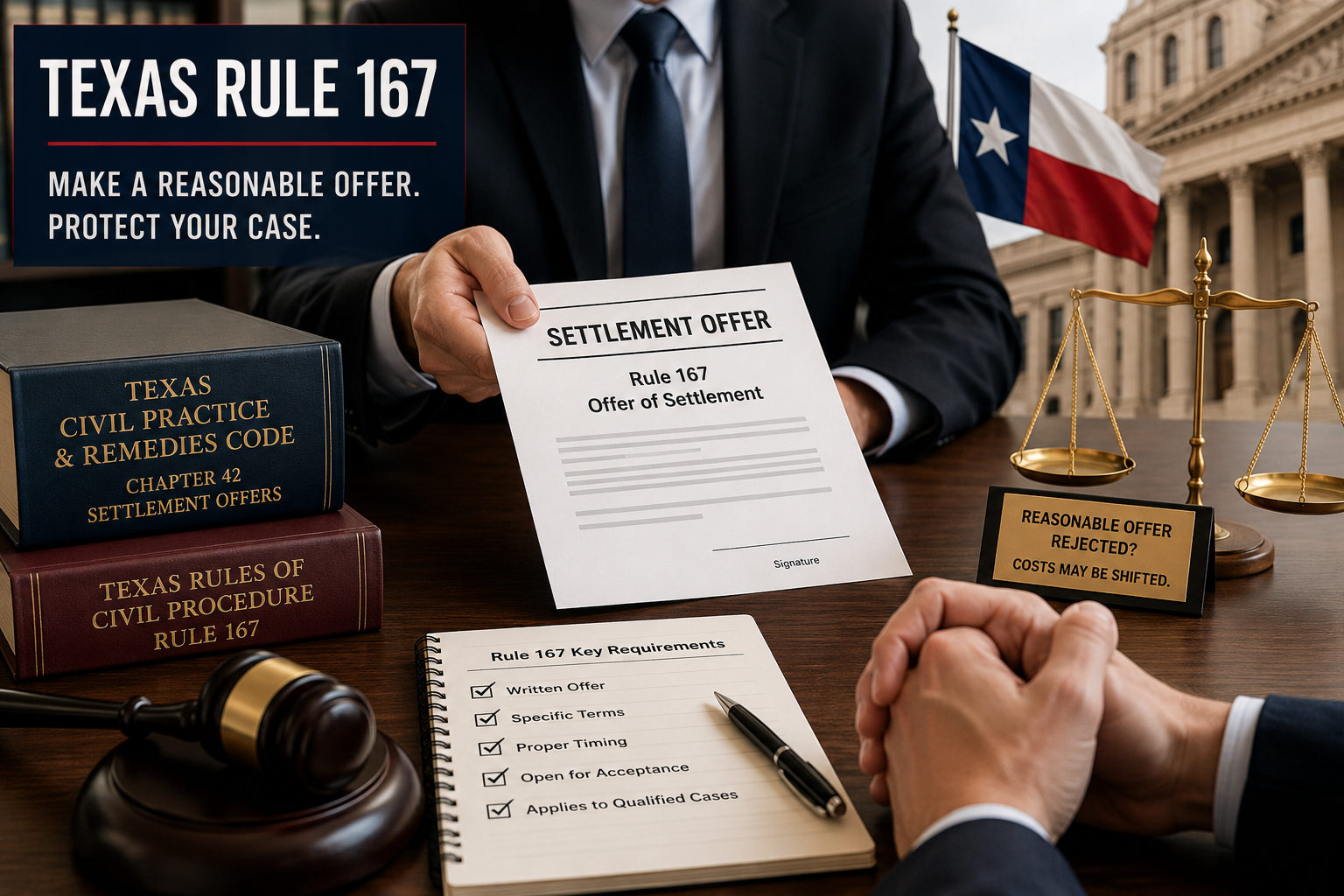
When litigation begins, many people assume that if they win their lawsuit, the losing party automatically pays their attorney's fees. In Texas, that generally is not true. The "American Rule" typically requires each side to pay its own legal fees unless a statute or contract provides otherwise.
However, Texas has created a significant exception designed to encourage settlement. Under Texas Rule of Civil Procedure 167 and Chapter 42 of the Texas Civil Practice and Remedies Code, a party who makes a qualifying settlement offer may recover certain litigation costs if the opposing party unreasonably rejects that offer and ultimately obtains a significantly worse result at trial.
Understanding these rules can dramatically affect litigation strategy.
The Purpose of Rule 167
Rule 167 exists to encourage parties to settle cases instead of forcing unnecessary trials.
When one party makes a reasonable settlement offer that the opposing party rejects, the law may shift certain litigation costs if the rejecting party ultimately receives a less favorable judgment.
The rule rewards realistic settlement negotiations while discouraging unnecessary litigation.
The Statutory Authority
Texas Civil Practice and Remedies Code § 42.002 provides:
"This chapter applies only to a settlement offer made under the Texas Rules of Civil Procedure."
Likewise, Texas Rule of Civil Procedure 167.1establishes the offer-of-settlement procedure applicable to many civil lawsuits.
Because Rule 167 and Chapter 42 work together, they should generally be analyzed as a single statutory framework.
Which Cases Qualify?
Rule 167 does not apply to every lawsuit.
Certain proceedings are excluded, including various family law matters, class actions, workers' compensation cases, and other proceedings specifically exempted by the rule.
For many ordinary civil disputes—including contract litigation, property disputes, commercial litigation, and numerous tort claims—the rule may apply.
Before relying on Rule 167, litigants should determine whether their particular case falls within one of the exclusions.
What Makes a Valid Settlement Offer?
Not every settlement proposal qualifies.
A qualifying offer generally must comply with Rule 167's procedural requirements, including:
- being made in writing;
- identifying the claims being resolved;
- remaining open for the required acceptance period;
- complying with timing requirements established by the rule.
Failure to comply with these technical requirements may prevent cost-shifting, even if the settlement amount itself was reasonable.
When Does Cost-Shifting Occur?
The central question is whether the rejecting party ultimately receives a substantially worse result than the settlement offer.
In general terms:
- A plaintiff who rejects a settlement offer and later recovers substantially less than the offer may become responsible for certain litigation costs.
- Likewise, a defendant who rejects a reasonable demand and ultimately suffers a substantially larger judgment may face similar consequences.
The comparison is mathematical rather than emotional. The court compares the judgment with the rejected settlement offer using the formulas established by Rule 167.
What Costs Can Be Recovered?
Importantly, Rule 167 does not simply award ordinary attorney's fees.
Instead, recoverable litigation costs may include items such as:
- reasonable attorney's fees;
- deposition costs;
- expert witness expenses;
- court costs;
- exhibit preparation;
- other litigation expenses authorized under the rule.
These costs are subject to statutory limitations and judicial review for reasonableness.
Why This Rule Matters During Litigation
Settlement negotiations often become emotional.
A party may believe:
- "The jury will give me much more."
- "They'll never win."
- "I'm going to make them spend money."
Rule 167 introduces financial consequences for those decisions.
Sometimes rejecting an otherwise reasonable settlement offer can ultimately reduce—or even eliminate—the financial benefit of winning at trial.
Conversely, making a carefully drafted Rule 167 offer may strengthen a litigant's strategic position throughout the case.
Strategic Considerations
An effective Rule 167 offer requires more than selecting a dollar amount.
Experienced litigators often consider:
- the strength of liability evidence;
- anticipated expert costs;
- likely jury verdict ranges;
- expected litigation expenses;
- insurance considerations;
- appellate risks.
A poorly timed or improperly drafted offer may have little strategic value, while a well-prepared offer can significantly influence settlement discussions.
Final Thoughts
Texas Rule of Civil Procedure 167 is one of the state's most underutilized litigation tools. While many parties focus exclusively on who will "win" the lawsuit, Rule 167 recognizes that litigation is also about the reasonableness of settlement conduct.
Understanding this rule before rejecting—or making—a settlement offer can have substantial financial consequences that extend well beyond the jury's verdict.
If you are involved in Texas civil litigation, consulting an attorney before rejecting a formal settlement offer may help you avoid unexpected cost-shifting under Rule 167.
Disclaimer: This article is provided for educational purposes only and does not constitute legal advice. Every lawsuit is unique, and the application of Texas Rule of Civil Procedure 167 and Chapter 42 of the Texas Civil Practice and Remedies Code depends on the specific facts and procedural posture of the case.
At David C. Barsalou, Attorney at Law, PLLC, we help clients navigate business, family, tax, estate planning, and real estate matters ranging from document drafting to litigation with clarity and confidence. If you’d like guidance on your situation, schedule a consultation today. Call us at (713) 397-4678, email barsalou.law@gmail.com, or reach us through our Contact Page. We’re here to help you take the next step.
