Many people assume that if an original deed disappears, ownership of the property somehow disappears with it. Fortunately, that is generally not how Texas real estate law works.
Ownership usually depends upon the legal conveyance itself—not merely possession of the original paper document. However, losing an important recorded instrument can create significant practical problems when refinancing property, selling real estate, or proving title decades later.
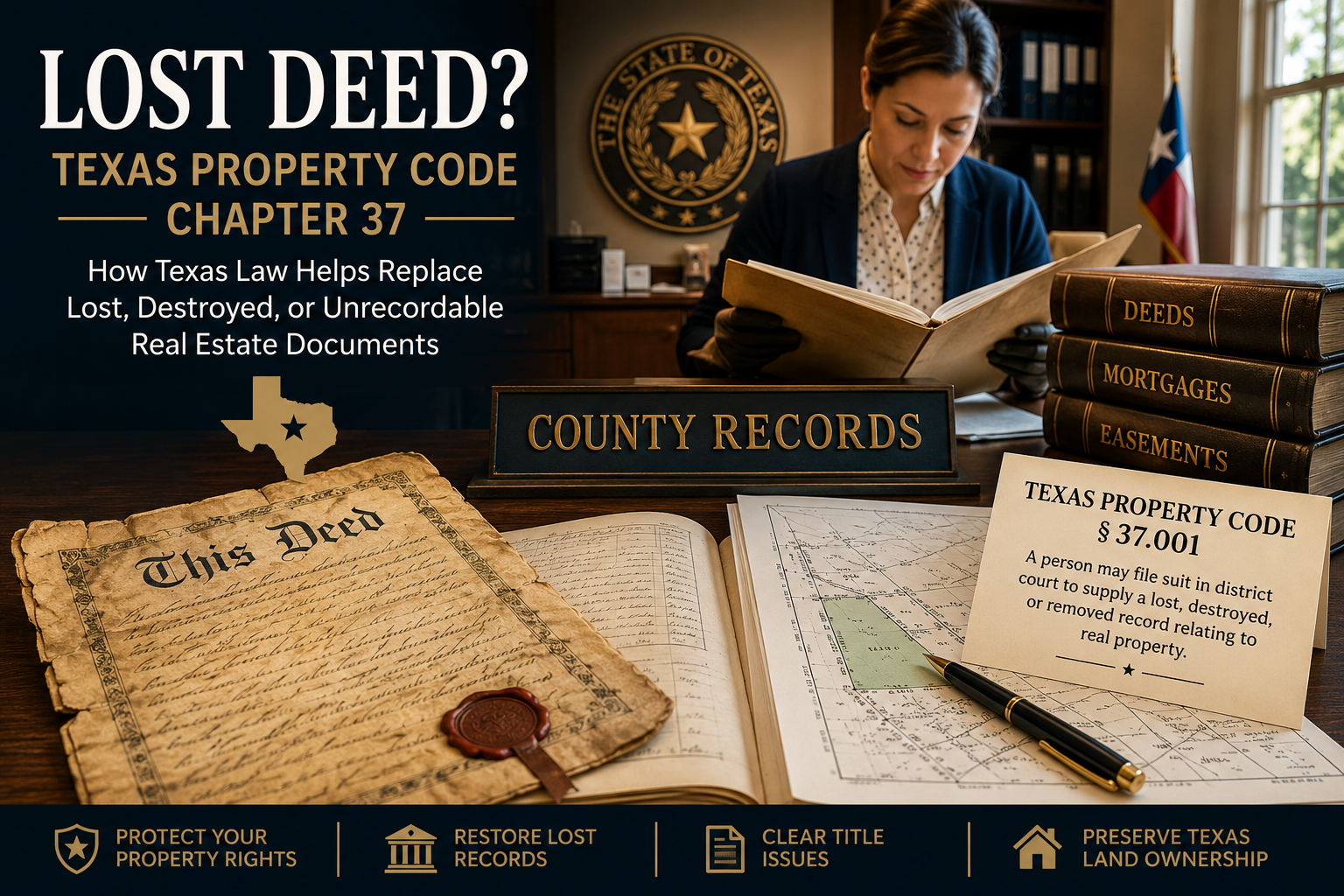
Texas Property Code Chapter 37 provides a statutory procedure for replacing certain lost, destroyed, or otherwise unavailable property records.
What Types of Documents Can Be Replaced?
Chapter 37 is broader than many people realize.
Depending upon the circumstances, it may apply to various instruments affecting title, including:
- Deeds
- Easements
- Releases
- Assignments
- Mortgages
- Deeds of trust
- Other recorded real property instruments
Rather than permanently losing the legal effect of an instrument simply because the original disappeared, Texas law provides a mechanism to establish its existence through the courts.
What Does the Texas Property Code Say?
Texas Property Code § 37.001 provides:
"A person may file suit in district court to supply a lost, destroyed, or removed record relating to real property."
This statute recognizes that courthouse records, originals, and historical documents are not always preserved forever.
The goal is to restore certainty to Texas land records.
Why Does This Matter?
Imagine purchasing a ranch in the 1970s.
Forty years later:
- the original deed is gone;
- the county's historical records are damaged;
- your lender wants proof of ownership before refinancing.
Without a statutory procedure, proving title could become extraordinarily difficult.
Chapter 37 provides a way to establish what the missing instrument contained so that the chain of title can continue without unnecessary uncertainty.
Does Losing the Original Mean You Lose Ownership?
Usually, no.
Texas follows the principle that ownership is created by the legal conveyance—not by continuing possession of the original document.
However, practical problems can arise if:
- title companies cannot verify ownership;
- future purchasers question the chain of title;
- lenders require documentation;
- litigation develops over competing claims.
Replacing the missing record can eliminate many of these issues.
What Must Be Proven?
Every case is different, but generally the court must be persuaded regarding:
- the prior existence of the instrument;
- its contents;
- its execution;
- its loss or destruction; and
- why replacement is appropriate.
Evidence may include:
- certified copies;
- witness testimony;
- title company records;
- attorney files;
- lender records;
- historical county documents.
Why This Happens More Often Than You Think
Texas has counties with records stretching back nearly two centuries.
Over time:
- floods,
- courthouse fires,
- hurricanes,
- simple human error,
- deteriorating paper records, and
- misplaced originals
can all affect important real estate documentation.
Although modern electronic recording has greatly reduced these risks, older property transactions sometimes require reconstruction of historical title records.
Should You File Immediately After Losing a Deed?
Not necessarily.
In many cases, a certified copy from the county clerk solves the problem because recorded deeds remain part of the public records.
Chapter 37 becomes more important when:
- the official record is unavailable,
- the document cannot be located,
- historical records have been destroyed, or
- title cannot otherwise be satisfactorily established.
An experienced Texas real estate attorney can help determine which remedy best fits the situation.
Final Thoughts
Texas real estate often stays in families for generations. During that time, important documents can disappear, county records may become incomplete, and proving ownership may become unexpectedly complicated.
Texas Property Code Chapter 37 provides an important safeguard by allowing courts to restore lost or destroyed real property records. While the process is not necessary in every situation, it serves as an important tool for protecting the integrity of Texas land titles and ensuring that missing paperwork does not permanently cloud ownership.
Disclaimer: This article is for informational purposes only and is not legal advice. Every real estate matter is unique. If you have questions regarding a lost deed, title issue, or other property dispute, consult a qualified Texas attorney regarding your specific circumstances.
At David C. Barsalou, Attorney at Law, PLLC, we help clients navigate business, family, tax, estate planning, and real estate matters ranging from document drafting to litigation with clarity and confidence. If you’d like guidance on your situation, schedule a consultation today. Call us at (713) 397-4678, email barsalou.law@gmail.com, or reach us through our Contact Page. We’re here to help you take the next step.