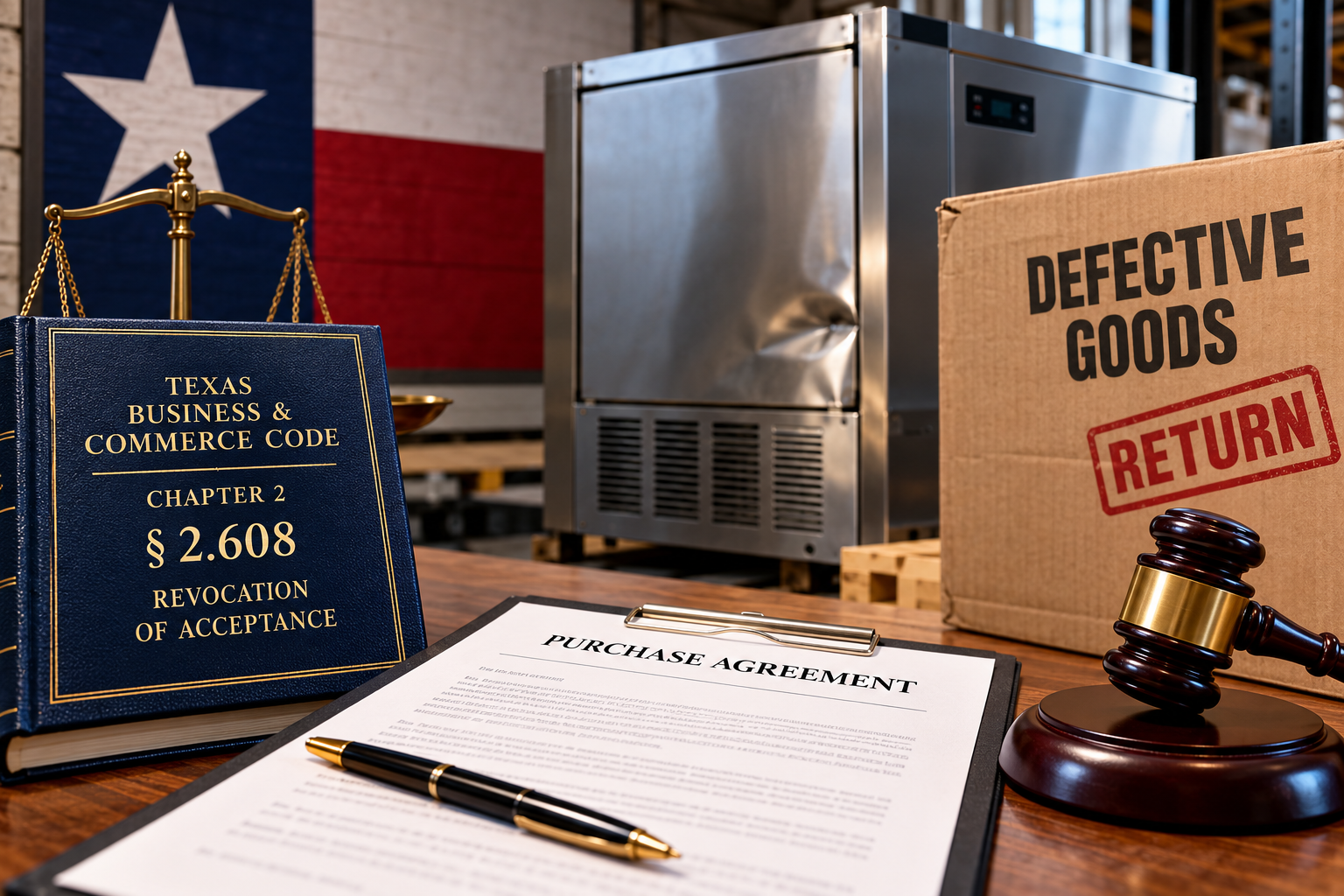
Imagine purchasing an expensive refrigerator, commercial machine, or piece of business equipment. The seller delivers it, you accept it, and everything initially appears satisfactory. Several days later, however, you discover a serious defect.
You contact the seller, who insists that the transaction is complete. You accepted delivery, and according to the seller, the product is now your problem.
But is that actually how Texas law works?
Not necessarily.
Under Texas Business & Commerce Code § 2.608, buyers may have the right to revoke their acceptance of defective goods even after taking possession. This remedy can be particularly important when defects were difficult to discover or when a seller promised to correct problems but failed to do so.
However, revocation of acceptance is not an unrestricted right to return merchandise. Texas law imposes specific requirements concerning the seriousness of the defect, the circumstances surrounding acceptance, and the timing of the buyer's response.
Understanding these requirements can help Texas consumers and businesses protect themselves when a purchase goes wrong.
1. What Does It Mean to Revoke Acceptance of Goods in Texas?
Revocation of acceptance is a legal remedy that allows a buyer, under certain circumstances, to withdraw an earlier acceptance of goods that do not conform to the contract.
Texas Business & Commerce Code Chapter 2 governs many transactions involving the sale of goods, including consumer products, machinery, equipment, and commercial inventory.
Under § 2.608(a), a buyer may revoke acceptance when a nonconformity substantially impairs the value of the goods to that buyer and one of the statute's additional conditions is satisfied.
The critical distinction is between rejecting goods before acceptance and revoking acceptance afterward.
For example, a customer who discovers that a delivered refrigerator is visibly damaged before accepting it may have grounds to reject the delivery under § 2.602.
But what happens when the refrigerator initially appears functional and stops cooling several days later?
That situation may implicate § 2.608.
The law recognizes that some defects cannot reasonably be discovered during an initial inspection.
2. What Does Texas Business & Commerce Code § 2.608 Actually Say?
The governing statute is Texas Business & Commerce Code § 2.608, entitled "Revocation of Acceptance in Whole or in Part."
Section 2.608(a) provides, in relevant part:
"The buyer may revoke his acceptance of a lot or commercial unit whose non-conformity substantially impairs its value to him"
The statute then identifies two circumstances that can support revocation.
First, the buyer may have accepted the goods on the reasonable assumption that an existing defect would be corrected, only to discover that the seller failed to correct it within an appropriate time.
Second, the buyer may have accepted the goods without discovering the defect because the problem was difficult to detect or because the seller's assurances reasonably induced acceptance.
These provisions recognize an important commercial reality: accepting delivery does not necessarily mean that a buyer has surrendered every remedy for defective merchandise.
Nevertheless, the buyer must establish more than mere dissatisfaction.
3. What Does "Substantially Impairs Its Value" Mean?
One of the most important requirements under § 2.608 is that the nonconformity must substantially impair the value of the goods to the buyer.
This requirement separates serious contractual problems from relatively minor inconveniences.
Consider several examples.
Example One: A Defective Commercial Freezer
A restaurant purchases a commercial freezer for $12,000. Although the freezer initially operates, it repeatedly fails to maintain safe temperatures.
The seller attempts repairs, but the equipment continues malfunctioning.
Because the freezer cannot reliably perform its essential function, the defect may substantially impair its value to the restaurant.
Example Two: A Cosmetic Defect
A customer purchases a new appliance and discovers a small scratch on a concealed exterior panel.
Although the scratch may constitute a nonconformity, it does not necessarily justify revocation of acceptance.
The buyer may have other contractual or warranty remedies, but revocation requires a sufficiently serious impairment.
Example Three: Defective Manufacturing Equipment
A manufacturer purchases a machine intended to produce a specified number of units per hour.
After installation, the machine consistently operates far below the agreed specifications.
If the deficiency substantially undermines the equipment's intended commercial purpose, revocation may be available.
The outcome in each situation depends on the contract, the seriousness of the defect, the circumstances of acceptance, and the available evidence.
4. What If the Seller Promised to Repair the Defect?
Texas law expressly addresses situations in which a buyer accepts defective goods because the seller promises to correct the problem.
Under § 2.608(a)(1), revocation may be available when the buyer reasonably assumed that the nonconformity would be cured but the seller failed to provide a timely cure.
Suppose a business purchases a printing machine for $25,000.
During installation, the machine experiences significant operational problems. The seller assures the buyer that replacement parts will resolve the defects.
Relying on those assurances, the buyer accepts the machine.
Over the next several weeks, the seller attempts multiple repairs without success.
The buyer may have grounds to revoke acceptance if the unresolved problems substantially impair the machine's value and the other statutory requirements are satisfied.
This is an important distinction because a buyer's willingness to cooperate with repair efforts does not automatically eliminate the possibility of revocation.
However, waiting too long or continuing to use defective goods without adequately preserving one's rights can complicate the claim.
5. How Long Do You Have to Revoke Acceptance in Texas?
Section 2.608(b) requires revocation within a reasonable time after the buyer discovers, or should have discovered, the grounds for revocation.
It also requires revocation before a substantial change in the goods' condition that is unrelated to their own defects.
The statute does not establish a universal 10-day, 30-day, or 90-day deadline.
Instead, the reasonableness of the buyer's timing depends on the circumstances.
Relevant considerations may include the nature of the product, the difficulty of diagnosing the defect, the seller's repair efforts, and the buyer's conduct after discovering the problem.
For example, a buyer who promptly documents repeated equipment failures and communicates with the seller may occupy a stronger position than someone who discovers a serious defect but waits many months without explanation.
The important lesson is that buyers should not assume they have unlimited time to act.
6. Do You Have to Notify the Seller Before Revoking Acceptance?
Yes.
Texas Business & Commerce Code § 2.608(b) expressly states:
"It is not effective until the buyer notifies the seller of it."
This requirement is critical.
A buyer who privately decides that merchandise is unacceptable has not necessarily accomplished a legally effective revocation.
The seller must receive notice of the buyer's decision to revoke acceptance.
Although the statute does not universally require a particular written form, written notice is generally preferable because it creates evidence of what was communicated and when.
A properly prepared notice should ordinarily identify the transaction, describe the defects, explain why they substantially impair the value of the goods, and clearly communicate the decision to revoke acceptance.
Supporting documents may include purchase agreements, invoices, repair records, photographs, inspection reports, and prior communications.
A vague complaint that merchandise is unsatisfactory may create unnecessary disputes about whether the buyer actually revoked acceptance.
7. Can You Get Your Money Back After Revoking Acceptance?
Potentially.
Texas Business & Commerce Code § 2.711 addresses remedies available when a buyer rightfully rejects goods or justifiably revokes acceptance.
Depending on the circumstances, the buyer may cancel the affected transaction, recover payments already made, and pursue certain additional damages.
For example, suppose a company purchases defective equipment for $18,000 and successfully revokes acceptance.
The company may seek recovery of the purchase price it paid.
Depending on the facts, it may also seek damages associated with obtaining reasonable substitute equipment or other losses recognized by Chapter 2.
However, recovery is not necessarily unlimited.
The buyer must establish the applicable legal requirements, prove recoverable losses, and account for contractual limitations or other defenses.
8. Can You Recover Lost Business Income Caused by Defective Equipment?
In some circumstances, yes.
Texas Business & Commerce Code § 2.715 recognizes incidental and consequential damages arising from a seller's breach.
Consequential damages may include certain losses resulting from the buyer's particular requirements or needs when the seller had reason to know of those needs at the time of contracting and the losses could not reasonably be prevented.
Consider a small manufacturing business that purchases defective equipment necessary to fulfill existing customer orders.
If the equipment repeatedly fails, the business may incur expenses obtaining substitute machinery or experience lost production.
Some resulting losses may be recoverable if the legal requirements are satisfied.
However, proving lost profits can be considerably more difficult than establishing the purchase price of defective goods.
The buyer may need financial records, customer orders, production histories, and other evidence demonstrating causation and the amount of loss with reasonable certainty.
Additionally, contractual limitations on consequential damages may affect recovery.
9. What Happens If You Cannot Legally Revoke Acceptance?
Failure to qualify for revocation does not necessarily eliminate every legal remedy.
Under Texas Business & Commerce Code § 2.714, a buyer who accepts nonconforming goods and provides the required notice may pursue damages for the seller's breach.
For breach of warranty, the ordinary measure of damages generally concerns the difference between the value of the goods as accepted and the value they would have possessed if they had conformed to the warranty.
For example, suppose a business purchases equipment represented as having a particular capacity.
The equipment performs below specifications, but the deficiency does not justify revocation.
The buyer may nevertheless have a claim for damages if the seller breached an enforceable contractual obligation or warranty.
This distinction matters because litigation should not automatically be framed as an all-or-nothing dispute over returning the merchandise.
In some cases, monetary compensation is the more appropriate remedy.
10. Does an "As Is" Clause Prevent Revocation of Acceptance?
An "as is" provision can significantly affect a buyer's rights, but its legal effect depends on the transaction and the language of the agreement.
Texas Business & Commerce Code § 2.316 governs the exclusion or modification of warranties.
An effective disclaimer may limit the warranties that otherwise would apply to a sale.
However, a disclaimer does not automatically resolve every question concerning express contractual promises, misrepresentations, or nonconforming goods.
For example, an agreement that effectively disclaims implied warranties may still contain specific enforceable promises concerning the equipment's condition or performance.
A buyer contemplating revocation should therefore examine the entire contract rather than assuming that the words "as is" conclusively determine the outcome.
Similarly, a seller should not assume that a general disclaimer defeats every possible claim arising from the transaction.
11. Does This Law Apply to Cars, Appliances, and Business Equipment?
Texas Business & Commerce Code Chapter 2 generally applies to transactions involving goods, subject to statutory definitions, exclusions, and other applicable law.
Examples may include household appliances, industrial machinery, furniture, commercial equipment, and certain vehicle purchases.
However, particular transactions may also be governed by specialized statutes, warranty provisions, or regulatory schemes.
Motor vehicle disputes, for example, may implicate additional Texas warranty and lemon-law protections.
The existence of § 2.608 should not be interpreted as creating an unconditional right to return every defective vehicle or consumer product.
Likewise, the rules governing the sale of goods should not automatically be applied to real estate transactions or contracts predominantly involving services.
Correctly identifying the nature of the transaction is an important first step.
12. What Should a Texas Buyer Do After Discovering Defective Goods?
A buyer who discovers a serious defect after accepting delivery should act carefully.
Several practical steps may help preserve available remedies:
- Review the purchase agreement. Identify the seller's obligations, warranties, disclaimers, and contractual notice requirements.
- Document the defects. Preserve photographs, videos, inspection reports, and records of equipment failures.
- Notify the seller promptly. Explain the problems and preserve evidence of the communication.
- Document repair efforts. Record promises, repair dates, replacement parts, and unsuccessful attempts to correct the problem.
- Avoid unnecessary alterations. Significant changes to the goods may complicate a revocation claim.
- Consider formal revocation notice. If the statutory requirements appear satisfied, communicate the decision clearly and preserve the goods while the parties' rights are resolved.
A buyer should also consider obtaining legal advice before disposing of goods, arranging an unauthorized resale, or taking action that could create additional contractual liability.
13. Frequently Asked Questions About Revocation of Acceptance in Texas
Can I return defective merchandise after using it?
Possibly. Prior use does not automatically prevent revocation, but the nature and extent of use, the timing of notice, and changes in the merchandise's condition may affect the analysis.
Does the seller have to agree to accept the return?
A seller's agreement is not necessarily required for a legally effective revocation. However, the seller may dispute whether the statutory requirements were satisfied, potentially requiring judicial resolution.
Can I revoke acceptance because I changed my mind?
Generally, no. Section 2.608 concerns qualifying nonconformities that substantially impair the goods' value, not ordinary buyer's remorse.
Can a business revoke acceptance of commercial equipment?
Yes. Chapter 2 can apply to commercial sales of goods as well as consumer transactions. The contract and surrounding circumstances remain important.
Is revocation of acceptance the same as rescission?
Not exactly. Revocation is a specific statutory remedy under Chapter 2, while rescission may arise under other legal doctrines. The remedies can have similar practical consequences but should not be treated as interchangeable.
Do I need an attorney to revoke acceptance?
Not necessarily. However, disputes involving expensive equipment, substantial losses, contractual disclaimers, or contested warranty obligations may benefit from legal analysis before formal action is taken.
Conclusion: Accepting Delivery Does Not Always Mean Accepting the Defect
Texas law recognizes that buyers sometimes discover serious defects only after goods have been delivered and accepted.
Under Texas Business & Commerce Code § 2.608, a buyer may be entitled to revoke acceptance when a qualifying nonconformity substantially impairs the value of the goods and the statutory conditions are satisfied.
But the remedy is not automatic.
The seriousness of the defect, the seller's assurances, the buyer's opportunity to inspect, the timing of notice, and the condition of the goods can all become important.
For consumers and businesses alike, the most effective approach is often to document problems early, communicate clearly, and evaluate available contractual and statutory remedies before the dispute escalates.
David C. Barsalou, Attorney at Law, PLLC, provides legal services involving Texas contracts, commercial disputes, civil litigation, and related business matters.
Disclaimer: This article provides general information about Texas law and does not constitute legal advice. Legal rights depend on the particular facts, contractual provisions, and applicable law. Reading this article does not create an attorney-client relationship.
At David C. Barsalou, Attorney at Law, PLLC, we help clients navigate business, family, tax, estate planning, and real estate matters ranging from document drafting to litigation with clarity and confidence. If you’d like guidance on your situation, schedule a consultation today. Call us at (713) 397-4678, email barsalou.law@gmail.com, or reach us through our Contact Page. We’re here to help you take the next step.