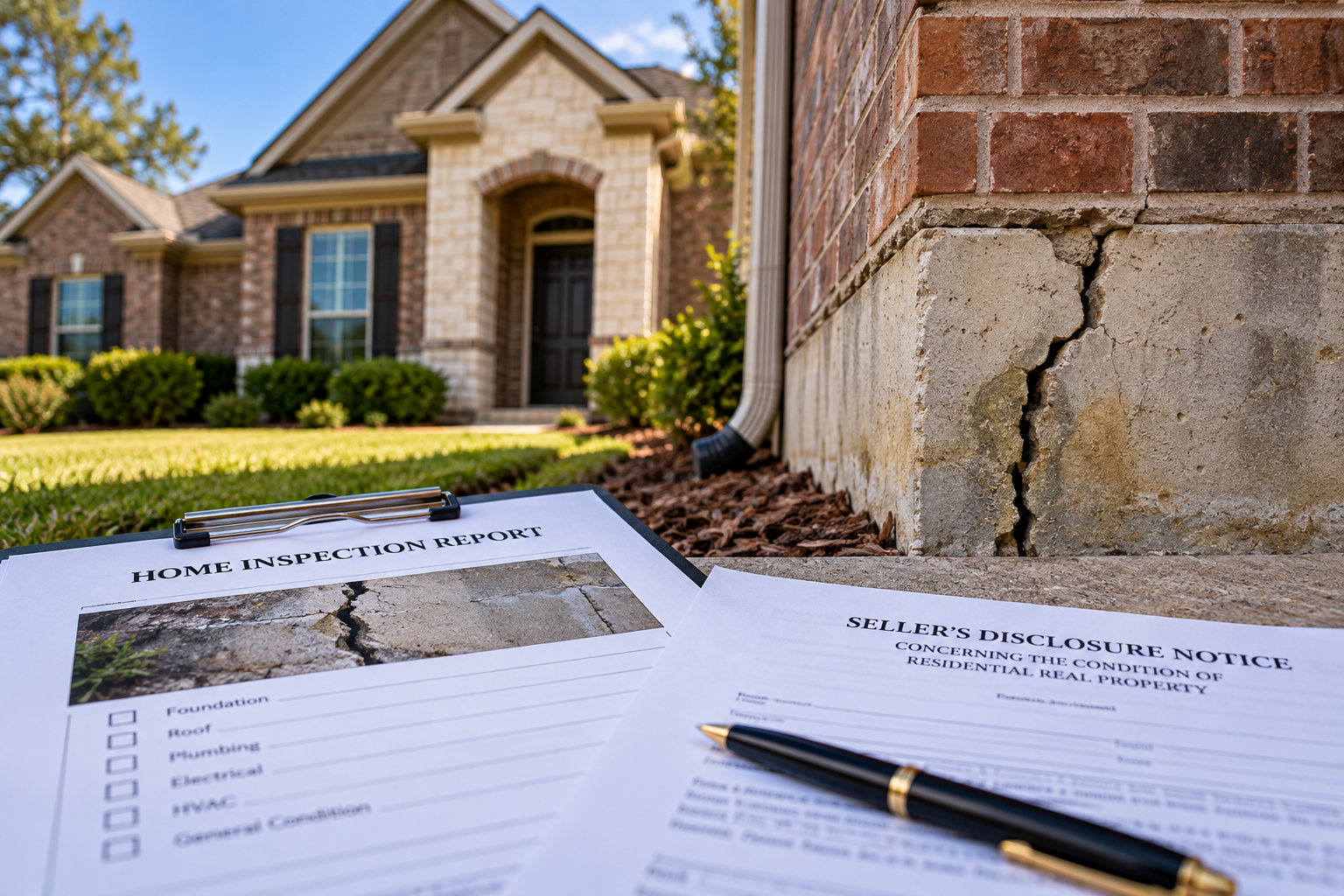
Buying a house is one of the largest financial transactions most people will ever make. Unfortunately, some homeowners discover serious problems only after moving in. A foundation begins shifting, water enters through a previously repaired roof, or a contractor discovers extensive damage concealed behind newly installed drywall.
These discoveries raise an important legal question: Can you sue a home seller for failing to disclose defects in Texas?
The answer is sometimes yes. Texas law imposes certain disclosure obligations on residential property sellers, and buyers may have legal remedies when a seller knowingly misrepresents or conceals material information.
However, not every undisclosed defect creates liability. Understanding the distinction between an unknown problem, an inaccurate disclosure, and intentional concealment is essential.
1. Texas Property Code § 5.008: What Must a Seller Disclose?
Texas Property Code § 5.008 establishes disclosure requirements for many residential real estate transactions.
Section 5.008(a) provides:
A seller of residential real property comprising not more than one dwelling unit located in this state shall give to the purchaser of the property a written notice as prescribed by this section or a written notice substantially similar to the notice prescribed by this section.
The statute generally requires sellers of covered single-family residential properties to provide a written disclosure notice addressing various aspects of the property's condition.
Among other matters, the disclosure notice addresses:
- Previous flooding and water damage.
- Foundation problems and structural defects.
- Roof conditions and previous repairs.
- Termite or wood-destroying insect damage.
- Known defects in major systems.
- Certain legal, environmental, and property-related conditions.
The disclosure requirement is not universal. Section 5.008 contains exemptions for certain transactions, including qualifying transfers by court order, certain fiduciary transfers, and some sales involving newly constructed residences.
Importantly, an exemption from the statutory notice requirement does not necessarily authorize affirmative misrepresentations or fraudulent concealment.
2. A Seller's Disclosure Is Not a Warranty
One of the most important features of Texas seller-disclosure law is that sellers generally disclose their knowledge rather than guarantee the property's condition.
The statutory disclosure form expressly states:
IT IS NOT A WARRANTY OF ANY KIND BY SELLER OR SELLER'S AGENTS.
This distinction matters.
Suppose a homeowner sells a house without knowing that an underground plumbing line has deteriorated. Six months later, the buyer discovers a serious leak requiring extensive repairs.
The existence of that defect does not automatically establish that the seller violated Texas law.
A different situation arises when the seller previously hired a plumber, received a report documenting the problem, and then affirmatively represented that no such condition existed.
The critical issue is often not merely whether the defect existed, but what the seller knew and represented before the transaction was completed.
3. What If the Seller Intentionally Concealed a Defect?
Consider a hypothetical example.
A homeowner discovers that a foundation has experienced substantial movement. An engineer recommends expensive structural repairs.
Rather than disclose the engineer's findings, the homeowner repairs visible drywall cracks, repaints the interior, and lists the house for sale.
The seller then answers negatively when asked about known foundation problems.
After closing, the buyer discovers the underlying damage and obtains the earlier engineering report.
Depending on the evidence, the buyer may have claims involving fraudulent misrepresentation, fraudulent nondisclosure, or violations of the Texas Deceptive Trade Practices–Consumer Protection Act.
Common-law fraud
A traditional fraudulent-misrepresentation claim generally requires proof of a material false representation, the requisite knowledge or recklessness, an intention that the other party act on it, actual and justifiable reliance, and resulting injury.
Fraudulent nondisclosure involves additional considerations, including whether the seller had a legal duty to disclose the omitted information.
A seller's silence is not necessarily fraudulent in every circumstance. However, deliberately creating a misleading impression or failing to correct a material misstatement can produce substantial legal exposure.
Evidence that may support a claim includes earlier inspection reports, repair invoices, communications with contractors, insurance records, photographs, and inconsistent disclosure statements.
4. The Texas DTPA May Provide an Additional Remedy
Texas Business and Commerce Code Chapter 17, commonly called the Deceptive Trade Practices Act or DTPA, provides remedies for certain deceptive commercial conduct.
Section 17.46(b)(24) identifies as a deceptive practice:
failing to disclose information concerning goods or services which was known at the time of the transaction if such failure to disclose such information was intended to induce the consumer into a transaction into which the consumer would not have entered had the information been disclosed;
This provision can be especially important in disputes involving undisclosed real estate defects.
A buyer asserting a nondisclosure theory generally must establish that the defendant knew the relevant information and withheld it with the required intent to induce the transaction. The buyer must also satisfy the DTPA's other applicable requirements, including consumer status, producing cause, and any statutory limitations or exemptions.
The DTPA is not simply a general remedy for every disappointing real estate purchase. Its application depends on the transaction, the parties, the alleged conduct, and the available evidence.
5. Does Buying a House “As Is” Prevent a Lawsuit?
Many Texas real estate contracts contain an as-is provision.
Generally speaking, such language allocates certain risks concerning the property's condition to the purchaser.
But an as-is clause does not necessarily protect a seller who fraudulently induces a buyer to enter the agreement.
Texas courts examine whether the as-is agreement was validly made, whether the parties were dealing at arm's length, whether the buyer had a meaningful opportunity to inspect, and whether fraudulent conduct affected the transaction.
In Prudential Insurance Co. of America v. Jefferson Associates, Ltd., 896 S.W.2d 156 (Tex. 1995), the Texas Supreme Court addressed the legal consequences of as-is agreements and recognized important limitations involving fraudulent inducement and concealment.
Consequently, a buyer should not assume that signing an as-is contract eliminates every possible remedy.
Likewise, sellers should not assume that the words as is provide absolute protection against their own fraudulent conduct.
6. What Damages Can a Texas Homebuyer Recover?
The available damages depend on the legal theory, the evidence, and the circumstances of the transaction.
Potential categories include the difference between the property's represented value and its actual value, or other legally recoverable economic losses.
Repair estimates can provide useful evidence, although the full cost of repairs is not automatically the proper measure of damages in every case.
Under Texas Business and Commerce Code § 17.50, qualifying DTPA claims may permit recovery of economic damages, additional damages when the applicable statutory mental-state requirements are satisfied, and reasonable and necessary attorney's fees for a prevailing consumer.
Fraud claims may also support exemplary damages in appropriate circumstances, subject to Texas Civil Practice and Remedies Code Chapter 41.
The law generally does not permit duplicative recovery for the same injury merely because several legal theories are available.
7. What Should a Buyer Do After Discovering an Undisclosed Defect?
A homeowner who discovers a potentially concealed defect should act carefully before beginning extensive repairs or litigation.
First, preserve the original seller's disclosure notice, purchase contract, inspection report, and transaction-related communications.
Second, obtain a qualified professional assessment of the condition. The professional should identify the problem, its likely cause, and, where reasonably possible, evidence concerning how long it has existed.
Third, investigate whether the seller previously knew about the condition. Earlier repair records or communications may prove more important than the existence of the defect itself.
Fourth, document the damage before removing or replacing affected materials. Necessary emergency repairs should not be delayed, but preserving photographs, reports, and relevant physical evidence can be critical.
Finally, consider the applicable deadlines and presuit requirements.
DTPA claims generally require written notice at least 60 days before filing suit, subject to statutory exceptions, under Texas Business and Commerce Code § 17.505.
The DTPA also contains a limitations provision in § 17.565. Common-law fraud claims generally have a four-year limitations period under Texas Civil Practice and Remedies Code § 16.004(a)(4), subject to applicable accrual and tolling principles.
Waiting too long can jeopardize an otherwise viable claim.
8. What If the Seller Genuinely Did Not Know?
Texas law does not ordinarily make a residential seller an insurer against every unknown condition.
A seller who accurately reports existing knowledge and does not make fraudulent representations may have substantial defenses when a buyer later discovers an unknown defect.
For example, a roof may develop a leak after closing even though the seller never experienced or knew of any previous leakage.
Likewise, a concealed construction defect may have existed for years without the seller knowing about it.
The legal analysis becomes more complicated when the seller received prior warnings, repeatedly experienced symptoms of a problem, or made representations inconsistent with known facts.
The difference between a defect and a concealed defect is often the difference between an unfortunate purchase and a potentially actionable legal claim.
9. Can a Seller Be Liable Even If the Buyer Obtained an Inspection?
A professional home inspection is an important protective measure, but it does not necessarily resolve every legal issue involving seller misconduct.
Home inspectors have limited access to concealed structural components, underground systems, and other inaccessible areas.
A seller may possess material information that a reasonably conducted inspection would not reveal.
Nevertheless, the inspection results can affect questions of reliance, causation, and damages.
If an inspection expressly identified a defect and the buyer proceeded with the purchase, a subsequent claim that the seller concealed that same condition may face significant obstacles.
Conversely, a buyer who obtained a clean inspection may still have a viable claim if the seller knowingly concealed information that the inspection could not reasonably uncover.
The facts surrounding the transaction are therefore critical.
10. Frequently Asked Questions
Can I sue a Texas home seller after closing?
Yes, potentially. Closing does not automatically eliminate claims for fraud, actionable misrepresentation, or qualifying DTPA violations. The contract terms, evidence, and applicable deadlines must be evaluated.
Can I sue because the seller lied on the disclosure form?
Potentially. A knowingly false material statement may support a claim if the other required legal elements are established.
Can I recover the cost of foundation repairs?
Possibly. Foundation repair expenses may be relevant to damages, but the recoverable amount depends on the applicable measure of damages and supporting evidence.
What if the seller checked “Unknown” on the disclosure form?
Checking “Unknown” does not automatically establish fraud or eliminate liability. The important question is whether that answer accurately reflected the seller's knowledge.
Can I sue the seller's real estate agent?
In some circumstances, yes. A real estate agent's liability depends on the agent's own representations, knowledge, conduct, and applicable legal duties. An agent is not automatically liable merely because the seller provided inaccurate information.
Conclusion: Texas Law Protects Buyers Against Certain Forms of Concealment
Purchasing a home involves risk, and Texas law does not guarantee that every house will be free of defects.
Nevertheless, sellers cannot necessarily avoid responsibility when they knowingly misrepresent or conceal material information to induce a transaction.
Texas Property Code § 5.008, the Deceptive Trade Practices Act, and common-law fraud principles provide an important framework for evaluating these disputes.
For buyers, the strongest cases often depend on evidence establishing what the seller knew before closing.
For sellers, accurate and complete disclosures can substantially reduce the risk of expensive litigation.
When serious defects are discovered after a real estate transaction, a careful review of the disclosure documents, inspection records, contract provisions, and repair history is often the appropriate starting point.
David C. Barsalou, Attorney at Law, PLLC, provides legal services involving Texas real estate disputes, contracts, and civil litigation. This article is intended for general informational purposes and does not constitute legal advice. Legal outcomes depend on the facts and applicable law.
At David C. Barsalou, Attorney at Law, PLLC, we help clients navigate business, family, tax, estate planning, and real estate matters ranging from document drafting to litigation with clarity and confidence. If you’d like guidance on your situation, schedule a consultation today. Call us at (713) 397-4678, email barsalou.law@gmail.com, or reach us through our Contact Page. We’re here to help you take the next step.