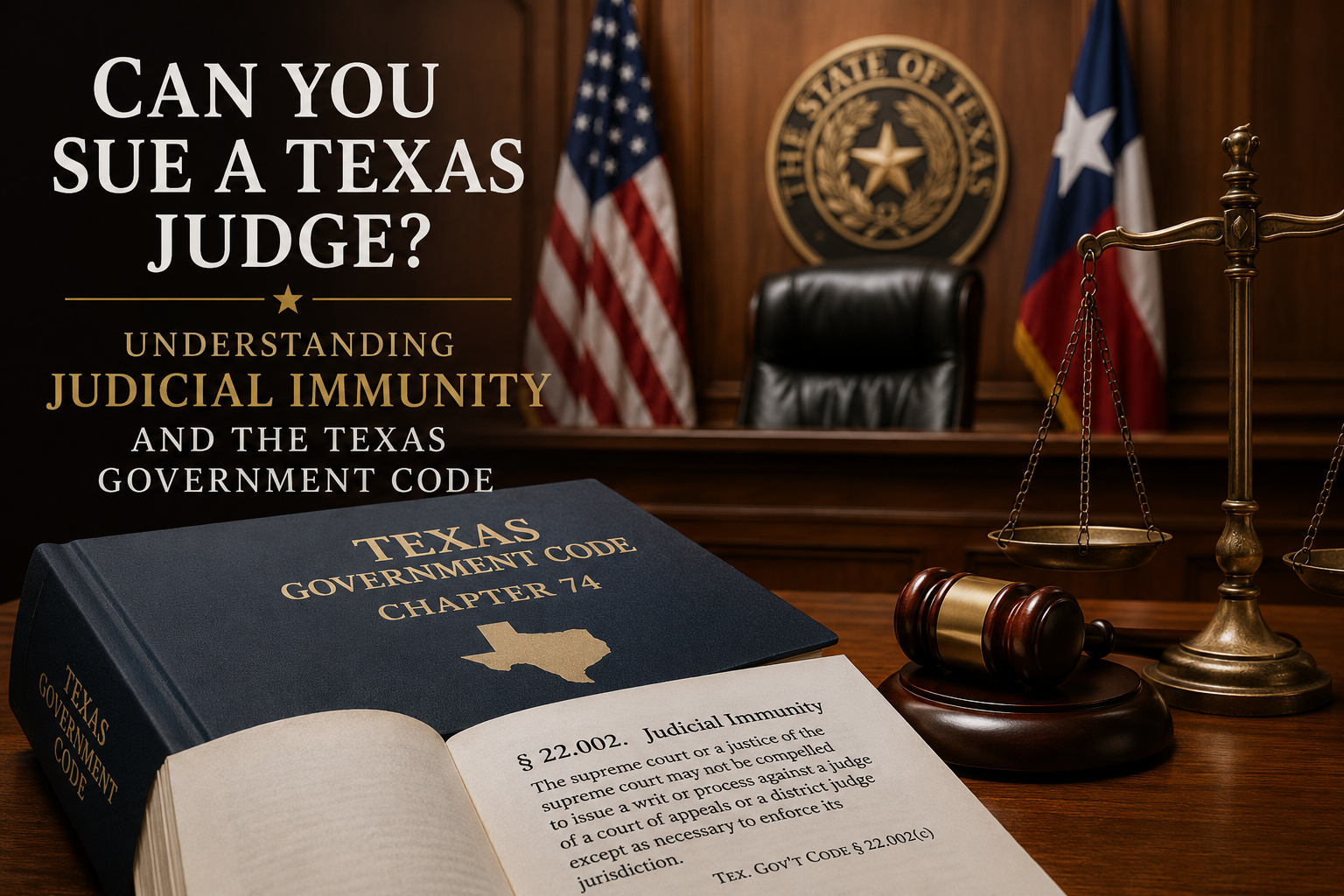
Most people who lose a lawsuit have the same initial reaction:
"Can I sue the judge?"
The answer is almost always no.
That does not mean judges are above the law. Rather, Texas and federal law recognize that judges must be able to make decisions without constantly fearing personal lawsuits from disappointed litigants.
Understanding judicial immunity helps explain why appeals—not new lawsuits against judges—are usually the proper remedy.
What Is Judicial Immunity?
Judicial immunity is a long-standing legal doctrine providing judges with broad protection from civil liability for actions taken while performing their judicial duties.
The doctrine exists to preserve judicial independence.
Imagine if every losing party could sue the judge personally after every adverse ruling. Judges would spend enormous amounts of time defending themselves rather than deciding cases.
Instead, the legal system provides appellate review.
Texas Government Code Recognizes Judicial Immunity
The Texas Government Code expressly acknowledges judicial immunity in several contexts.
For example, Texas Government Code § 22.002(c)provides:
"The supreme court or a justice of the supreme court may not be compelled to issue a writ or process against a judge of a court of appeals or a district judge except as necessary to enforce its jurisdiction."
Likewise, Texas Government Code § 74.053(b) states regarding assigned judges:
"An assigned judge has all the powers of the judge of the court to which the judge is assigned."
Because assigned judges possess the same judicial authority as regularly elected judges, they generally receive the same judicial immunity when performing judicial functions.
Judicial Immunity Is Extremely Broad
Judicial immunity generally protects judges even when someone alleges that the judge:
- Made the wrong legal decision
- Misinterpreted evidence
- Misapplied the law
- Acted negligently
- Issued a ruling later reversed on appeal
A judge does not lose immunity simply because the decision was incorrect.
Appeals exist precisely because judges sometimes make mistakes.
Are There Any Exceptions?
Yes—but they are narrow.
Generally speaking, judicial immunity may not apply if a judge:
- Acts in the complete absence of jurisdiction; or
- Performs acts that are administrative or non-judicial rather than judicial in nature.
For example, presiding over hearings, signing orders, ruling on motions, and conducting trials are classic judicial acts protected by immunity.
What If the Judge Violated Ethical Rules?
Ethics violations usually do not eliminate judicial immunity.
Instead, Texas has a separate disciplinary system for judicial misconduct.
The State Commission on Judicial Conduct investigates complaints involving issues such as:
- Improper courtroom behavior
- Conflicts of interest
- Bias or misconduct
- Ethical violations
- Abuse of judicial office
Discipline may include sanctions ranging from private warnings to public admonitions, censures, recommendations for removal, or retirement proceedings.
Importantly, judicial discipline is different from recovering money damages.
If You Cannot Sue the Judge, What Can You Do?
Depending on the circumstances, possible remedies include:
- Filing a motion for new trial
- Filing a motion to reconsider
- Pursuing an appeal
- Seeking mandamus relief where appropriate
- Filing a judicial conduct complaint if ethical misconduct is involved
Each remedy addresses a different problem.
A legal error generally belongs in the appellate courts.
Misconduct belongs before the disciplinary authorities.
Why Judicial Immunity Exists
Many people initially find judicial immunity frustrating.
However, consider the alternative.
If every disappointed litigant could personally sue judges, judges would face enormous pressure to avoid unpopular decisions.
The law instead protects judicial independence while providing review through appellate courts and accountability through judicial discipline.
The goal is to encourage impartial decision-making rather than fear of personal liability.
An Attorney Can Help Evaluate Your Options
Not every unfavorable ruling is legally incorrect, and not every incorrect ruling justifies an appeal.
Likewise, not every disagreement with a judge amounts to judicial misconduct.
An experienced Texas attorney can evaluate whether the appropriate response is:
- an appeal,
- a mandamus proceeding,
- a motion in the trial court,
- or, in rare situations, a complaint regarding judicial conduct.
Understanding the difference can save significant time, expense, and frustration.
Disclaimer: This article is for informational purposes only and does not constitute legal advice. Every case depends on its own facts and applicable law. If you have questions about a Texas court ruling or your appellate options, consult a qualified Texas attorney.
At David C. Barsalou, Attorney at Law, PLLC, we help clients navigate business, family, tax, estate planning, and real estate matters ranging from document drafting to litigation with clarity and confidence. If you’d like guidance on your situation, schedule a consultation today. Call us at (713) 397-4678, email barsalou.law@gmail.com, or reach us through our Contact Page. We’re here to help you take the next step.