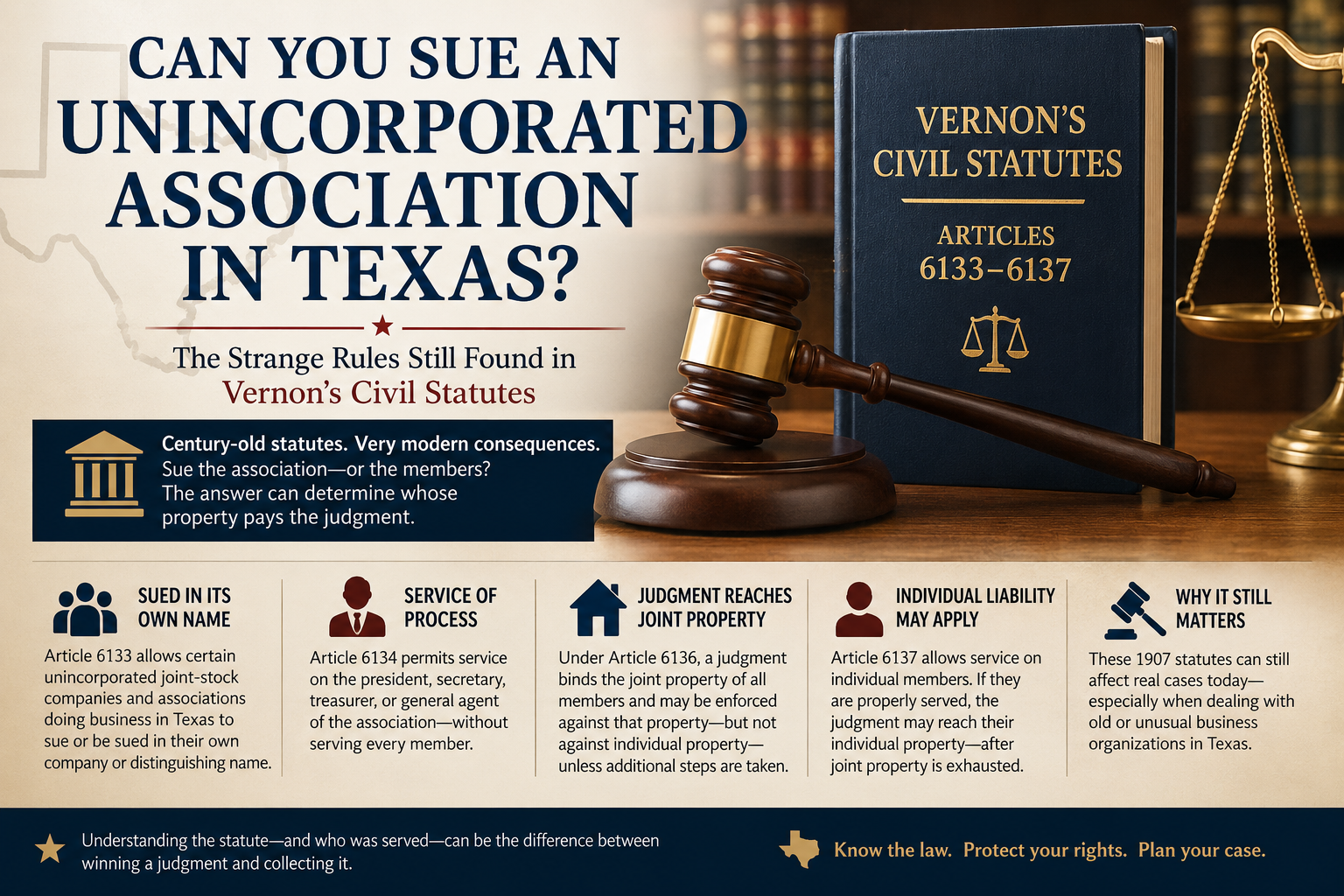
Texas business law is now largely organized into modern statutory codes such as the Texas Business Organizations Code.
But not every Texas business statute made the journey into a modern code.
Some remarkably old laws remain in Vernon’s Civil Statutes, including provisions enacted in 1907 governing lawsuits against certain unincorporated joint-stock companies and associations.
Those provisions raise a surprisingly practical question:
If a business or association is not incorporated, who exactly do you sue—and whose property can be used to satisfy the judgment?
For certain unincorporated joint-stock companies and associations doing business in Texas, Vernon’s Civil Statutes Articles 6133 through 6138 provide an unusual statutory framework.
The distinction between suing the organization and imposing liability on its individual members can be extremely important.
Texas Law Allows Certain Unincorporated Associations to Be Sued in Their Own Name
Article 6133 of Vernon’s Civil Statutes provides:
“Any unincorporated joint stock company or association, whether foreign or domestic, doing business in this State, may sue or be sued in any court of this State having jurisdiction of the subject matter in its company or distinguishing name.”
The statute further provides that:
“it shall not be necessary to make the individual stockholders or members thereof parties to the suit.”
That language dates to 1907.
Yet the basic concept sounds surprisingly modern.
An organization that is not itself a corporation can nevertheless be treated, for purposes of litigation, as something capable of suing and being sued under its own name.
Texas Rule of Civil Procedure 28 also provides a procedural mechanism under which certain partnerships, unincorporated associations, private corporations, and individuals doing business under an assumed or common name may sue or be sued in that name.
But the surviving Vernon’s statutes go further by addressing an especially important issue:
What happens after the plaintiff wins?
Service Can Be Made on Certain Officers or Agents
Vernon’s Civil Statutes Article 6134 addresses service of citation.
It provides:
“In suits against such companies or associations, service of citation may be had on the president, secretary, treasurer or general agent of such unincorporated companies.”
That may permit a plaintiff to obtain jurisdiction over the association without individually serving every person who happens to own an interest in or belong to it.
For a large association, the practical significance is obvious.
Requiring a plaintiff to identify, locate, name, and serve every member before pursuing the organization itself could make litigation extraordinarily difficult.
But service on the association and service on the individual members are not necessarily the same thing.
That becomes important when the plaintiff tries to collect a judgment.
A Judgment Against the Association Can Reach the Joint Property
Article 6136 draws an important distinction between joint property and the individual property of members.
Where the only service has been upon the president, secretary, treasurer, or general agent, the statute provides that a judgment against the defendant company:
“shall be binding on the joint property of all the stockholders or members thereof, and may be enforced by execution against the joint property.”
But the statute immediately creates a limitation.
Such a judgment:
“shall not be binding on the individual property of the stockholders or members, nor authorize execution against it.”
That distinction can become critical.
Suppose a plaintiff obtains a $100,000 judgment against an unincorporated association.
Winning the lawsuit does not necessarily mean that the plaintiff can immediately execute upon a member’s personal bank account, vehicle, investment account, or other individually owned property.
The identity of the parties who were actually served can matter.
Individual Members May Face a Different Result If They Are Served
Article 6137 addresses individual liability.
It allows service not merely on an officer or general agent of the association, but also upon individual stockholders or members.
The statute provides that when judgment is entered against the unincorporated company or association, the judgment may also become binding upon:
“the individual property of the stockholders or members so served.”
The difference is substantial.
A lawsuit solely against the association may produce a judgment enforceable against joint property.
A lawsuit in which individual members are properly served may potentially expose the individual property of those members under the statutory framework.
But Article 6137 contains another protection.
It provides that execution may not issue against individual property:
“until execution against the joint property has been returned without satisfaction.”
In other words, the statute establishes an order of collection.
The creditor generally looks first to the association’s joint property before proceeding against individual property under Article 6137.
Suing an Organization Is Not Necessarily the Same as Suing Its Members
This is the broader lesson behind these old statutes.
People frequently speak about organizations as though the organization and everyone associated with it are legally interchangeable.
They are not necessarily interchangeable.
A plaintiff should ask several different questions:
Who is the defendant?
Who was served?
What kind of organization is involved?
What substantive law governs the members’ liability?
What assets can legally be reached to satisfy the judgment?
Those questions can produce very different answers.
A judgment stating that an association owes money does not automatically establish that every person associated with it personally owes the same debt.
The Texas Supreme Court Has Addressed These Statutes
The Texas Supreme Court discussed this statutory framework in Flint v. Culbertson, 159 Tex. 243, 319 S.W.2d 690 (Tex. 1958).
The case involved the Fraternal Bank & Trust Company, which had been organized as an unincorporated joint-stock association.
After the organization became insolvent, litigation arose concerning the liability of its members.
The Texas Supreme Court specifically discussed Article 6137 and the effect of service upon individual members.
Although Flint involved legal doctrines and circumstances from a much earlier era, the case demonstrates something important about Articles 6133–6138:
These provisions were intended to address not merely the procedural convenience of suing an organization by name, but the much more consequential question of when a judgment against the organization can affect the property of its individual members.
The Texas Supreme Court Has Also Distinguished Different Types of Unincorporated Associations
There is another important qualification.
The word “association” in Article 6133 should not automatically be read to mean every informal group of people in Texas.
In Cox v. Thee Evergreen Church, 836 S.W.2d 167 (Tex. 1992), the Texas Supreme Court examined whether Articles 6133–6138 applied to an unincorporated charitable association.
The Court discussed earlier authority holding that Article 6133 did not apply to an unincorporated religious society that was not an association “doing business in this state.”
That means the statutory classification itself matters.
A plaintiff should not simply find an organization that lacks “Inc.” or “LLC” after its name and assume Articles 6133–6138 automatically apply.
The nature and activities of the organization must be examined.
Why Would Anyone Still Care About a Statute Enacted in 1907?
Because old organizational forms do not necessarily disappear merely because newer ones become more popular.
Modern Texas businesses commonly operate as:
- limited liability companies;
- corporations;
- limited partnerships;
- general partnerships; or
- other entities governed principally by the Texas Business Organizations Code.
Those forms usually provide a much more familiar statutory framework.
But litigation does not always involve a newly organized Texas LLC.
A dispute might involve an old investment organization, business association, legacy entity, trust-like business arrangement, or other organization created many decades ago.
The Fifth Circuit, for example, discussed Articles 6133–6138 in True v. Robles, 571 F.3d 412 (5th Cir. 2009), while considering Texas law concerning an unincorporated association.
Thus, the fact that a statute looks ancient does not necessarily mean that it has no modern legal significance.
The Entity’s Name Does Not Answer the Liability Question
One practical danger is assuming that the organization's label determines the result.
Calling something an “association,” “company,” “group,” “trust,” or “organization” does not by itself establish the legal consequences of membership.
Likewise, the absence of “LLC” or “Inc.” from a name does not automatically mean that every participant has unlimited personal liability.
The actual organizational structure, governing documents, applicable statutes, substantive law, and procedural history of the lawsuit all matter.
This is particularly important before filing suit.
A plaintiff who wants more than a judgment against organizational assets should consider the potential liability of individual members before service and pleading decisions are made, rather than discovering the issue after judgment.
Collection Strategy Should Be Considered Before the Lawsuit Is Filed
This is a recurring principle in civil litigation.
A plaintiff can win a case and still have a collection problem.
Before suing an unusual business organization, counsel should investigate:
- the legal form of the organization;
- how and when it was created;
- whether it remains active;
- who owns or controls it;
- what property belongs to the organization;
- whether individual members may have personal liability;
- which parties must be named and served; and
- what property would actually be available to satisfy a judgment.
Articles 6136 and 6137 make that analysis especially important because they expressly distinguish between joint property and individual property.
Waiting until after judgment to investigate those distinctions may be too late to structure the lawsuit in the most useful way.
Old Texas Statutes Can Still Have Modern Consequences
Vernon’s Civil Statutes can sometimes look like a legal museum.
Articles written more than a century ago remain surrounded by statutory language and organizational concepts that modern lawyers rarely encounter.
But occasionally an old statute still answers a very modern question.
Vernon’s Civil Statutes Articles 6133–6138 demonstrate that principle particularly well.
Texas law has long recognized that certain unincorporated business organizations can participate in litigation under their own names.
But the ability to sue the organization does not necessarily mean that a judgment automatically reaches the personal property of everyone behind it.
For creditors, business owners, association members, and attorneys, that distinction can be the difference between merely winning a judgment and actually knowing who is legally responsible for paying it.
This article is for general informational purposes only and is not legal advice. The application of Vernon’s Civil Statutes Articles 6133–6138 depends heavily on the nature of the particular organization, the parties served, the claims asserted, and other applicable Texas law.
At David C. Barsalou, Attorney at Law, PLLC, we help clients navigate business, family, tax, estate planning, and real estate matters ranging from document drafting to litigation with clarity and confidence. If you’d like guidance on your situation, schedule a consultation today. Call us at (713) 397-4678, email barsalou.law@gmail.com, or reach us through our Contact Page. We’re here to help you take the next step.