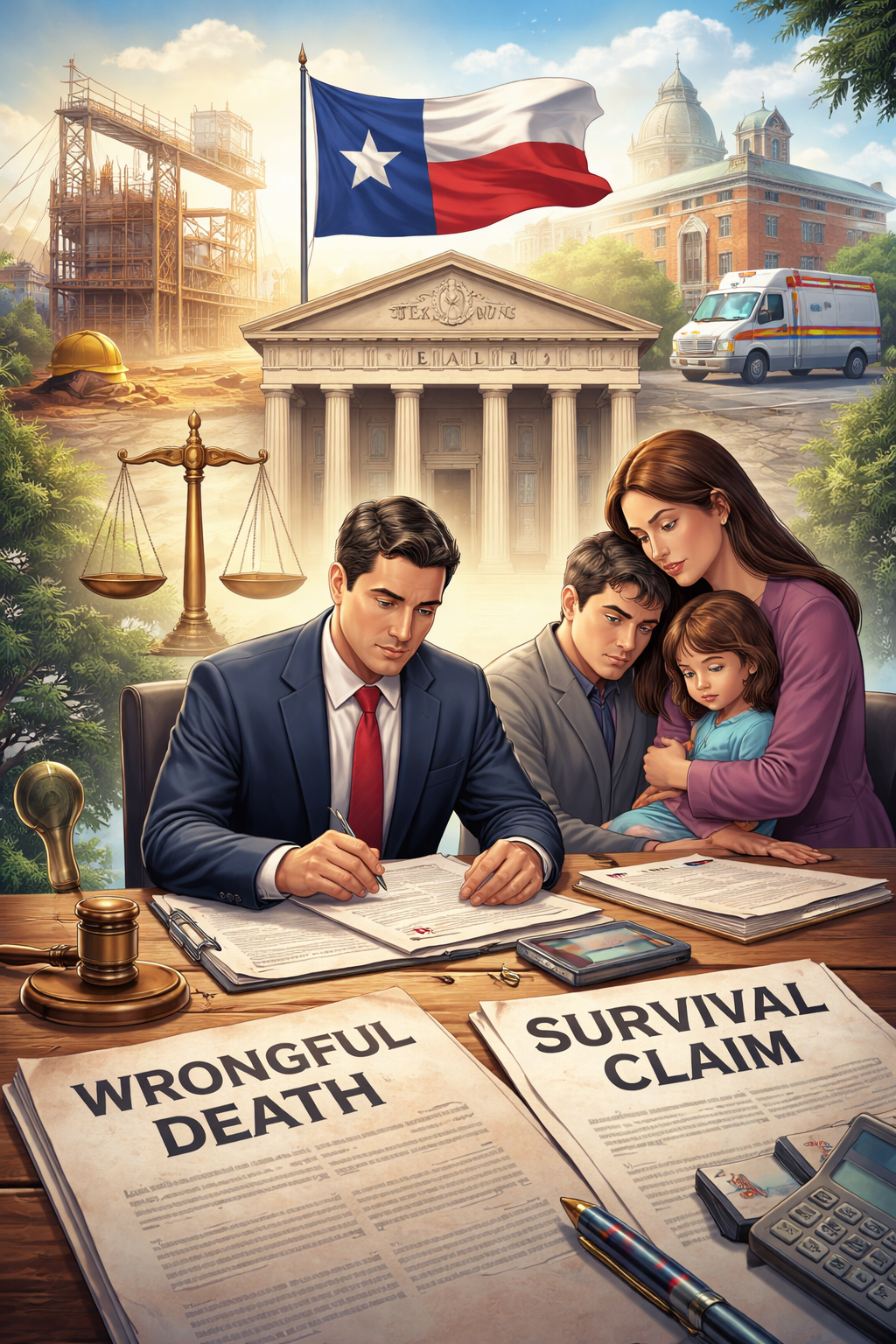
Understanding Wrongful Death and Survival Claims Under Texas Law
When a loved one dies because of someone else’s negligence or wrongdoing, Texas law allows certain family members and estates to pursue financial compensation. However, many people are surprised to learn that Texas actually recognizes two different types of death-related lawsuits:
- Wrongful Death Claims, and
- Survival Claims
Understanding the difference between these two claims is critical, because filing the wrong case—or missing a deadline—can permanently destroy your rights.
This article explains how both claims work under Texas law and when each applies.
1. Wrongful Death Claims Under Texas Law
Texas wrongful death claims are governed by Chapter 71 of the Texas Civil Practice and Remedies Code.
Who Can File a Wrongful Death Lawsuit?
Under Tex. Civ. Prac. & Rem. Code § 71.004(a):
“An action… may be brought by the surviving spouse, children, and parents of the deceased.”
Only the following people may file:
- The surviving spouse
- Biological or adopted children
- Biological or adoptive parents
Siblings, grandparents, and other relatives do not have standing to file.
What Must Be Proven?
To succeed, the plaintiff must show that the death was caused by:
- A wrongful act,
- Neglect,
- Carelessness,
- Unskillfulness, or
- Default of another person.
See § 71.002(b).
In practice, this usually involves:
- Car accidents
- Workplace accidents
- Medical malpractice
- Defective products
- Dangerous property conditions
- Intentional acts
What Damages Are Available?
Wrongful death damages focus on what the family lost, not what the deceased suffered.
Courts may award compensation for:
- Loss of financial support
- Loss of companionship
- Loss of consortium
- Mental anguish
- Loss of inheritance
These damages belong to the family members individually, not to the estate.
2. Survival Claims: When the Estate Can Sue
Wrongful death claims are often confused with survival claims, which are governed by Tex. Civ. Prac. & Rem. Code § 71.021.
What Is a Survival Claim?
Section 71.021(b) provides:
“A cause of action for personal injury to the health, reputation, or person of an injured person does not abate because of the death of the injured person.”
In simple terms:
If the deceased could have sued while alive, that claim survives their death.
It becomes property of the estate.
Who Files a Survival Claim?
A survival claim is brought by:
- The executor, or
- The administrator of the estate.
If no probate is opened, heirs may sometimes bring the claim under limited circumstances.
What Damages Are Recoverable?
Survival claims focus on what the deceased personally suffered before death, including:
- Medical expenses
- Pain and suffering
- Mental anguish
- Lost wages before death
- Property damage
- Funeral expenses (in some cases)
These damages are paid to the estate, then distributed through probate.
3. Wrongful Death vs. Survival Claims: Key Differences
Issue
Wrongful Death
Survival Claim
Who Files
Family Members
Estate
Focus
Family’s Loss
Decedent’s Suffering
Damages Go To
Individual Plaintiffs
Estate
Legal Basis
§ 71.002–.012
§ 71.021
In many serious cases, both claims are filed together.
4. Statute of Limitations: The Two-Year Rule
Most death-related claims are subject to a two-year statute of limitations.
Under Tex. Civ. Prac. & Rem. Code § 16.003(a):
“A person must bring suit… not later than two years after the day the cause of action accrues.”
In wrongful death and survival cases, this usually means:
Two years from the date of death.
Missing this deadline almost always bars recovery.
5. Can Multiple Family Members File Separately?
Texas law encourages families to pursue wrongful death claims together.
Under § 71.004(b):
If one qualified family member files suit, they may do so on behalf of all beneficiaries unless others intervene.
This prevents multiple conflicting lawsuits over the same death.
6. Common Situations Where These Claims Arise
In practice, wrongful death and survival claims frequently arise from:
- Auto and truck accidents
- Construction accidents
- Oilfield injuries
- Nursing home neglect
- Hospital negligence
- Premises liability cases
- Defective equipment
- Workplace incidents
Given your construction, real estate, and civil litigation practice, these cases align well with your existing content and audience.
7. Why These Cases Are Legally Complex
Death cases often involve:
- Insurance disputes
- Probate administration
- Medical records
- Expert witnesses
- Liability defenses
- Comparative fault issues
- Settlement allocation problems
Mistakes early in the process—especially regarding standing and damages—can be fatal to a case.
8. Practical Example
Suppose a worker is injured at a construction site and survives for three months before dying.
Two claims may exist:
Survival Claim
The estate sues for:
- Hospital bills
- Pain and suffering
- Lost wages before death
Wrongful Death Claim
The spouse and children sue for:
- Lost income support
- Emotional loss
- Loss of companionship
Both claims may proceed in the same lawsuit.
9. When You Should Speak With a Texas Attorney
You should seek legal advice promptly if:
- A family member died due to negligence
- Insurance companies are involved
- An employer denies responsibility
- Probate is required
- Multiple relatives are disputing claims
- Deadlines are approaching
Early legal planning preserves evidence and maximizes recovery.
Conclusion
Texas law provides two powerful tools when a wrongful death occurs:
- Wrongful death claims protect families, and
- Survival claims protect estates.
Each serves a different legal purpose, and both are often necessary.
Understanding these distinctions can mean the difference between full compensation and no recovery at all.
At David C. Barsalou, Attorney at Law, PLLC, we help clients navigate business, family, tax, estate planning, and real estate matters ranging from document drafting to litigation with clarity and confidence. If you’d like guidance on your situation, schedule a consultation today. Call us at (713) 397-4678, email barsalou.law@gmail.com, or reach us through our Contact Page. We’re here to help you take the next step.