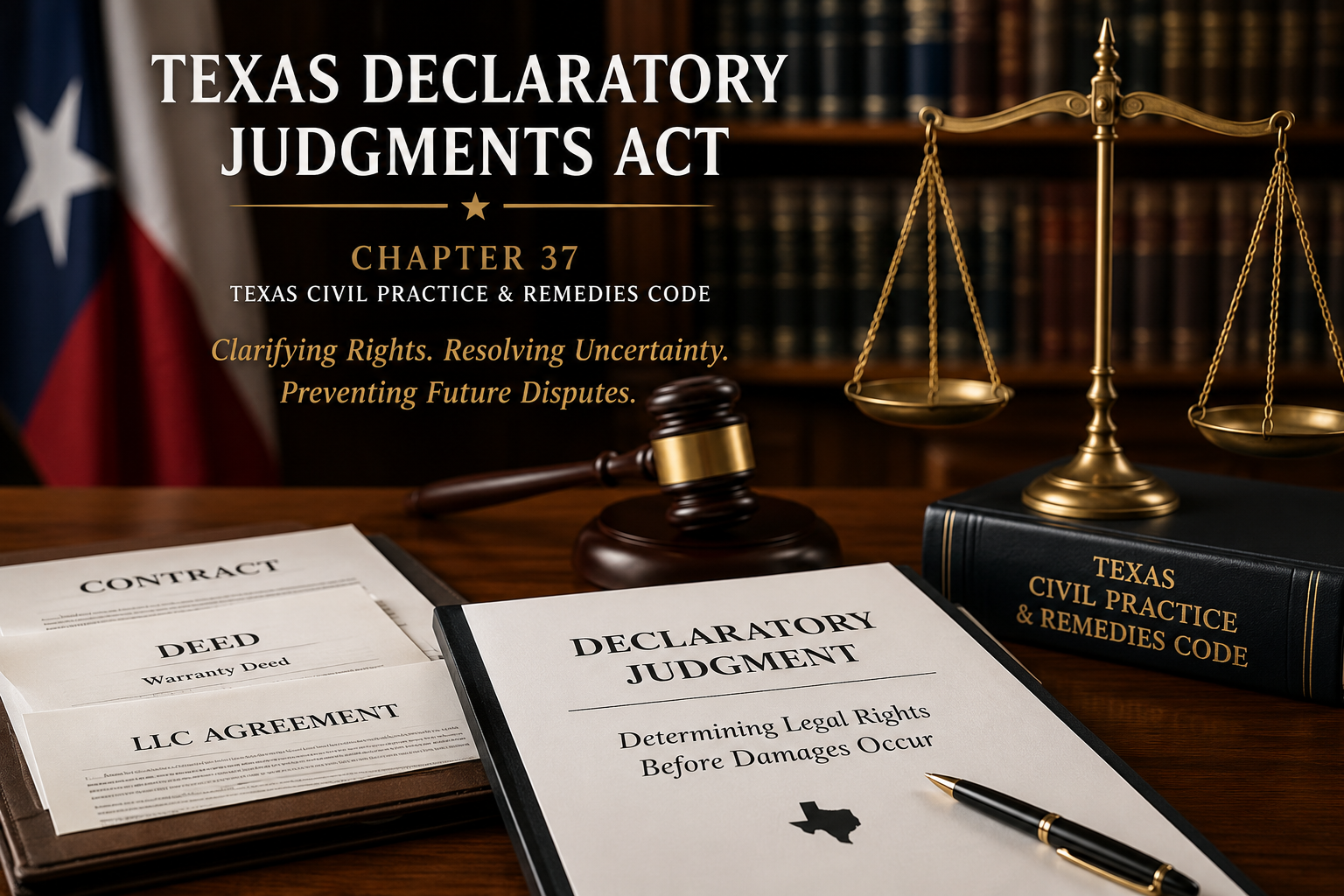
Texas Civil Practice & Remedies Code Chapter 37
Many people assume a lawsuit can only be filed after someone has already suffered damages. In Texas, that is not always true.
One of the most interesting—and frequently misunderstood—laws in Texas is the Texas Declaratory Judgments Act (TDJA), found in Chapter 37 of the Texas Civil Practice and Remedies Code. Rather than asking a court to award money, a declaratory judgment action asks the court to determine the parties' legal rights before the dispute becomes even more expensive.
This makes declaratory judgments especially useful in business disputes, contract litigation, real estate conflicts, probate matters, and partnership disagreements.
What Is a Declaratory Judgment?
The Texas Legislature explains the purpose of the statute in Texas Civil Practice and Remedies Code § 37.002:
"The purpose of this chapter is to settle and to afford relief from uncertainty and insecurity with respect to rights, status, and other legal relations; and it is to be liberally construed and administered."
In other words, the law recognizes that uncertainty itself can create significant problems. Sometimes parties simply need a court to determine who is correct before anyone proceeds further.
What Can a Court Decide?
Section 37.004 provides that:
"A person interested under a deed, will, written contract, or other writings constituting a contract... may have determined any question of construction or validity arising under the instrument... and obtain a declaration of rights, status, or other legal relations thereunder."
This surprisingly broad language allows courts to interpret:
- Contracts
- Commercial leases
- Easements
- Deeds
- Restrictive covenants
- LLC agreements
- Partnership agreements
- Wills
- Trust instruments
The court is not necessarily awarding damages. Instead, it is answering the legal question that prevents the parties from moving forward.
A Few Common Examples
Declaratory judgment actions arise in many situations, including:
- Whether a contract has been terminated.
- Whether a non-compete agreement is enforceable.
- Whether an easement exists.
- Whether restrictive covenants apply to particular property.
- Which party owns mineral rights.
- Whether an insurance policy provides coverage.
- Whether an LLC operating agreement permits a particular action.
- Whether a deed contains an enforceable reservation.
In each case, the dispute centers on legal rights—not necessarily on damages that have already occurred.
One of the Most Interesting Features: Attorney's Fees
Perhaps the most unique aspect of the Declaratory Judgments Act is its attorney's fee provision.
Texas Civil Practice and Remedies Code § 37.009provides:
"In any proceeding under this chapter, the court may award costs and reasonable and necessary attorney's fees as are equitable and just."
Notice what the statute does not say.
Unlike many fee-shifting statutes, it does not automatically award attorney's fees to the prevailing party. Instead, the court has discretion to award fees that are both:
- reasonable and necessary; and
- equitable and just.
That broad discretion makes declaratory judgment actions strategically significant in Texas litigation.
Why Businesses Frequently Use Declaratory Judgments
Businesses often cannot afford to wait until a dispute becomes catastrophic.
Imagine:
- two companies disagree over the meaning of a contract;
- a commercial landlord and tenant disagree over lease obligations;
- business partners dispute ownership percentages;
- an insurance carrier disputes coverage.
Rather than waiting until substantial damages accumulate, one party may seek a judicial declaration defining everyone's legal rights.
This often narrows—or even resolves—the dispute.
Declaratory Judgments Are Not Advisory Opinions
One important limitation is that Texas courts do not answer hypothetical questions.
There must be an actual controversy between parties with genuine adverse legal interests.
The Declaratory Judgments Act is designed to resolve real legal disputes—not academic questions or requests for legal advice.
Why This Matters
Many Texans believe lawsuits exist only to recover money after something has gone wrong.
In reality, one of the most valuable tools in Texas civil litigation is a lawsuit that simply asks:
"What are our legal rights?"
When uncertainty threatens a business transaction, a real estate deal, an estate, or an ongoing contractual relationship, obtaining a judicial declaration may prevent years of unnecessary litigation and expense.
Understanding the Texas Declaratory Judgments Act can help individuals and businesses resolve uncertainty before it grows into a much larger—and much more expensive—legal problem.
Disclaimer: This article is provided for general educational purposes only and is not legal advice. Every dispute is unique, and the availability of declaratory relief depends on the specific facts and applicable Texas law. If you have questions about your rights under a contract, deed, lease, LLC agreement, or other legal instrument, consult a qualified Texas attorney.
At David C. Barsalou, Attorney at Law, PLLC, we help clients navigate business, family, tax, estate planning, and real estate matters ranging from document drafting to litigation with clarity and confidence. If you’d like guidance on your situation, schedule a consultation today. Call us at (713) 397-4678, email barsalou.law@gmail.com, or reach us through our Contact Page. We’re here to help you take the next step.