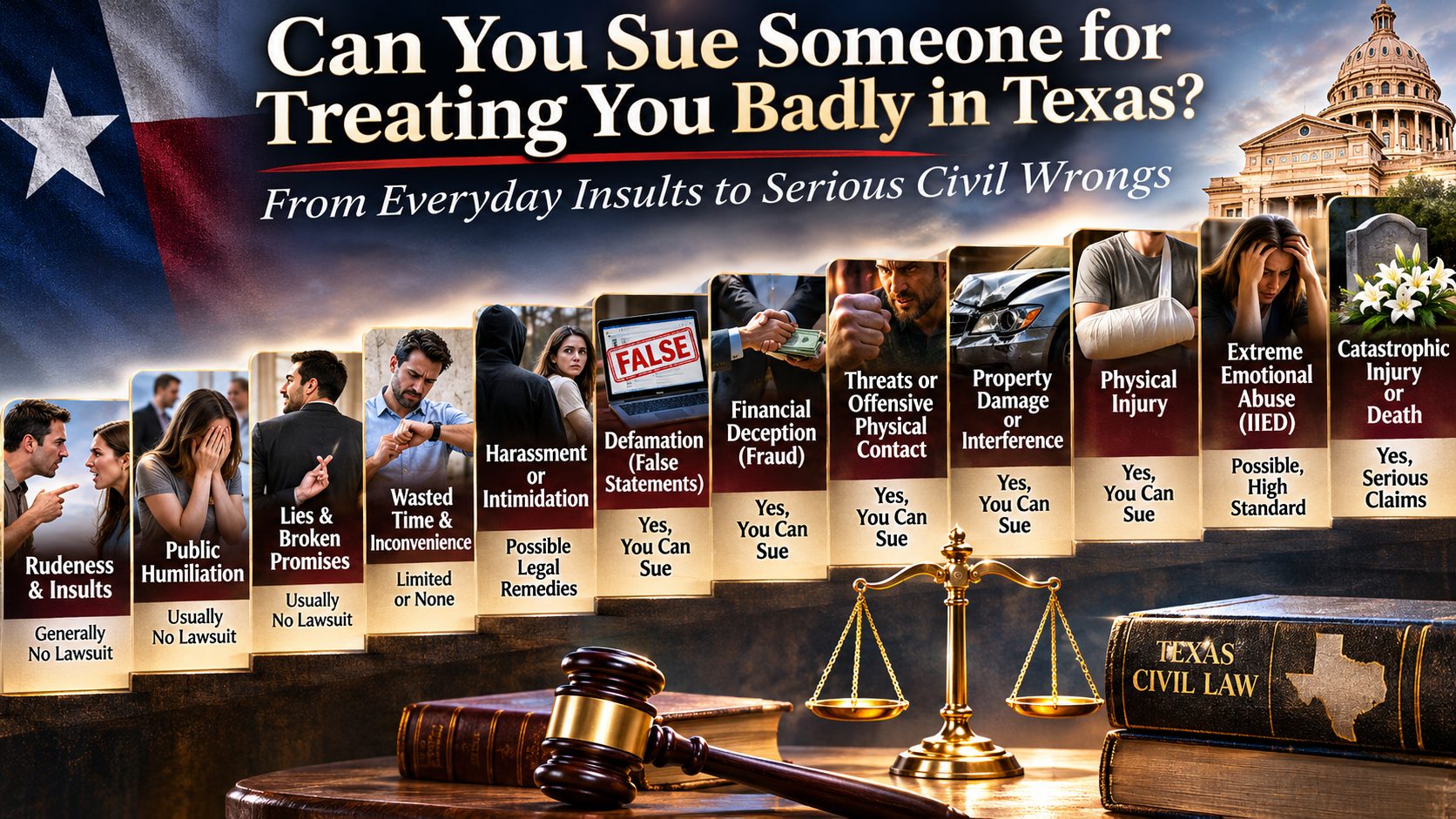
Understanding when rude, offensive, threatening, or harmful behavior becomes grounds for a lawsuit under Texas law.
Introduction: Not Every Wrong Is a Legal Wrong
Life involves a surprising number of indignities. People are rude, dishonest, inconsiderate, aggressive, and sometimes deliberately cruel. A stranger might insult you in public. A coworker might embarrass you. A business might waste your time. A neighbor might repeatedly antagonize you. In more serious situations, someone might threaten you, damage your property, or physically attack you.
But can you sue someone for any of these things?
Under Texas law, the answer depends less on how offensive the conduct feels and more on whether it violates a legally recognized right.
The distinction is important. Civil law does not exist to correct every instance of bad behavior. Instead, it provides remedies for particular categories of legally actionable misconduct.
This article examines common indignities along a spectrum, beginning with ordinary discourtesy and progressing toward serious civil wrongs. Along the way, we will consider which situations generally provide no legal remedy, which may support a lawsuit under particular circumstances, and which can justify substantial damages.
Level 1: Someone Is Rude, Dismissive, or Disrespectful
Examples:
- A stranger insults your appearance.
- A cashier treats you dismissively.
- Someone ignores you at a social gathering.
- A coworker speaks to you condescendingly.
- A neighbor makes an unkind remark.
Potential lawsuit: Generally none.
Texas law does not recognize a general cause of action for rudeness, disrespect, or discourtesy.
A person can be inconsiderate, arrogant, unpleasant, or deliberately offensive without necessarily violating anyone's legal rights.
For example, if someone tells you that you are unattractive, unintelligent, or unsuccessful, those statements may be insulting. But they ordinarily do not support a civil lawsuit.
Likewise, there is generally no legal obligation to be friendly, socially inclusive, or polite.
There are important exceptions when conduct involves unlawful discrimination, actionable threats, or another independently recognized legal wrong. But ordinary interpersonal unpleasantness is not enough.
Practical takeaway: Being treated badly does not automatically mean you have been legally injured.
Level 2: Someone Embarrasses or Humiliates You
Examples:
- A supervisor criticizes you in front of coworkers.
- A friend reveals an embarrassing but truthful story.
- Someone makes fun of you at a party.
- A business employee speaks harshly to you in front of other customers.
Potential lawsuit: Usually none, although additional facts can change the analysis.
Humiliation can be painful, particularly when it occurs publicly.
Nevertheless, Texas law generally does not award damages merely because someone made another person feel embarrassed.
The analysis changes when the conduct involves an independent legal wrong.
For example, a person who publicly discloses highly private information might face a claim for public disclosure of private facts if the demanding elements of that tort are satisfied. Similarly, sufficiently serious conduct in a workplace might violate applicable discrimination or harassment laws.
But an embarrassing incident, standing alone, usually does not create civil liability.
Texas also recognizes intentional infliction of emotional distress, but the claim has exceptionally demanding requirements.
In Hoffmann-La Roche Inc. v. Zeltwanger, 144 S.W.3d 438 (Tex. 2004), the Texas Supreme Court explained that intentional infliction of emotional distress operates as a limited gap-filling tort. It is not a general remedy for conduct that is merely insulting, humiliating, or upsetting.
Practical takeaway: Humiliation alone is usually insufficient. The plaintiff must identify conduct that satisfies a recognized legal claim.
Level 3: Someone Lies to You or Breaks a Personal Promise
Examples:
- A friend promises to help you move and never arrives.
- Someone falsely claims to admire you.
- A romantic partner makes promises about the future and changes their mind.
- An acquaintance exaggerates personal accomplishments.
- Someone tells you a harmless lie to avoid an uncomfortable conversation.
Potential lawsuit: Usually none.
Not every lie constitutes fraud.
Under Texas law, actionable common-law fraud generally requires a material misrepresentation, knowledge of falsity or recklessness, an intent that another person act upon the representation, actual and justifiable reliance, and resulting injury.
A false statement that causes no legally compensable injury ordinarily does not justify a fraud lawsuit.
Likewise, a broken promise is not automatically a breach of contract.
Contracts generally require legally sufficient agreement and consideration, among other requirements. Casual social arrangements ordinarily lack the necessary contractual foundation.
However, the situation changes when a person knowingly makes a material misrepresentation to induce someone to part with money or property.
Practical takeaway: Dishonesty may be morally objectionable without being legally actionable. Fraud and breach of contract require additional elements.
Level 4: Someone Wastes Your Time or Causes a Minor Inconvenience
Examples:
- A contractor arrives several hours late.
- A business keeps you waiting unnecessarily.
- Someone cancels an appointment without warning.
- A seller provides poor customer service.
- A person repeatedly fails to return telephone calls.
Potential lawsuit: Usually none, unless there is a legal duty, breach, and recoverable injury.
Time has value. Unfortunately, that does not mean every unnecessary expenditure of time creates a claim for damages.
Texas courts generally require a legally recognized basis for liability and an appropriate measure of damages.
For example, if a contractor breaches an enforceable agreement and causes measurable financial losses, a breach-of-contract claim may exist.
Similarly, certain deceptive business practices may implicate the Texas Deceptive Trade Practices–Consumer Protection Act, Chapter 17 of the Texas Business and Commerce Code.
But inconvenience alone is not necessarily a recoverable loss.
This reflects a broader principle sometimes described by the Latin phrase de minimis non curat lex—the law does not concern itself with trifles.
The principle does not mean that every small monetary claim fails. Indeed, Texas justice courts routinely adjudicate relatively modest disputes. Rather, it recognizes that not every trivial grievance warrants judicial intervention.
Practical takeaway: A lawsuit ordinarily requires more than wasted time and frustration.
Level 5: Someone Repeatedly Harasses, Intimidates, or Disturbs You
Examples:
- A neighbor repeatedly approaches your property to provoke arguments.
- Someone sends persistent unwanted communications.
- An acquaintance repeatedly follows you.
- A former partner engages in threatening behavior.
- Someone deliberately interferes with your peaceful enjoyment of property.
Potential lawsuits or remedies: Depending on the circumstances, stalking-related remedies, trespass, nuisance, assault, or other recognized claims.
At this level, the analysis becomes more serious.
Texas does not provide a universal civil cause of action for every form of interpersonal harassment. However, particular conduct may violate specific laws.
For example, repeated unwanted conduct may implicate Texas Penal Code § 42.072, addressing stalking, if the statutory requirements are met. Certain qualifying victims may also seek protective orders under applicable Texas law.
If someone repeatedly enters another person's property without permission, a trespass claim may be available.
If a neighbor's conduct substantially interferes with the use and enjoyment of land, a private nuisance claim may arise, depending on the nature and circumstances of the interference.
The distinction is between conduct that is merely irritating and conduct that infringes upon a legally protected interest.
Practical takeaway: Repetition alone does not automatically create liability, but persistent conduct involving threats, property interference, or stalking may justify legal intervention.
Level 6: Someone Spreads False Statements That Damage Your Reputation
Examples:
- A former coworker falsely accuses you of stealing.
- Someone publicly claims that you committed a crime.
- A business competitor makes false factual allegations about your professional conduct.
- Someone publishes a damaging false statement about you online.
Potential lawsuit: Defamation, including libel or slander.
Texas recognizes civil claims for defamatory statements.
Generally, a plaintiff must establish the publication of a defamatory statement of fact to a third party, the required degree of fault, and legally sufficient injury or damages. Additional requirements and constitutional protections may apply depending on the plaintiff's status and the subject matter.
An important distinction exists between statements of opinion and provably false assertions of fact.
Calling someone unpleasant or incompetent may, depending on context, constitute protected opinion. Falsely asserting that the person stole money from an employer is potentially much more serious.
Some defamatory statements may constitute defamation per se, allowing certain damages to be presumed, subject to applicable limitations and defenses.
Truth is generally a defense to defamation.
Texas Civil Practice and Remedies Code § 16.002 generally imposes a one-year limitations period for libel and slander.
Practical takeaway: False factual accusations that damage a person's reputation may support a lawsuit, but offensive opinions ordinarily do not.
Level 7: Someone Deliberately Deceives You and Causes Financial Harm
Examples:
- A contractor accepts payment for work that was never intended to be performed.
- A seller knowingly misrepresents a material defect.
- A business partner lies about the disposition of company funds.
- Someone induces you to invest money through materially false representations.
Potential lawsuits: Fraud, fraudulent inducement, breach of contract, or statutory consumer claims.
At this stage, the conduct has moved beyond ordinary interpersonal dishonesty.
When deception causes measurable economic injury, Texas law may provide meaningful remedies.
Depending on the facts, claims may include common-law fraud, fraudulent inducement, negligent misrepresentation, or violations of the DTPA.
Texas Business and Commerce Code § 17.46 identifies numerous unlawful deceptive trade practices, although a private DTPA claim requires satisfaction of additional statutory requirements.
Under § 17.50, qualifying consumers may recover actual economic damages for certain violations and, under specified circumstances, additional damages.
Fraud claims may also permit exemplary damages when the statutory requirements are established.
However, plaintiffs must distinguish genuine fraud from an ordinary contractual disagreement. A failed business transaction does not automatically establish that someone committed fraud.
Practical takeaway: Financial deception becomes legally significant when it satisfies the elements of a recognized cause of action and produces compensable injury.
Level 8: Someone Threatens You or Makes Offensive Physical Contact
Examples:
- Someone threatens imminent physical harm.
- A person deliberately shoves you during an argument.
- Someone spits on you.
- An individual intentionally makes offensive physical contact.
- A person acts in a manner creating reasonable apprehension of imminent harmful contact.
Potential lawsuits: Civil assault, battery, or related intentional torts.
Physical injury is not always necessary for an actionable intentional tort.
Texas recognizes civil assault claims involving certain threats or offensive physical contact. Civil assault principles are related to, but not identical in every respect to, the criminal definition of assault.
Texas Penal Code § 22.01 provides that criminal assault can include intentionally or knowingly threatening another with imminent bodily injury or intentionally or knowingly causing physical contact that the actor knows or reasonably should believe will be regarded as offensive or provocative.
A qualifying civil assault claim may support recovery for legally recognized injuries, including appropriate mental anguish damages.
Nevertheless, the circumstances matter.
An accidental bump in a crowded store is different from an intentional shove during a confrontation. Similarly, a vague statement about possible future retaliation is not necessarily equivalent to an actionable threat of imminent harm.
Practical takeaway: The law protects bodily integrity, and intentional offensive contact may be actionable even without a major physical injury.
Level 9: Someone Damages, Takes, or Interferes with Your Property
Examples:
- A neighbor intentionally destroys your fence.
- Someone refuses to return property belonging to you.
- A person damages your vehicle.
- Someone unlawfully enters your land.
- A contractor removes equipment that belongs to the property owner.
Potential lawsuits: Trespass, conversion, negligence, breach of contract, or other property-related claims.
Property rights are among the interests most directly protected by civil law.
A person who wrongfully exercises dominion or control over another's personal property may be liable for conversion.
Unauthorized entry onto land may support a trespass claim.
Property damage caused by a failure to exercise reasonable care may support a negligence claim when the necessary elements are established.
Recoverable damages depend on the type of property, the nature of the wrong, and the appropriate legal measure of loss.
For example, a damaged vehicle might support recovery of reasonable repair costs or another applicable measure of property damage.
Some property disputes also justify injunctive relief to prevent continuing or threatened violations.
Practical takeaway: Interference with legally protected property interests frequently provides a more concrete basis for civil litigation than interpersonal mistreatment.
Level 10: Someone Physically Injures You
Examples:
- A driver negligently causes an automobile collision.
- A property owner negligently permits a dangerous condition that causes injury.
- Someone punches another person.
- A business negligently causes a customer to suffer bodily harm.
- A person deliberately inflicts physical injury during an altercation.
Potential lawsuits: Negligence, premises liability, civil assault, or other personal injury claims.
Physical injury is among the clearest categories of legally recognizable harm.
In a negligence action, a plaintiff generally must establish duty, breach, causation, and damages.
In an intentional assault case, different elements apply.
Depending on the circumstances, recoverable damages may include medical expenses, lost earning capacity, physical pain, mental anguish, physical impairment, and other recognized losses.
Texas Civil Practice and Remedies Code § 16.003 generally establishes a two-year limitations period for personal injury claims, subject to exceptions and special rules.
However, even a serious injury does not automatically establish liability. The plaintiff must still prove that the defendant is legally responsible.
Practical takeaway: Physical injury can support substantial civil recovery, but causation, liability, evidence, and damages remain essential.
Level 11: Someone Engages in Extreme, Deliberate, or Repeatedly Abusive Conduct
Examples:
- A person engages in exceptionally outrageous conduct designed to cause severe emotional distress.
- Someone undertakes a sustained campaign of threatening or terrorizing behavior.
- An individual deliberately exploits another person's vulnerability through extreme misconduct.
- A defendant commits serious intentional wrongdoing that causes severe psychological harm.
Potential lawsuits: Intentional infliction of emotional distress or other intentional torts, depending on the facts.
Texas recognizes intentional infliction of emotional distress, but the standard is intentionally difficult to satisfy.
Under Hoffmann-La Roche Inc. v. Zeltwanger, a plaintiff generally must establish:
- The defendant acted intentionally or recklessly.
- The conduct was extreme and outrageous.
- The conduct caused emotional distress.
- The resulting emotional distress was severe.
The Texas Supreme Court has emphasized that this tort is a limited gap-filling remedy rather than a substitute for established causes of action.
Conduct must be far beyond ordinary insults, indignities, threats, annoyances, or petty oppression.
Even repeated offensive behavior may fail to satisfy the standard.
Moreover, when another recognized tort or statutory claim addresses the gravamen of the misconduct, intentional infliction of emotional distress generally cannot be used to duplicate that remedy.
Practical takeaway: Extreme emotional abuse may be actionable, but Texas courts set a very high threshold.
Level 12: Someone Causes Catastrophic Injury or Death
Examples:
- A negligent driver causes a fatal collision.
- A business's actionable misconduct causes permanent disability.
- A person commits a violent attack resulting in catastrophic injury.
- Grossly negligent conduct causes a preventable death.
Potential lawsuits: Serious personal injury, wrongful death, survival actions, and potentially claims for exemplary damages.
At the most severe end of the spectrum, civil law provides remedies for catastrophic injuries and wrongful death.
Texas Civil Practice and Remedies Code Chapter 71 governs wrongful death and survival actions.
A wrongful death claim may permit certain surviving family members to seek damages resulting from a death caused by legally actionable conduct.
A survival action preserves qualifying claims that the deceased person could have pursued had death not occurred.
Depending on the facts, damages may include financial losses, mental anguish, loss of companionship, medical expenses, and other legally recoverable categories.
Texas Civil Practice and Remedies Code Chapter 41 also permits exemplary damages in certain cases involving fraud, malice, or gross negligence, subject to statutory requirements and limitations.
Not every tragic event creates civil liability. But where the required elements are proven, serious misconduct can justify substantial recovery.
Practical takeaway: Civil law provides some of its most significant remedies when wrongful conduct causes devastating injury or loss of life.
The Spectrum of Everyday Indignities Under Texas Law
Type of conduct
Possible legal remedy
Rudeness or disrespect
Generally none
Ordinary embarrassment
Generally none
Harmless lies or broken social promises
Generally none
Wasted time or inconvenience
Limited; depends on legal duty and damages
Persistent harassment or intimidation
Possible statutory or tort remedies
False factual accusations
Defamation
Financial deception
Fraud, DTPA, or contract claims
Threats or offensive physical contact
Civil assault or related torts
Property damage or interference
Trespass, conversion, or negligence
Physical injury
Personal injury claims
Extreme and outrageous misconduct
Potential intentional infliction of emotional distress
Catastrophic injury or death
Serious injury, wrongful death, or survival claims
These categories are illustrative, not a formal ranking of legal severity. The applicable law depends on the facts, and a seemingly minor incident may involve important statutory or constitutional rights.
Why Emotional Harm Does Not Always Mean You Can Sue
One of the most common misconceptions about civil litigation is that emotional distress automatically entitles someone to monetary compensation.
That is not how Texas law works.
Mental anguish damages may be available in particular kinds of cases, but a plaintiff ordinarily cannot obtain them simply by demonstrating that another person's behavior caused unhappiness, embarrassment, anger, or anxiety.
The plaintiff must first establish an applicable legal basis for recovery.
This distinction protects against converting virtually every interpersonal disagreement into litigation.
If ordinary unpleasantness created a right to compensation, courts could be overwhelmed with disputes over failed friendships, embarrassing remarks, social rejection, and everyday discourtesy.
The law instead identifies particular interests worthy of judicial protection and imposes requirements for obtaining relief.
Can You Sue Someone Even If Your Damages Are Small?
Yes, in appropriate circumstances.
The seriousness of an injury and the existence of a cause of action are different questions.
A relatively small financial loss may support a valid lawsuit if the defendant breached an enforceable contract or committed another actionable wrong.
Conversely, a deeply humiliating experience may provide no cause of action at all.
Texas justice courts generally have jurisdiction over qualifying civil matters involving amounts in controversy not exceeding $20,000, subject to statutory jurisdictional requirements.
But filing a lawsuit is not necessarily economically sensible merely because it is legally possible.
Court costs, service expenses, time commitments, evidentiary problems, collection difficulties, and potential exposure to adverse rulings should all be considered.
A successful plaintiff may also discover that winning a judgment is easier than collecting it.
When Does a Lawsuit Become Worth Pursuing?
Before filing a civil lawsuit in Texas, consider five questions.
First, what legal duty did the defendant violate?
The defendant's conduct must ordinarily implicate a recognized legal obligation or protected right.
Second, what evidence establishes the misconduct?
Documents, communications, photographs, witness testimony, financial records, and other admissible evidence may be necessary.
Third, what legally compensable harm occurred?
An unpleasant experience is not necessarily a recoverable injury.
Fourth, what remedy is available?
Depending on the claim, remedies might include monetary damages, return of property, declaratory relief, or an injunction.
Fifth, is litigation economically worthwhile?
A meritorious lawsuit may still be impractical when the anticipated costs exceed the realistic benefits.
Additionally, applicable statutes of limitations, notice requirements, governmental immunity, contractual provisions, and other legal defenses can affect whether a claim may proceed.
The Difference Between Justice and Vindication
People sometimes pursue litigation because they want a court to declare that another person's behavior was unacceptable.
That desire is understandable.
But civil courts are not general tribunals of personal morality.
A defendant can behave badly and still prevail in litigation because the plaintiff cannot establish the elements of a recognized cause of action.
Likewise, a plaintiff may prove that another person acted unlawfully but recover relatively modest damages.
The distinction between moral wrongdoing and legal liability is fundamental to understanding the civil justice system.
The central question is not simply whether someone treated you unfairly. It is whether the conduct violated a legally enforceable right and whether the law provides a remedy for that violation.
Conclusion: The Law Does Not Promise a Life Without Indignities
Everyday life inevitably involves disappointment, conflict, embarrassment, and mistreatment.
Some of these experiences are unavoidable consequences of living among other people. Others reflect genuine wrongdoing.
Texas law draws boundaries between them.
Ordinary rudeness, social rejection, and minor discourtesy generally provide no basis for civil recovery. False factual accusations, financial deception, unlawful property interference, actionable threats, and physical injury may support recognizable causes of action.
The most serious misconduct can result in substantial damages, particularly when it causes permanent injury or death.
But severity alone does not decide whether a lawsuit exists.
A legally actionable wrong requires the elements of an applicable claim, sufficient evidence, and an available remedy.
Understanding those distinctions can help Texans determine when to tolerate ordinary unpleasantness, when to seek a practical resolution, and when to consider pursuing a civil lawsuit.
Speak with a Texas Civil Litigation Attorney
If someone has caused you financial loss, damaged your property, made actionable false statements, or otherwise violated your legal rights, an attorney can help evaluate whether the circumstances justify a civil lawsuit.
David C. Barsalou, Attorney at Law, PLLC, represents clients in civil litigation, contract disputes, real estate matters, and related legal controversies throughout Texas.
Visit barsalou-law.com to learn more about the firm's services or to request a consultation.
Disclaimer: This article is provided for general educational purposes and does not constitute legal advice. Civil liability depends on the specific facts, applicable law, available evidence, and procedural requirements. Reading this article does not establish an attorney-client relationship.
At David C. Barsalou, Attorney at Law, PLLC, we help clients navigate business, family, tax, estate planning, and real estate matters ranging from document drafting to litigation with clarity and confidence. If you’d like guidance on your situation, schedule a consultation today. Call us at (713) 397-4678, email barsalou.law@gmail.com, or reach us through our Contact Page. We’re here to help you take the next step.