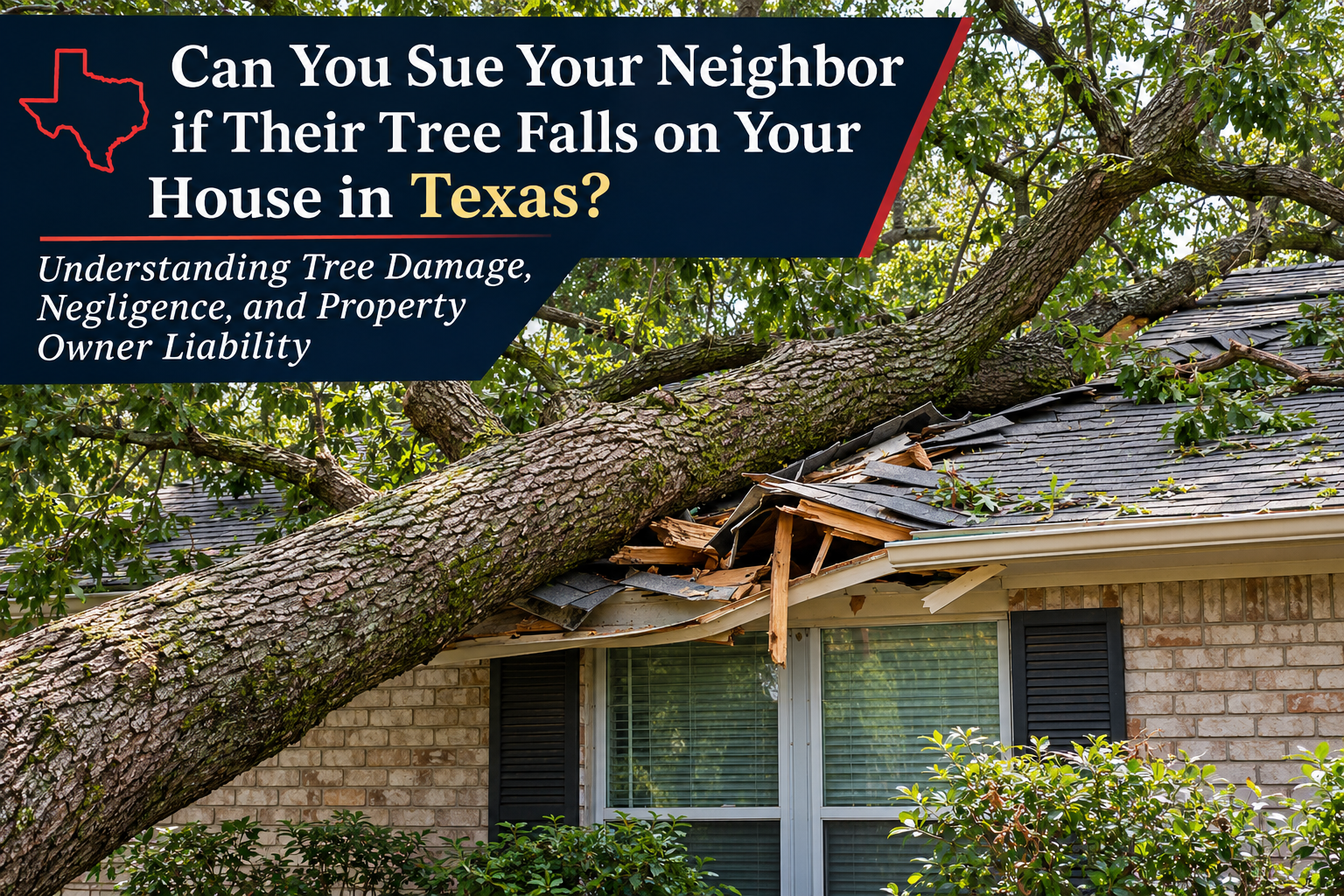
Texas is no stranger to hurricanes, thunderstorms, tornadoes, and severe weather. In heavily wooded communities such as Kingwood, Atascocita, Humble, and The Woodlands, mature trees can significantly enhance property values while also presenting substantial risks to neighboring properties.
But what happens when your neighbor's tree falls onto your house, destroys your fence, damages your vehicle, or causes thousands of dollars in other property damage?
Can you require your neighbor to pay simply because the tree belonged to them?
Under Texas law, the answer generally depends on whether the tree owner was negligent, whether the danger was reasonably foreseeable, and whether reasonable precautions could have prevented the damage.
Ownership of a tree does not automatically establish liability for the damage it causes.
Does Texas Have a Specific Law Governing Falling Trees?
Unlike certain other property disputes, Texas does not have a comprehensive state statute specifically governing liability for falling trees and encroaching tree branches.
Instead, these disputes are generally governed by common-law principles, including:
- Negligence;
- Proximate causation;
- Trespass;
- Private nuisance;
- Reasonable property maintenance;
- The act-of-God doctrine; and
- A property owner's limited right of self-help.
Local ordinances, restrictive covenants, homeowners' association rules, and insurance policies may also affect the rights and obligations of neighboring property owners.
This means that two seemingly identical incidents involving falling trees can produce substantially different legal outcomes.
Who Is Responsible When a Healthy Tree Falls During a Storm?
Suppose your neighbor owns a large, apparently healthy oak tree. During a hurricane, exceptionally strong winds uproot the tree, causing it to fall directly onto your home.
Your neighbor may not be legally responsible for the resulting damage.
Texas law generally does not impose strict liability upon property owners merely because naturally occurring conditions on their property cause damage elsewhere.
If a reasonably maintained tree falls solely because of extraordinary natural forces, the incident may qualify as an act of God.
In that situation, the damaged property's owner will frequently need to pursue recovery through their own homeowners' insurance policy, subject to applicable exclusions, deductibles, and coverage limitations.
The fact that the tree originated on someone else's property does not necessarily change this result.
What If Your Neighbor's Tree Was Already Dead or Diseased?
The legal analysis changes considerably when a property owner fails to address a reasonably foreseeable danger.
Consider a different situation.
Your neighbor has a large pine tree that has been visibly dead for approximately two years. Its bark is deteriorating, branches regularly fall onto your property, and the tree leans toward your house.
You repeatedly notify your neighbor of the problem, but the neighbor refuses to have the tree inspected or removed.
Eventually, during an ordinary thunderstorm, the tree falls onto your roof.
Under these circumstances, you may have a viable negligence claim against your neighbor.
To establish negligence under Texas law, a plaintiff generally must demonstrate:
- The defendant owed the plaintiff a legal duty;
- The defendant breached that duty;
- The breach proximately caused the plaintiff's injury; and
- The plaintiff sustained legally recoverable damages.
A property owner's failure to address a known or reasonably discoverable hazardous tree may, depending on the circumstances, satisfy these requirements.
The central question is not simply who owned the tree. It is whether the property owner acted reasonably under the circumstances.
Can Your Neighbor Blame the Storm to Avoid Liability?
Not necessarily.
Texas courts recognize that natural disasters do not automatically excuse independent acts of negligence.
In Luther Transfer & Storage, Inc. v. Walton, 296 S.W.2d 750 (Tex. 1957), the Texas Supreme Court addressed the relationship between natural forces and negligence in determining liability.
Similarly, in Gannett Outdoor Co. of Texas v. Kubeczka, 710 S.W.2d 79 (Tex. App.—Houston [14th Dist.] 1986, no writ), a Houston appellate court considered damage caused by a billboard during Hurricane Alicia.
The court concluded that inadequate precautions could contribute to liability notwithstanding the extraordinary weather conditions.
Although that case involved a billboard rather than a tree, the underlying legal principle is relevant to hazardous property conditions.
A storm may be the immediate event that causes a tree to fall, but the property owner's negligence may still be a proximate cause of the resulting damage.
A hurricane does not necessarily absolve a property owner of responsibility for a dangerous condition that existed long before the hurricane arrived.
Does Your Neighbor Have to Know That the Tree Is Dangerous?
Actual knowledge can be powerful evidence in a property damage lawsuit. However, the absence of actual knowledge does not necessarily defeat a negligence claim.
Depending on the circumstances, a property owner's knowledge may be characterized as either actual or constructive.
Actual Knowledge
Actual knowledge exists when the property owner is genuinely aware of the hazardous condition.
Examples may include:
- Receiving a written warning from a neighbor;
- Receiving an arborist's report identifying structural instability;
- Observing substantial deterioration;
- Receiving a notice from a governmental authority; or
- Receiving prior complaints concerning falling limbs.
Constructive Knowledge
Constructive knowledge concerns conditions that a person reasonably should have discovered under the circumstances.
For example, a tree with extensive visible decay, exposed and damaged roots, or a significant structural defect may present evidence that its dangerous condition was reasonably discoverable.
However, Texas law does not necessarily require every residential property owner to obtain professional inspections of every tree on their property.
The existence of a duty and the reasonableness of the owner's conduct remain fact-specific questions.
Can You Legally Cut Your Neighbor's Tree Branches in Texas?
Generally, Texas recognizes a limited common-law right of self-help concerning vegetation that extends across property boundaries.
If your neighbor's tree branches extend over your property, you may generally trim the encroaching portions from your own property, subject to important limitations.
You should not assume that this right allows you to:
- Enter your neighbor's property without permission;
- Cut branches beyond your property boundary;
- Remove the entire tree;
- Destroy the tree's root system; or
- Perform work that unreasonably damages or destabilizes the tree.
Improper trimming can expose you to liability for damaging your neighbor's property.
For example, cutting several major structural roots of a mature oak tree could destabilize the tree and cause it to fall during subsequent weather events.
In that situation, the person who performed the improper cutting could potentially bear responsibility for the resulting damage.
Local tree preservation ordinances and applicable restrictive covenants should also be considered before undertaking significant tree removal or trimming.
What Happens if Your Neighbor's Tree Roots Damage Your Foundation?
Falling trees are not the only source of vegetation-related property disputes.
Tree roots may allegedly contribute to damage involving residential foundations, underground plumbing, driveways, sidewalks, retaining walls, or other improvements.
These disputes can be particularly complicated because establishing the source of the damage often requires expert testimony.
For example, foundation movement in the Houston area may result from several interacting conditions, including expansive clay soils, drainage problems, drought, plumbing leaks, and vegetation.
The mere presence of a large tree near a damaged foundation does not establish that the tree caused the damage.
Depending on the facts, a property owner may need to retain a structural engineer, arborist, or another qualified expert to establish causation.
Claims involving encroaching roots may implicate negligence, nuisance, or other property law doctrines, although the existence of encroaching roots alone does not necessarily establish an actionable legal wrong.
Can You Force Your Neighbor to Remove a Dangerous Tree Before It Falls?
Potentially.
A property owner does not necessarily have to wait until substantial damage occurs before seeking legal assistance.
Where a neighboring tree presents a sufficiently serious and imminent danger, the affected property owner may consider seeking injunctive relief.
Texas Civil Practice and Remedies Code Chapter 65 governs various aspects of injunction proceedings.
Obtaining an injunction generally requires more than establishing that a tree is unattractive, inconvenient, or potentially dangerous at some indefinite point in the future.
A party seeking temporary injunctive relief ordinarily must establish a viable underlying cause of action, a probable right to relief, and a probable, imminent, and irreparable injury before trial.
Evidence supporting such a request might include a professional arborist's assessment, photographs of structural deterioration, records of previous limb failures, and documentation of unsuccessful attempts to resolve the matter.
In some circumstances, a local governmental authority may also possess the authority to address hazardous trees under applicable ordinances.
As a practical matter, a written demand supported by professional evidence may resolve the dispute without litigation.
What Damages Can You Recover if Your Neighbor Was Negligent?
When negligence is established, the injured property owner may be entitled to recover damages recognized under Texas law.
Depending on the circumstances and applicable measure of damages, recoverable losses may include:
- Reasonable and necessary roof repairs;
- Structural repairs;
- Fence replacement or repair;
- Damage to vehicles and personal property;
- Reasonable tree removal expenses;
- Damage to landscaping;
- Loss of use of property;
- Temporary housing expenses; and
- Diminution in property value, where legally appropriate.
Texas law generally prohibits duplicative recovery for the same injury.
For example, a plaintiff ordinarily cannot recover both the full cost of restoring property and a permanent reduction in property value representing the same damage.
Additionally, attorney's fees are generally not recoverable for an ordinary negligence claim unless an independent statutory or contractual basis authorizes their recovery.
This distinction can significantly affect whether pursuing a lawsuit is economically sensible.
What If You Were Partially Responsible for the Damage?
Texas follows a modified proportionate responsibility system.
Texas Civil Practice and Remedies Code § 33.001 provides:
A claimant may not recover damages if his percentage of responsibility is greater than 50 percent.
Under § 33.012, a claimant's recovery is generally reduced by the claimant's percentage of responsibility.
Suppose your neighbor negligently maintained a dangerous tree, but you also performed improper root cutting that contributed to its eventual collapse.
If a court determines that you were 30% responsible for $40,000 in property damage, your recovery could be reduced to $28,000, assuming no other applicable reductions.
If you were found more than 50% responsible, Chapter 33 could prevent you from recovering damages altogether.
This is another reason why attempting to resolve hazardous tree conditions through aggressive self-help can create substantial legal risks.
Does Homeowners' Insurance Cover Damage Caused by a Neighbor's Tree?
Homeowners' insurance frequently provides coverage for certain types of falling-tree damage, although the precise coverage depends on the policy.
Importantly, insurance coverage and legal liability are separate questions.
Your insurance company may cover damage to your house even when your neighbor was not negligent.
Alternatively, your insurance company may pay a covered claim and subsequently pursue reimbursement from a negligent neighbor or the neighbor's insurer through a process known as subrogation.
You should carefully review:
- Your applicable windstorm or hurricane deductible;
- Coverage for other structures, including fences;
- Debris removal limitations;
- Additional living expense coverage;
- Policy exclusions; and
- Notice and claim submission requirements.
Before independently settling a claim with your neighbor, consider whether doing so could interfere with your insurer's contractual subrogation rights.
How Long Do You Have to Sue for Tree Damage in Texas?
Property damage claims based on negligence are generally subject to a two-year statute of limitations.
Texas Civil Practice and Remedies Code § 16.003(a) establishes a two-year limitations period for various claims, including injury to another person's property.
The statute requires qualifying claims to be brought:
not later than two years after the day the cause of action accrues.
The applicable accrual date may become more complicated when the damage develops gradually, such as in disputes involving tree roots or recurring property damage.
Insurance policies may also impose separate deadlines for reporting claims or pursuing contractual remedies.
Sending a demand letter, negotiating with your neighbor, or communicating with an insurance company does not ordinarily suspend the applicable statute of limitations.
Property owners should therefore avoid allowing prolonged negotiations to jeopardize their legal rights.
What Should You Do if Your Neighbor Has a Dangerous Tree?
If you believe a neighboring tree threatens your property, taking reasonable steps before an accident occurs may substantially improve both your safety and your legal position.
Consider the following:
1. Document the condition. Take dated photographs of visible deterioration, damaged limbs, leaning trunks, or other potential hazards.
2. Notify your neighbor in writing. Explain your concerns in a factual and nonconfrontational manner.
3. Obtain a professional assessment. A qualified arborist may identify hazards that are not apparent to an ordinary property owner.
4. Preserve your communications. Retain copies of correspondence, professional reports, and any responses.
5. Review applicable restrictions. Determine whether municipal ordinances or homeowners' association restrictions govern tree maintenance.
6. Avoid unauthorized removal. Do not enter neighboring property or undertake work that could damage or destabilize the tree.
7. Consult an attorney when necessary. Particularly serious hazards may warrant a formal demand or consideration of injunctive relief.
A well-documented effort to resolve the problem peacefully may also become important evidence if litigation eventually becomes necessary.
Frequently Asked Questions About Tree Damage Under Texas Law
If my neighbor's tree falls on my fence, who pays?
The answer depends on whether the neighbor was negligent, the circumstances causing the tree to fall, and applicable insurance coverage. Ownership of the tree alone does not establish responsibility.
Can I make my neighbor pay my insurance deductible?
Potentially. If your neighbor is legally responsible for the damage, your deductible may represent part of your unreimbursed loss, subject to applicable insurance and subrogation considerations.
Can I throw fallen branches back into my neighbor's yard?
You should avoid depositing debris on neighboring property without permission. Doing so could create an additional property dispute or potentially expose you to liability.
Is my HOA responsible for a tree that falls on my house?
Possibly. If the association owned or controlled the tree, responsibility may depend on its maintenance obligations, knowledge of the hazardous condition, governing documents, and applicable negligence principles.
Can I sue my neighbor if their tree damages my car?
Yes, if an appropriate legal basis for liability exists. However, comprehensive automobile insurance may provide coverage regardless of whether the tree owner was negligent.
Does sending my neighbor a certified letter automatically make them liable?
No. Written notice may help establish knowledge of a potential hazard, but you must still establish the applicable elements of your legal claim.
Can I sue my neighbor in small claims court for tree damage?
Texas justice courts generally have jurisdiction over qualifying civil claims involving up to $20,000, subject to applicable jurisdictional rules. More substantial damages or requests for injunctive relief may require proceedings in another court.
Conclusion: Tree Ownership and Legal Responsibility Are Not the Same Thing
Texas property owners are not automatically insurers against every natural event that originates on their land.
A healthy tree that unexpectedly falls during a severe storm may create an unfortunate financial loss without creating an actionable negligence claim against the tree's owner.
However, ignoring a visibly dangerous tree, disregarding repeated warnings, or failing to take reasonable precautions against a foreseeable hazard can create substantial legal exposure.
As with many Texas property disputes, the outcome frequently depends less on the location of the property boundary and more on the evidence establishing what each party knew, what each party reasonably should have done, and what actually caused the damage.
Contact a Texas Real Estate and Civil Litigation Attorney
David C. Barsalou, Attorney at Law, PLLC, assists clients with real estate disputes, property damage claims, boundary disputes, negligence claims, and other civil litigation matters throughout the greater Houston area and Texas.
Whether you are dealing with an existing property damage claim or attempting to address a dangerous condition before substantial damage occurs, understanding your legal rights can help you avoid unnecessary financial losses and litigation.
Visit www.barsalou-law.comto learn more or schedule a consultation.
This article is provided for general informational purposes only and does not constitute legal advice or establish an attorney-client relationship.
At David C. Barsalou, Attorney at Law, PLLC, we help clients navigate business, family, tax, estate planning, and real estate matters ranging from document drafting to litigation with clarity and confidence. If you’d like guidance on your situation, schedule a consultation today. Call us at (713) 397-4678, email barsalou.law@gmail.com, or reach us through our Contact Page. We’re here to help you take the next step.