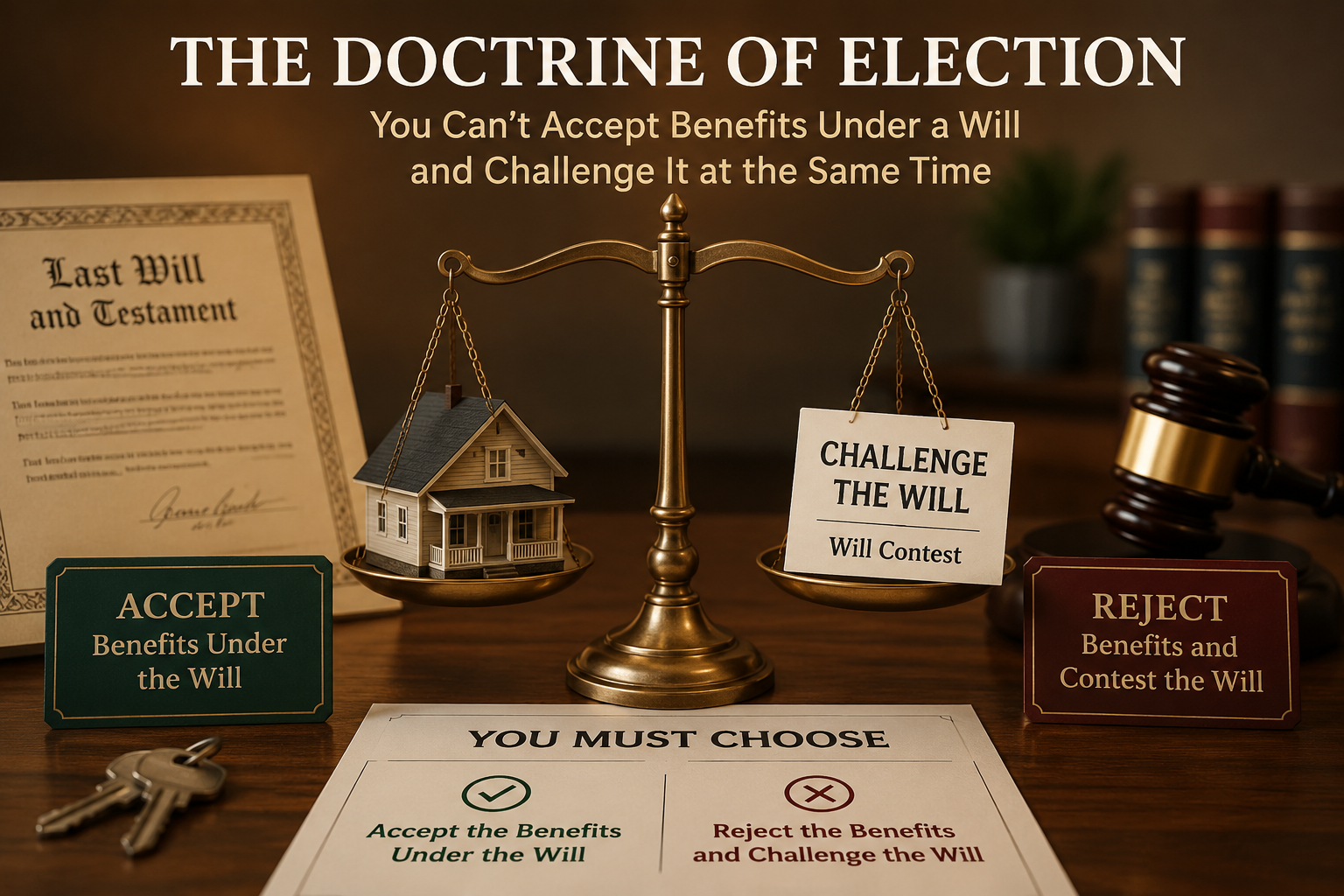
Most people assume that if they disagree with a will, they can simply challenge it in court while simultaneously accepting whatever property the will gives them.
Under Texas law, that assumption can be dangerously wrong.
A little-known doctrine known as the Doctrine of Electioncan force a beneficiary to make a choice: either accept the benefits granted under a will or reject those benefits and pursue a claim that is inconsistent with the will's provisions. In some situations, trying to do both can result in the loss of valuable inheritance rights.
For beneficiaries, executors, and family members involved in probate disputes, understanding this doctrine can be critical.
What Is the Doctrine of Election?
The doctrine of election is an equitable principle developed by Texas courts. The basic concept is simple:
A person generally cannot accept benefits under a legal instrument while simultaneously attacking the validity of that same instrument.
The Texas Supreme Court has described the doctrine as preventing a person from "accepting and rejecting the same instrument."
In probate cases, this issue commonly arises when a beneficiary receives property under a will but later seeks to challenge provisions of that same will.
A Common Example
Imagine a will leaves:
- A family home to Daughter;
- An investment account to Son; and
- The remainder of the estate to various grandchildren.
Suppose Daughter accepts title to the home, moves into it, and begins exercising ownership rights.
Months later, Daughter files a lawsuit claiming that the will is invalid because of undue influence.
The executor may argue that Daughter has already accepted substantial benefits under the will and should not be allowed to simultaneously attack it.
The court will then examine whether the doctrine of election applies.
Why Does Texas Law Recognize This Doctrine?
The doctrine exists to promote fairness.
Courts generally dislike situations where a person attempts to:
- Keep favorable portions of a legal document; and
- Reject unfavorable portions of that same document.
Without the doctrine, beneficiaries could effectively "have it both ways" by retaining inherited assets while litigating against the very document that granted them those assets.
The Doctrine Is Not Automatic
Many people incorrectly assume that accepting any inheritance automatically prevents a will contest.
That is not necessarily true.
Texas courts often analyze several factors, including:
- Whether the beneficiary knowingly accepted benefits;
- Whether the beneficiary understood the relevant facts;
- Whether the benefits were substantial;
- Whether returning the benefits is possible; and
- Whether the beneficiary's legal challenge is truly inconsistent with the will.
As a result, the doctrine is highly fact-specific.
The Executor's Role
An executor who becomes aware that a beneficiary has accepted benefits while pursuing claims inconsistent with the will should carefully document:
- Property distributions;
- Signed receipts;
- Estate accountings;
- Deeds and transfers; and
- Communications with beneficiaries.
These records may become important evidence if the doctrine of election becomes an issue during litigation.
Related Texas Law
Texas law recognizes the authority of courts to admit wills to probate and supervise estate administration. For example, Texas Estates Code § 256.001 provides:
"A will may be admitted to probate if the court is satisfied that the will should be admitted to probate."
Tex. Est. Code § 256.001.
Likewise, Texas Estates Code § 22.031 defines a "beneficiary" as:
"a person entitled to receive a benefit under a will, trust, insurance policy, retirement account, or other arrangement."
Tex. Est. Code § 22.031.
While the doctrine of election itself is primarily a court-created equitable doctrine rather than a statute, it regularly appears in Texas probate litigation involving wills, inheritances, and beneficiary disputes.
Practical Advice Before Accepting an Inheritance
If you believe a will may be invalid due to:
- Lack of testamentary capacity;
- Undue influence;
- Fraud;
- Forgery; or
- Improper execution,
you should be extremely careful before accepting distributions from the estate.
Taking possession of inherited property before consulting counsel can create legal arguments that may complicate a future will contest.
Similarly, executors should seek legal guidance before making distributions when they are aware of potential disputes among beneficiaries.
Final Thoughts
The Doctrine of Election is one of the stranger corners of Texas probate law. Most people have never heard of it until they find themselves in the middle of a family inheritance dispute.
Yet the doctrine can have enormous consequences. In the wrong circumstances, accepting inherited property today may limit your ability to challenge a will tomorrow.
If you are involved in a contested probate matter, careful planning before accepting or distributing estate assets can prevent costly mistakes and preserve important legal rights.
At David C. Barsalou, Attorney at Law, PLLC, we help clients navigate business, family, tax, estate planning, and real estate matters ranging from document drafting to litigation with clarity and confidence. If you’d like guidance on your situation, schedule a consultation today. Call us at (713) 397-4678, email barsalou.law@gmail.com, or reach us through our Contact Page. We’re here to help you take the next step.