Most Texans understand that failing to repay a loan can lead to collection calls, lawsuits, damaged credit, or even foreclosure. What many do not realize is that, under certain circumstances, a bank may be able to take money directly from a customer's checking or savings account to satisfy an unpaid debt owed to that same bank.
The bank may not need to sue the customer first. It may not need a judgment. And in some cases, it may not even need to provide advance notice before applying the customer's money toward the debt.
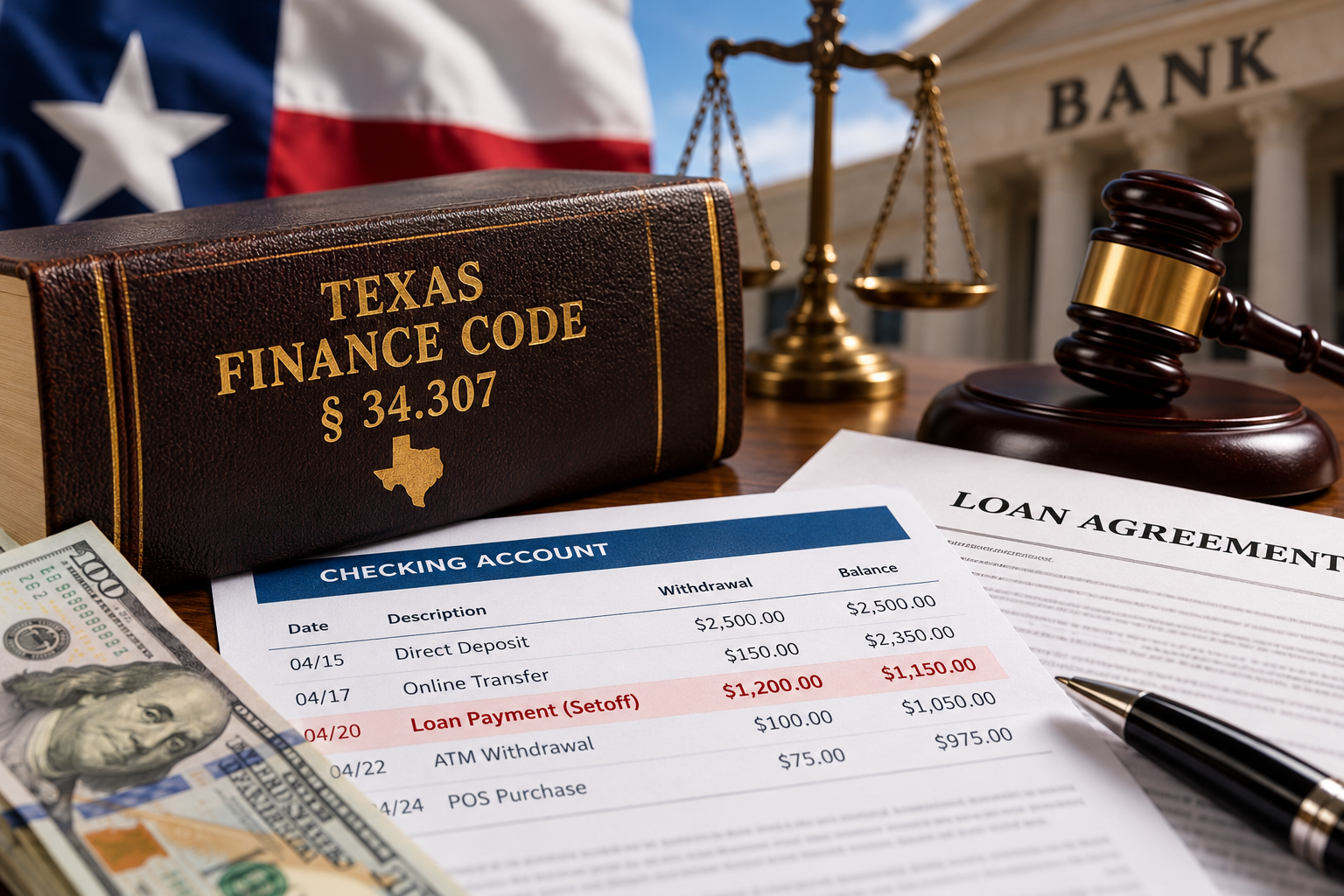
This legal mechanism is known as the right of setoff, and it is expressly recognized under Texas Finance Code § 34.307.
For Texas consumers and business owners, understanding this right can be especially important when financial difficulties arise.
What Is the Right of Setoff Under Texas Law?
The right of setoff allows a bank, under specified circumstances, to apply money it owes a depositor against money the depositor owes the bank.
When a customer deposits money into an ordinary checking account, the bank generally becomes obligated to repay that money according to the account agreement. If the customer also owes the bank money under a loan or other qualifying credit obligation, the bank may have competing financial obligations with the same customer.
Setoff allows those obligations to be offset against one another.
For example, suppose a Texas resident has:
- $8,000 in a checking account at a particular bank;
- An outstanding personal loan from that same bank;
- A required loan payment that is overdue after the applicable grace period.
Under qualifying circumstances, the bank may be permitted to apply some of the checking account balance toward the defaulted obligation.
The customer may discover the transaction only after reviewing the account balance.
However, the bank's authority is not unlimited.
Texas Finance Code § 34.307: What Does the Statute Actually Say?
Texas Finance Code § 34.307(a) recognizes a bank's right of setoff, subject to applicable federal law and statutory conditions.
The statute provides, in relevant part:
"Except as otherwise provided by the Truth in Lending Act (15 U.S.C. Section 1601 et seq.) or other federal law, a bank has a right of set-off, without further agreement or action"
The statutory right applies to qualifying accounts when the bank has previously disclosed the right to the depositor.
The provision further permits a bank, following a qualifying default, to apply account funds toward the obligation without obtaining the depositor's additional consent or providing advance notice.
This distinction is important.
A bank exercising a valid statutory right of setoff is not necessarily engaging in unlawful debt collection merely because the customer did not authorize the particular withdrawal.
The authority comes from the applicable law and banking relationship, rather than from a new authorization signed at the moment of collection.
Nevertheless, the bank must satisfy the applicable legal requirements.
Does the Bank Need to Sue You First?
Generally, no.
One of the most significant features of the statutory right of setoff is that it can operate independently of ordinary judgment collection procedures.
A creditor that does not hold the debtor's deposits ordinarily cannot simply instruct the debtor's bank to transfer money to satisfy an unpaid debt.
Such a creditor may need to pursue a lawsuit, obtain a judgment, and use legally authorized collection procedures, such as garnishment.
A bank holding its own customer's deposits occupies a different position.
If the bank has a valid right of setoff, it may be able to apply those deposits against the customer's qualifying debt without first obtaining a judgment.
This makes setoff fundamentally different from post-judgment garnishment.
It also explains why a customer who has never been sued may nevertheless discover that funds have been withdrawn from an account.
When Is a Borrower Considered in Default?
Texas Finance Code § 34.307(b) addresses the meaning of default.
Under that provision, a default occurs when the borrower fails to make a payment required by the credit obligation and an applicable contractual or legal grace period has expired.
The statute also recognizes that the entire loan need not necessarily be accelerated or mature before setoff becomes available against a defaulted payment.
This matters because consumers sometimes assume that a bank cannot exercise collection rights unless the entire outstanding loan balance has become immediately payable.
That assumption is not always correct.
A missed payment, followed by expiration of the applicable grace period, may create a qualifying default even though other installments are not yet due.
However, the amount the bank may properly apply depends on the underlying obligation, applicable agreements, and governing law.
The existence of one missed payment does not automatically establish that the bank may seize the entire outstanding balance of an installment loan.
Can a Bank Take Money From a Joint Checking Account?
Joint accounts create additional complications.
Suppose a married couple maintains a joint checking account, but only one spouse owes money under a separate loan.
Can the bank apply funds from the joint account toward that spouse's obligation?
The answer depends on the account structure, the applicable agreements, the legal capacities in which the funds are held, and other governing law.
Texas Finance Code § 34.307(c) limits the statutory right of setoff by requiring that the account be owed to the depositor in the same capacity as the defaulted credit obligation.
A bank cannot simply disregard the legal ownership and capacity requirements associated with an account.
However, the existence of multiple account holders does not, by itself, establish that the account is immune from setoff.
Joint account agreements may contain important provisions concerning ownership, liability, and setoff rights.
Consumers should therefore review the actual account documents rather than assume that adding another person's name automatically protects deposited funds.
Are Trust Accounts Protected From Bank Setoff?
Trust accounts present another important distinction.
Texas Finance Code § 34.307(c) specifically addresses accounts held by a depositor acting as trustee.
The statute generally restricts setoff against qualifying trust accounts, subject to an exception involving certain trust relationships evidenced solely by account documentation.
This protection reflects a basic legal distinction: money held by a person in a fiduciary capacity is not necessarily money that person owns individually.
For example, a trustee administering money for beneficiaries may have personal debts entirely unrelated to the trust.
The bank cannot automatically treat trust property as the trustee's personal property merely because the trustee is authorized to manage the account.
The precise account structure and applicable trust law remain important.
Business owners, executors, trustees, and other fiduciaries should be especially careful to maintain proper separation between personal and fiduciary funds.
Can a Bank Take Money to Pay a Credit Card Debt?
Credit card debts require particular caution.
Although Texas law recognizes setoff rights, federal consumer-credit protections may restrict their use.
The federal Truth in Lending Act and Regulation Z generally prohibit a card issuer from offsetting a consumer's credit card indebtedness against funds held on deposit with the issuer, subject to specified exceptions.
See 15 U.S.C. § 1666h and 12 C.F.R. § 1026.12(d).
Consequently, the existence of a checking account and credit card with the same financial institution does not necessarily mean that the institution may take checking account funds to satisfy a delinquent credit card balance.
This is an important exception to the broader discussion of bank setoff rights.
Consumers should distinguish between personal loans, overdraft obligations, credit card accounts, and other forms of indebtedness.
Different legal rules may apply.
What If the Money in the Account Comes From Social Security Benefits?
The source of deposited money can also matter.
Federal law provides significant protections for certain government benefits, including Social Security payments.
For example, 42 U.S.C. § 407 generally protects Social Security benefits from execution, levy, attachment, garnishment, and other legal processes, subject to statutory exceptions.
Federal regulations also establish special protections for covered federal benefits when financial institutions receive certain garnishment orders.
However, protection from garnishment is not identical to protection from every possible contractual deduction, setoff, or recovery of an obligation owed directly to the financial institution.
Whether a particular withdrawal is prohibited requires examination of the type of benefit, the legal basis for the withdrawal, applicable federal law, and the account agreement.
Consumers should not assume either that every government benefit is completely untouchable or that a bank can freely take such benefits whenever a debt exists.
What Happens If the Bank Takes More Money Than It Is Entitled to Take?
A bank's right of setoff does not eliminate its obligation to comply with the law.
Potential disputes may arise when a bank:
- Applies funds to an obligation that is not actually in default;
- Takes more than the amount legally subject to setoff;
- Withdraws money from an account held in a legally different capacity;
- Exercises setoff contrary to applicable federal restrictions;
- Relies on account terms that do not authorize the disputed conduct; or
- Makes an accounting error concerning the amount owed.
Depending on the facts, the customer may have grounds to dispute the transaction, demand restoration of funds, or pursue a civil claim.
Possible legal theories may include breach of contract or other claims supported by the particular facts and governing law.
The availability of damages, attorney's fees, or other relief must be evaluated separately. An improper setoff does not automatically entitle a customer to punitive damages or recovery of legal fees.
Can a Business Bank Account Be Used to Pay the Owner's Personal Debt?
Business accounts raise important questions about separate legal ownership.
A Texas limited liability company is generally a legal entity distinct from its members.
Consequently, money owned by an LLC is not ordinarily treated as the personal property of an individual member simply because that person controls the company.
For example, if an individual owns an LLC and separately owes money on a personal bank loan, the bank cannot necessarily apply funds owned by the LLC toward the individual's personal debt.
The bank must consider the identity of the debtor, ownership of the account, contractual obligations, and any applicable guarantees or security interests.
Conversely, where a business itself owes the bank money, or where additional contractual rights have been granted, the analysis may be different.
The key issue is not merely who controls the account, but who legally owns the funds and who owes the obligation.
This distinction is particularly important for small-business owners who maintain personal and business accounts at the same institution.
What Should You Do If Your Bank Takes Money Without Warning?
If a bank has unexpectedly withdrawn funds to satisfy a debt, the first step is to determine the legal basis for the transaction.
A consumer or business owner should ordinarily:
- Request a written explanation. Ask the bank to identify the debt, the amount applied, and the authority for the withdrawal.
- Review the deposit agreement. Determine whether the bank disclosed a right of setoff and whether additional contractual provisions apply.
- Examine the loan documents. Confirm whether a default actually occurred and whether the bank calculated the outstanding obligation correctly.
- Identify the ownership and source of the funds. Joint accounts, fiduciary accounts, business accounts, and certain protected benefits may require different treatment.
- Preserve relevant evidence. Retain account statements, notices, correspondence, payment confirmations, and loan records.
- Seek legal advice when necessary. A lawyer can evaluate whether the bank complied with the applicable statutory and contractual requirements.
Time may be important, especially where the withdrawal creates immediate problems involving payroll, housing expenses, business operations, or other obligations.
A prompt written dispute can also help establish a clear record of the customer's position.
Frequently Asked Questions About Bank Setoff in Texas
Can a bank legally take money from my checking account without asking me?
Yes, under qualifying circumstances. Texas Finance Code § 34.307 recognizes a statutory right of setoff when its requirements are satisfied, subject to applicable federal law.
Does a bank need a court judgment before exercising setoff?
Not necessarily. A valid right of setoff may be exercised without first obtaining a judgment.
Can a bank take money from my account for a loan owed to another bank?
The statutory right addressed in § 34.307 concerns obligations owed to the institution holding the relevant deposits. A separate creditor generally must rely on other legally available collection mechanisms.
Can my bank take my entire paycheck?
The answer depends on the ownership and character of the deposited funds, the amount of the qualifying debt, applicable federal protections, and the governing agreements. The mere fact that funds originated as wages does not answer every setoff question.
Can I sue a bank for an improper setoff?
Potentially. If a bank violates an applicable contractual or legal restriction, a civil claim may be available. The proper cause of action and remedies depend on the circumstances.
Conclusion: Your Bank May Have More Collection Rights Than You Realize
Texas law recognizes a meaningful distinction between an ordinary creditor seeking to collect a debt and a bank that both holds a customer's deposits and is owed money by that customer.
Under Texas Finance Code § 34.307, a qualifying bank may possess a right of setoff that allows it to apply deposited funds toward certain unpaid obligations without first filing a lawsuit or obtaining a judgment.
But that authority is subject to important limitations involving disclosure, default, account ownership, legal capacity, and federal law.
For consumers and business owners, the practical lesson is straightforward: the terms of a banking relationship can become especially important when a borrower experiences financial difficulty.
Understanding those terms before a dispute arises may prevent substantial financial disruption.
David C. Barsalou, Attorney at Law, PLLC, provides legal services involving Texas civil litigation, contracts, business disputes, and creditor-debtor matters. Individuals and businesses facing disputes involving bank accounts, unpaid obligations, or contractual collection rights may benefit from obtaining legal advice tailored to their circumstances.
This article is provided for general educational purposes and does not constitute legal advice. The application of Texas and federal banking laws depends on the particular facts, account agreements, and legal relationships involved.
At David C. Barsalou, Attorney at Law, PLLC, we help clients navigate business, family, tax, estate planning, and real estate matters ranging from document drafting to litigation with clarity and confidence. If you’d like guidance on your situation, schedule a consultation today. Call us at (713) 397-4678, email barsalou.law@gmail.com, or reach us through our Contact Page. We’re here to help you take the next step.