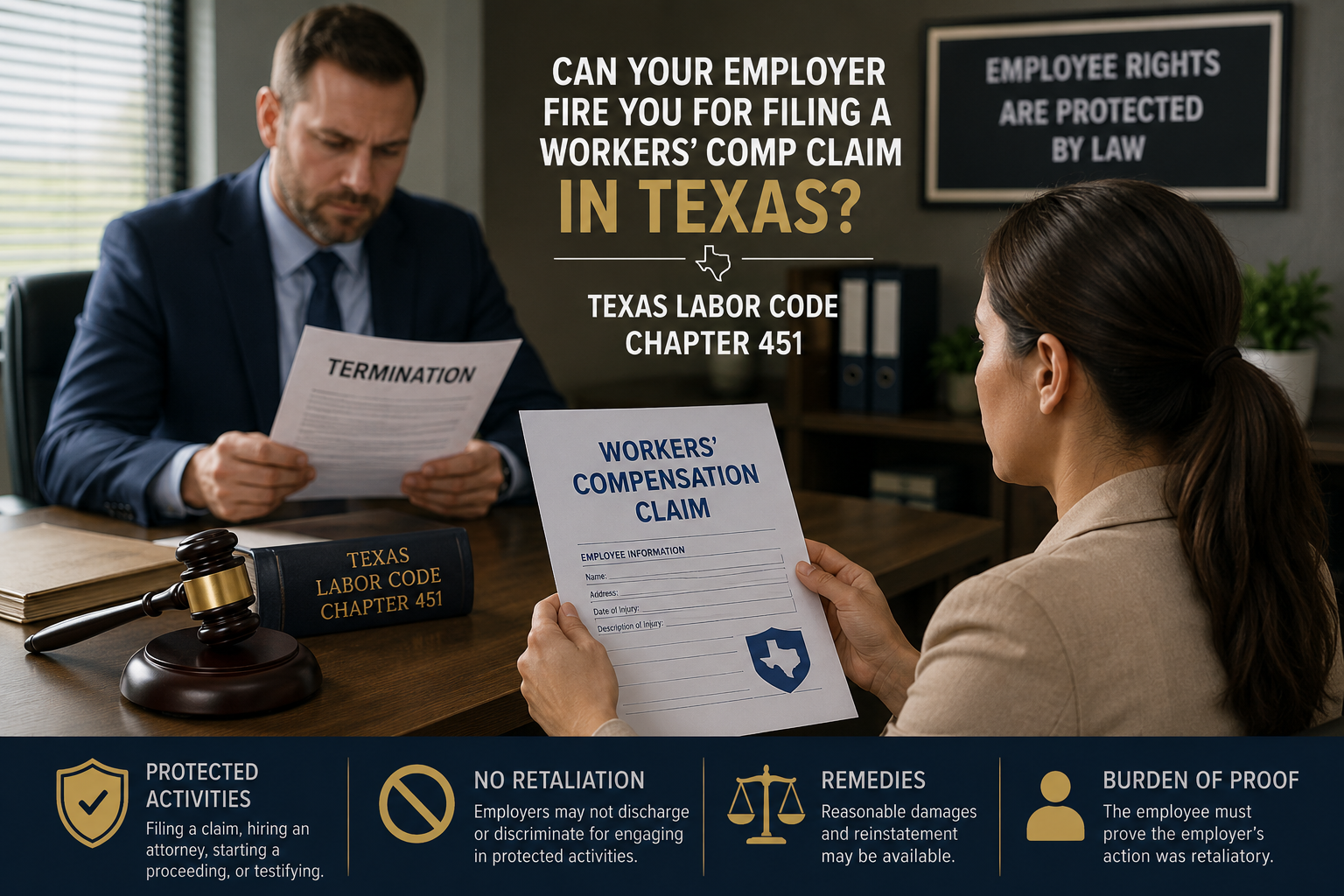
Texas is generally an employment-at-will state. In many circumstances, an employer may terminate an employee for a good reason, a bad reason, or no particular reason at all, provided the termination does not violate a contract or applicable law.
But employment at will has important statutory exceptions.
One of those exceptions protects employees who exercise certain rights involving workers’ compensation. An employer generally cannot fire, demote, punish, or otherwise discriminate against an employee because the employee filed a workers’ compensation claim or participated in the workers’ compensation process.
That protection appears in Texas Labor Code Chapter 451, and a violation can result in a civil lawsuit against the employer.
What Does Texas Labor Code § 451.001 Prohibit?
Texas Labor Code § 451.001 provides:
“A person may not discharge or in any other manner discriminate against an employee because the employee has” engaged in certain protected workers’ compensation activities.
The statute then identifies four categories of protected conduct. An employer may not discriminate against an employee because the employee:
- filed a workers’ compensation claim in good faith;
- hired a lawyer to represent the employee in a claim;
- instituted or caused to be instituted in good faith a proceeding under the Texas Workers’ Compensation Act; or
- testified or is about to testify in such a proceeding.
The protection therefore extends beyond the simple act of filing a claim.
For example, an employer potentially creates a Chapter 451 problem if it fires an employee because the employee hired an attorney concerning a workers’ compensation claim.
Does This Mean an Employee With a Workers’ Compensation Claim Cannot Be Fired?
No.
This distinction is extremely important.
Texas Labor Code § 451.001 does not create permanent job protection for every employee who has filed a workers’ compensation claim.
Instead, it prohibits an employer from taking an adverse action because of the employee's protected conduct.
An employee who has filed a workers’ compensation claim may still potentially be terminated for a legitimate reason unrelated to that claim.
For example, an employer may have evidence that an employee committed theft, repeatedly violated workplace policies, failed to perform required work, or was included in a legitimate reduction in force.
The central issue in a Chapter 451 case is therefore usually not merely whether the employee was terminated.
It is why the employee was terminated.
What If the Employer Gives Another Reason for the Termination?
That is where these cases can become fact-intensive.
An employer is unlikely to write a termination letter stating:
“We are firing you because you filed a workers’ compensation claim.”
Instead, the employer may identify another justification for the termination.
The employee may contend that the stated justification is merely a pretext and that the workers’ compensation activity was the actual reason for the adverse employment action.
Evidence relevant to that dispute may include:
- the timing between the workers’ compensation claim and termination;
- statements by supervisors or managers;
- changes in the employer’s attitude toward the employee after the injury or claim;
- inconsistent explanations for the termination;
- disciplinary records;
- treatment of similarly situated employees;
- emails, text messages, and internal communications;
- deviations from ordinary company procedures; and
- evidence showing whether the employer’s stated reason actually existed before the workers’ compensation dispute.
No single fact necessarily decides the case. The evidence must be evaluated as a whole.
Timing Can Matter—but Timing Alone May Not Decide the Case
Suppose an employee suffers a workplace injury on Monday, reports it on Tuesday, files a workers’ compensation claim on Wednesday, and is fired on Friday.
That timing naturally raises questions.
But temporal proximity does not automatically prove unlawful retaliation.
Now consider a different situation. An employee has received documented warnings for serious attendance violations for six months. The employer has consistently terminated other employees after the same number of violations. The employee then files a workers’ compensation claim and subsequently commits the final violation triggering termination under the employer’s existing policy.
The existence of the workers’ compensation claim does not necessarily prevent the employer from applying a legitimate policy.
The details matter.
What Damages Are Available Under Chapter 451?
Texas Labor Code § 451.002 expressly provides a remedy.
The statute states:
“A person who violates Section 451.001 is liable for reasonable damages incurred by the employee as a result of the violation.”
The statute provides an additional remedy when the employee was discharged:
“An employee discharged in violation of Section 451.001 is entitled to reinstatement in the former position of employment.”
Accordingly, a Chapter 451 case can involve substantial consequences beyond the underlying workers’ compensation benefits themselves.
Section 451.002 also places the burden of proof on the employee.
Workers’ Compensation Benefits and Retaliation Damages Are Different Issues
It is important not to confuse the underlying workers’ compensation claim with a Chapter 451 retaliation claim.
A workers’ compensation claim generally concerns matters such as whether an injury is compensable and what benefits are available under the workers’ compensation system.
A Chapter 451 retaliation case concerns the employer’s conduct toward the employee because of the employee’s participation in that system.
Those are different legal questions.
An employee could therefore have disputes concerning both the underlying injury and the employer’s later conduct.
What If the Employer Does Not Have Workers’ Compensation Insurance?
Texas is unusual because most private employers are not universally required to subscribe to the workers’ compensation system.
The legal consequences of a workplace injury can therefore depend significantly on whether the employer is a workers’ compensation subscriber or nonsubscriber.
Chapter 451 should not be treated as a general wrongful-termination statute covering every workplace injury. Its statutory protections are tied specifically to the workers’ compensation activities identified by the Legislature.
Determining whether Chapter 451 applies can consequently require examining the employer’s coverage status and the precise conduct allegedly causing the retaliation.
Employers Should Be Careful About What Managers Say
Workers’ compensation retaliation cases demonstrate why casual workplace communications can become important evidence.
A manager who complains in an email that an employee's claim is “costing the company money,” for example, may create evidence that becomes significant if the employee is terminated shortly afterward.
The Texas Workforce Commission's employer guidance specifically cautions employers that Chapter 451 prohibits retaliation against employees involved in workers’ compensation claims and warns that negative remarks concerning a claim can create problems in subsequent litigation.
For employers, the practical lesson is straightforward: employment decisions involving an injured employee should be based on legitimate, documented reasons unrelated to protected workers’ compensation activity.
What Should an Employee Do If Retaliation Is Suspected?
An employee who believes retaliation has occurred should preserve relevant evidence.
That can include termination notices, disciplinary records, emails, text messages, performance evaluations, workers’ compensation documents, schedules, and communications with supervisors.
The chronology can be particularly important. Memories fade, employees leave companies, and electronic records can disappear.
Creating an accurate timeline of the injury, claim, communications, disciplinary actions, and termination may make it much easier to evaluate whether the evidence actually supports a retaliation claim.
What Should an Employer Do Before Terminating an Employee With a Pending Claim?
Employers should likewise examine the record carefully.
Before taking an adverse employment action involving an employee who recently engaged in protected workers’ compensation activity, an employer should be able to identify and document the legitimate reason for the decision.
That does not mean an employer must retain an employee indefinitely.
It means the employer should be prepared to demonstrate that the employment decision was based on legitimate considerations rather than the employee's exercise of rights protected by Texas Labor Code § 451.001.
Consistent application of workplace policies can be especially important.
Texas At-Will Employment Has Limits
Texas employers possess substantial flexibility under the employment-at-will doctrine, but “at will” does not mean “without legal limits.”
Texas Labor Code Chapter 451 creates one of those limits.
An employer generally cannot discharge or discriminate against an employee because the employee filed a workers’ compensation claim in good faith, hired an attorney concerning the claim, initiated a protected proceeding, or participated as a witness.
At the same time, filing a workers’ compensation claim does not immunize an employee from every legitimate employment decision.
As with many retaliation disputes, the central question is causation: Was the adverse employment action taken because of the protected activity, or for an independent and lawful reason?
That deceptively simple question can turn an ordinary workplace termination into significant civil litigation.
This article is for general informational purposes only and does not constitute legal advice. Employment and workers’ compensation disputes are highly fact-specific, and anyone dealing with a potential claim should consult qualified counsel regarding the particular circumstances.
At David C. Barsalou, Attorney at Law, PLLC, we help clients navigate business, family, tax, estate planning, and real estate matters ranging from document drafting to litigation with clarity and confidence. If you’d like guidance on your situation, schedule a consultation today. Call us at (713) 397-4678, email barsalou.law@gmail.com, or reach us through our Contact Page. We’re here to help you take the next step.