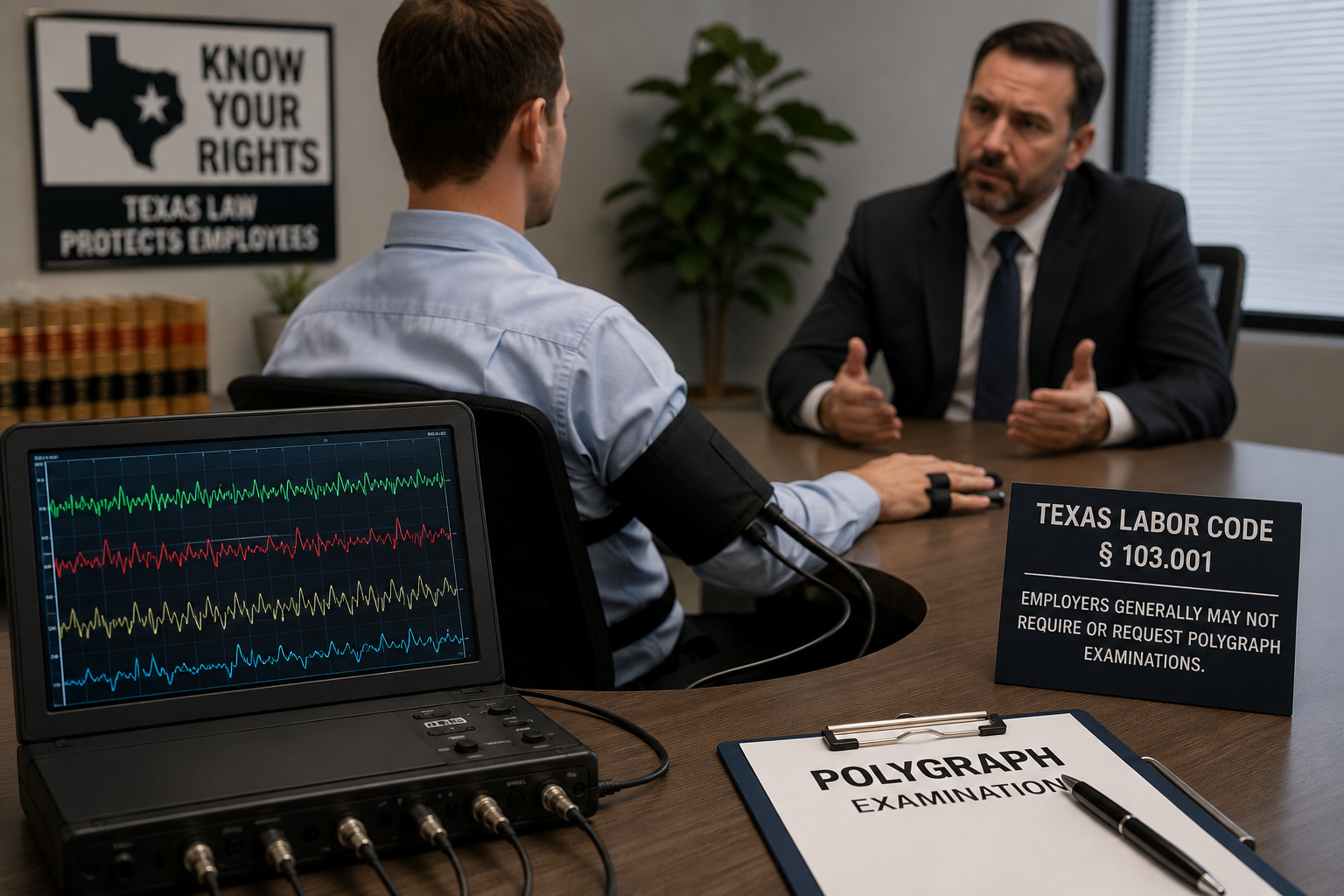
Imagine that money disappears from your workplace. Management gathers the employees and announces that everyone must submit to a lie detector test.
Many people assume an employer has the right to require this. In most situations, that assumption is incorrect.
Texas law contains an interesting—and often overlooked—protection for employees concerning polygraph examinations.
The General Rule
The Texas Labor Code provides:
"An employer may not require or request an employee or prospective employee to take or submit to a polygraph examination as a condition of employment or continued employment."
Texas Labor Code § 103.001
This is a surprisingly broad protection. An employer generally cannot make a lie detector test a condition of getting or keeping a job.
The law applies not only to current employees but also to many job applicants.
What Is a Polygraph?
A polygraph—commonly called a "lie detector test"—attempts to measure physiological responses such as:
- Heart rate
- Blood pressure
- Respiration
- Skin conductivity
Contrary to popular belief, a polygraph does notdirectly detect lies. Instead, it measures physical responses that may or may not correlate with deception.
Because of longstanding concerns about reliability, both federal and Texas law place significant restrictions on employers' use of these examinations.
Why Does Texas Restrict Polygraphs?
Several policy concerns explain the law:
- Polygraph results are not universally accepted as reliable.
- Innocent employees may fail because of stress or anxiety.
- Employees could feel pressured into waiving their rights to keep their jobs.
- Employers might rely on questionable test results instead of conducting a proper investigation.
The Texas Legislature chose to prevent many of these problems by limiting when employers can even request such examinations.
Are There Exceptions?
Yes.
Like many employment laws, there are exceptions. Certain employers or occupations may be governed by separate statutory provisions or federal law, particularly where public safety or law enforcement interests are involved.
Whether an exception applies depends on the specific employer, the employee's position, and the governing statutes.
What If an Employee Agrees?
Even if an employee is willing to take a polygraph, an employer should carefully consider whether requesting or requiring the examination complies with applicable law.
Employment laws often regulate not only coercion but also the circumstances under which an employer may request certain information from employees.
Federal Law Also Matters
Texas employers should also remember that the Employee Polygraph Protection Act (EPPA) imposes substantial restrictions on most private employers.
The federal statute contains limited exceptions but generally prohibits employers from requiring or requesting polygraph examinations in the workplace.
As a result, employers frequently need to comply with bothTexas law and federal law.
Practical Advice for Texas Employers
If workplace theft or misconduct occurs:
- Conduct a thorough internal investigation.
- Preserve documents and electronic evidence.
- Interview witnesses carefully.
- Consult experienced legal counsel before considering any action that could implicate employee rights.
Relying on a prohibited employment practice can create legal exposure that is entirely separate from the underlying misconduct being investigated.
Practical Advice for Employees
If your employer tells you that you must take a lie detector test to keep your job, do not assume the request is lawful.
The legality of the request depends on the circumstances, the type of employer involved, and any applicable statutory exceptions.
An employment attorney can evaluate whether your rights under Texas or federal law may have been violated.
Need Advice About a Texas Employment Issue?
Employment law often involves overlapping state and federal statutes. Whether you are an employee concerned about your rights or an employer trying to comply with Texas law, obtaining legal advice early can prevent costly mistakes.
David C. Barsalou, Attorney at Law, PLLC represents clients in a wide variety of Texas civil and business matters and can help evaluate employment-related legal issues when they intersect with contracts, litigation, or business operations.
