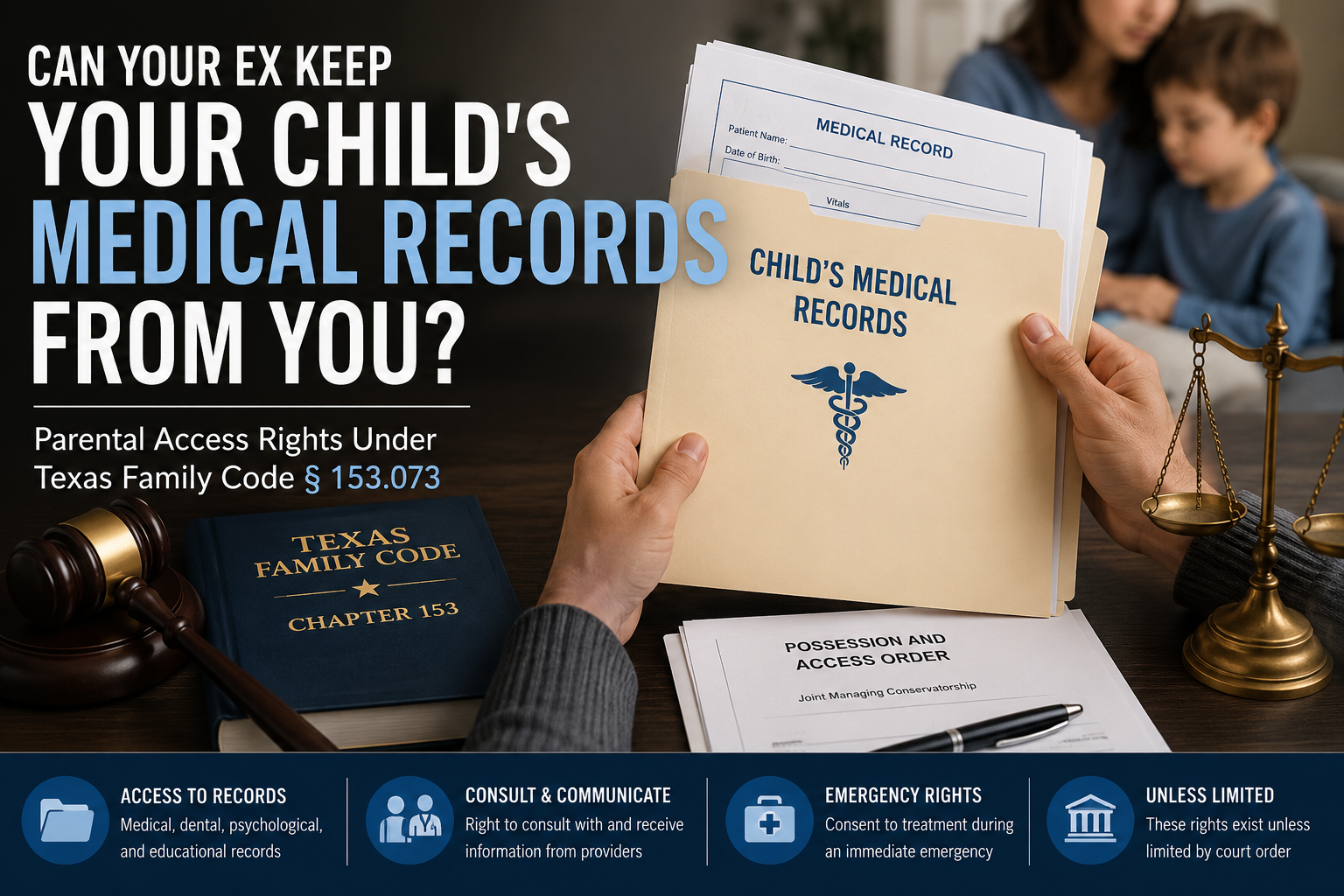
Divorce or separation can make even routine parenting decisions surprisingly complicated. One parent takes a child to the doctor, dentist, therapist, or specialist, and the other parent may not learn what happened until days or weeks later.
That raises an important question under Texas family law: Does a divorced parent have the right to obtain a child’s medical or psychological records directly, even if the other parent does not want to provide them?
In many cases, the answer is yes.
Texas law gives a parent who has been appointed a conservator several important rights concerning a child’s health, education, and welfare. Those rights generally exist regardless of which parent has possession of the child at a particular moment—unless the court has specifically limited them.
Texas Family Code § 153.073 Gives Conservators Important Rights at All Times
Texas Family Code § 153.073 is appropriately titled “Rights of Parent at All Times.”
The statute provides, in relevant part:
“Unless limited by court order, a parent appointed as a conservator of a child has at all times the right … of access to medical, dental, psychological, and educational records of the child.”
Tex. Fam. Code § 153.073(a)(3).
That is significant language.
The statute does not merely say that a parent can ask the other parent for information. It expressly gives a conservator access to the child’s records.
Section 153.073 also provides a conservator the right:
“to consult with a physician, dentist, or psychologist of the child.”
Tex. Fam. Code § 153.073(a)(4).
And the statute separately gives the parent the right:
“to receive information from any other conservator of the child concerning the health, education, and welfare of the child.”
Tex. Fam. Code § 153.073(a)(1).
Thus, Texas law contemplates several different ways in which a parent may remain informed about a child’s welfare.
You May Not Have to Depend on Your Ex for Information
This distinction can become extremely important after a difficult divorce or custody dispute.
Imagine that a child sees a physician. One parent attends the appointment but refuses to tell the other parent what the doctor said.
If both parents are conservators and the final order has not limited the second parent’s statutory rights, the second parent may have rights independent of the first parent. Section 153.073 expressly addresses access to records and consultation with the child’s medical, dental, and psychological providers.
In other words, the other parent is not necessarily the sole gatekeeper of information concerning the child.
This can matter when communication between parents has deteriorated.
The Court Order Still Matters
There is an extremely important qualification in § 153.073: the statute begins with the words “Unless limited by court order.”
A parent should therefore never assume that the general statutory rule overrides the particular terms of an existing custody order.
Texas Family Code § 153.072 expressly provides:
“The court may limit the rights and duties of a parent appointed as a conservator if the court makes a written finding that the limitation is in the best interest of the child.”
Accordingly, the actual divorce decree, custody order, or other order affecting the parent-child relationship should be reviewed carefully.
One family may have a relatively standard joint managing conservatorship arrangement. Another may have an order containing significant restrictions because of family violence, abuse, neglect, substance abuse, or other circumstances.
The precise language of the order matters.
Access to Information Is Different From the Right to Make Decisions
Parents should also distinguish between accessing information and making medical decisions.
Texas Family Code § 153.071 recognizes that when both parents are conservators, the court must specify which parental rights and duties may be exercised independently, which require joint agreement, and which belong exclusively to one parent.
A decree might therefore give both parents access to the child’s medical records while giving one parent the exclusive right to make certain medical decisions.
Those are not necessarily contradictory provisions.
A parent may have the legal right to know what is happening with the child without having the exclusive authority to decide what happens next.
This distinction is one reason parents should read the conservatorship provisions of their court orders carefully rather than relying only on labels such as “joint custody.”
What Rights Does a Parent Have During Their Period of Possession?
Texas law also creates certain rights and duties specifically during a parent’s period of possession.
Texas Family Code § 153.074 provides, unless limited by court order, that a conservator has during the period of possession:
“the right to consent for the child to medical and dental care not involving an invasive procedure.”
The parent also has duties relating to the child's care, control, protection, reasonable discipline, support, and ordinary medical and dental care during that period.
Again, however, the exact custody order matters. More significant medical decisions may be allocated differently in the order.
What About Medical Emergencies?
Texas law also recognizes the obvious reality that parents sometimes must act immediately.
Section 153.073 includes among a conservator’s rights at all times the right:
“to consent to medical, dental, and surgical treatment during an emergency involving an immediate danger to the health and safety of the child.”
Tex. Fam. Code § 153.073(a)(8).
That provision can be particularly important when a child is injured or suddenly becomes seriously ill while with one parent.
Family-law orders cannot anticipate every emergency. The statute provides a framework allowing a conservator to respond when immediate action is necessary to protect the child.
Can One Parent Refuse to Tell the Other Parent About the Child’s Health?
Section 153.073(a)(1) expressly gives a conservator the right to receive information from another conservator concerning the child’s health, education, and welfare, unless that right has been limited by court order.
That does not mean every minor parenting disagreement automatically becomes a contempt case. Nor does it mean parents must report every trivial event in real time.
But a parent should be cautious about deliberately withholding significant information concerning a child’s health or welfare when the other parent possesses rights under the custody order and Texas law.
The safest approach is usually to focus on the child rather than using information as leverage in an ongoing dispute between adults.
What Should a Parent Do If a Provider Refuses Access?
A medical office, therapist, dentist, school, or other institution may not know what rights a particular parent possesses under a Texas custody order.
If access becomes an issue, the first step is often to review the operative court order.
The parent may need to provide the provider with the relevant portions of the order showing that the parent is a conservator and identifying any limitations—or absence of limitations—on access to the child’s records.
If the order is ambiguous, unusually restrictive, or the parents disagree about its meaning, legal advice may be appropriate before escalating the dispute.
“Joint Managing Conservator” Does Not Mean Every Right Is Identical
Texas custody terminology sometimes creates confusion.
Being appointed joint managing conservators does not necessarily mean that both parents possess identical decision-making authority in every respect.
Section 153.071 specifically contemplates dividing parental rights into three categories:
- rights exercised independently by each parent;
- rights exercised by joint agreement; and
- rights exercised exclusively by one parent.
The actual order determines how many important decisions are allocated.
That is why two parents can both be joint managing conservators while one parent nevertheless possesses exclusive authority over a particular issue.
The Practical Lesson for Texas Parents
Parents involved in a divorce or custody case should understand the difference between possession of the child, access to information, and decision-making authority.
They are related concepts, but they are not the same thing.
A parent may not have possession of the child on a particular day and still retain statutory rights to medical, dental, psychological, and educational information.
Similarly, having access to a child’s medical records does not necessarily mean that the parent has exclusive authority to make major medical decisions.
The starting point is Texas Family Code Chapter 153. The next—and often more important—step is reading the actual court order governing that particular family.
Conclusion
Texas law generally attempts to keep parents who have been appointed conservators informed about their children.
Texas Family Code § 153.073 gives conservators important rights that ordinarily continue “at all times,” including access to a child’s medical, dental, psychological, and educational records and the ability to consult with certain healthcare providers.
But those statutory rights can be limited by court order, and decision-making authority may be allocated differently between the parents.
If a former spouse or co-parent is withholding important information about a child—or if a doctor, therapist, school, or other provider refuses to provide records—the first question should therefore be: What does the existing custody order actually say?
A careful review of the order and Texas Family Code Chapter 153 can often clarify whether a parent has the right to obtain the information directly.
This article is for general informational purposes only and does not constitute legal advice. Family-law rights depend on the facts of the case and the language of the applicable court order.
At David C. Barsalou, Attorney at Law, PLLC, we help clients navigate business, family, tax, estate planning, and real estate matters ranging from document drafting to litigation with clarity and confidence. If you’d like guidance on your situation, schedule a consultation today. Call us at (713) 397-4678, email barsalou.law@gmail.com, or reach us through our Contact Page. We’re here to help you take the next step.