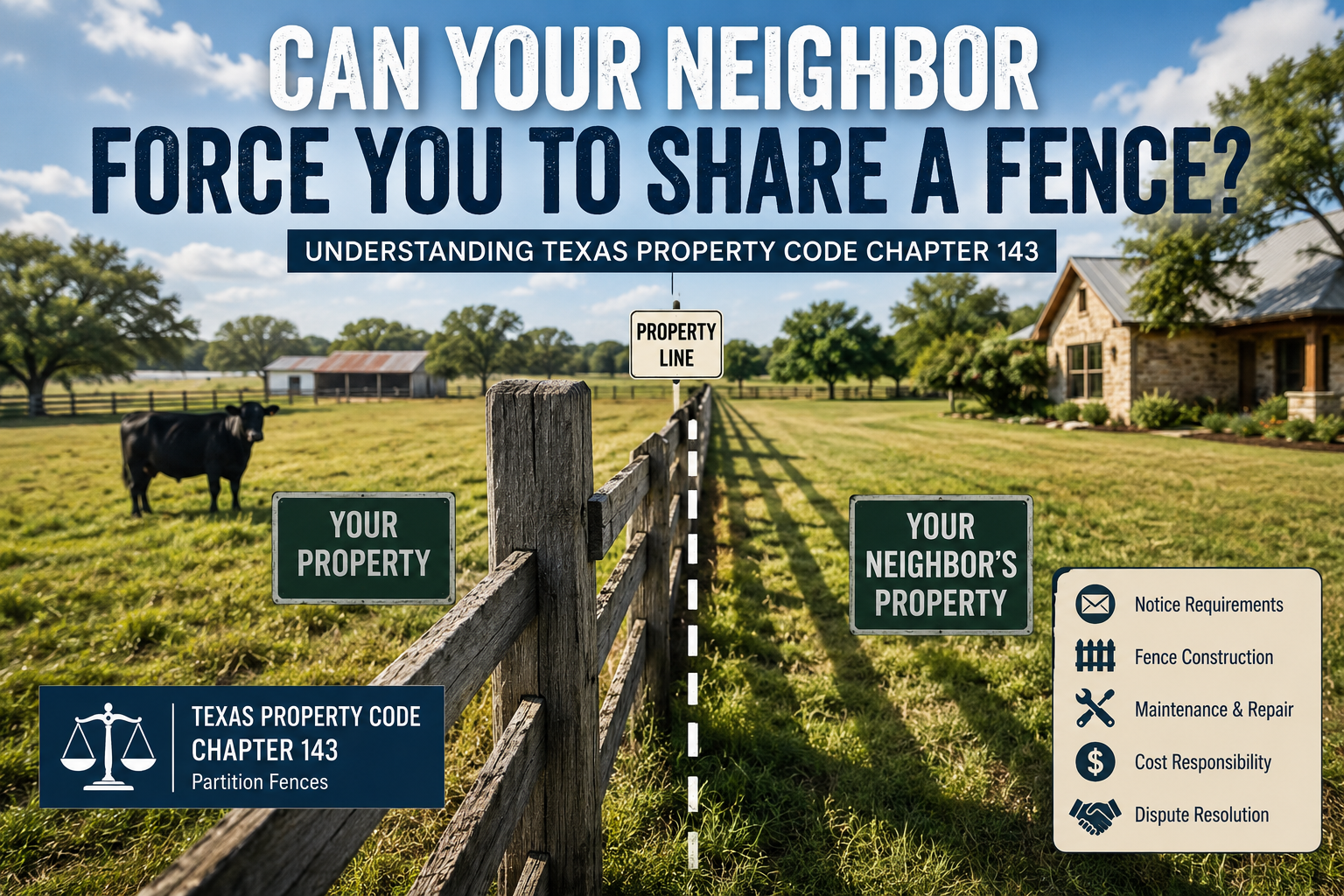
How Texas Law Handles Boundary Fences Between Neighboring Landowners
For many Texans, a fence marks more than a property line—it represents privacy, security, livestock control, and sometimes years of disagreement between neighbors. One of the most common misconceptions is that neighboring landowners must automatically split the cost of building or repairing a boundary fence.
In reality, Texas law generally does not require neighbors to share fence expenses simply because the fence sits on the property line. However, there is a little-known portion of the Texas Property Code that can dramatically change that rule in certain parts of Texas.
Texas Property Code Chapter 143 creates a statutory procedure allowing adjoining landowners in qualifying counties to compel participation in the construction or repair of partition fences.
Although Chapter 143 applies only in limited circumstances, it remains an important—and often overlooked—piece of Texas property law.
What Is a Partition Fence?
A partition fence is a fence located on or near the boundary between adjoining tracts of land.
Historically, these fences primarily existed to contain cattle and livestock, but today they frequently separate:
- Ranches
- Farms
- Acreage properties
- Rural residential homes
- Agricultural land
Disputes often arise when:
- one owner wants a new fence;
- an old fence has deteriorated;
- livestock repeatedly escape;
- one neighbor removes an existing fence; or
- one owner expects the other to pay half the cost.
Texas Does Not Automatically Require Cost Sharing
Many people assume that if a fence sits on the property line, each owner must pay fifty percent.
That assumption is usually incorrect.
Unlike some states, Texas generally follows the principle that a landowner is responsible for improvements placed on his or her own property unless another legal obligation exists.
Chapter 143 creates one of the few statutory exceptions.
What Does Texas Property Code Chapter 143 Say?
Section 143.001 provides that Chapter 143 applies only in certain counties meeting specific statutory population requirements.
The statute provides:
"This chapter applies only to a county having a population of more than 20,000 and less than 100,000."
Tex. Prop. Code § 143.001.
Because of this population limitation, Chapter 143 does notapply statewide.
Instead, applicability depends upon whether a county falls within the statutory requirements.
When Can a Neighbor Be Required to Participate?
Under Chapter 143, adjoining landowners may have legal obligations regarding a partition fence when the statutory requirements have been satisfied.
The chapter establishes procedures involving:
- construction;
- maintenance;
- repair;
- notice to neighboring owners; and
- allocation of responsibility.
The law does not simply allow one owner to build an expensive fence and send the neighbor a bill.
Instead, statutory procedures must be followed before financial responsibility may arise.
Why the Notice Requirements Matter
One of the most important concepts in Chapter 143 is notice.
Before attempting to recover costs, the landowner seeking contribution must generally comply with the procedures established by the statute.
Ignoring those procedures can eliminate an otherwise valid claim.
Like many Texas property statutes, procedural compliance often determines whether a party wins or loses.
Why This Law Exists
Modern suburban homeowners may find Chapter 143 unusual, but its origins make perfect sense.
Texas has long been an agricultural state where boundary fences protected:
- cattle;
- horses;
- sheep;
- crops; and
- neighboring property.
Without shared fencing responsibilities, one landowner could leave another bearing the entire burden of maintaining property boundaries that benefitted both parcels.
The Legislature addressed that concern through Chapter 143—but only for counties falling within its scope.
Common Misconceptions
Several myths regularly appear in neighbor fence disputes.
"The fence is on the property line, so we automatically split the cost."
Usually false.
Texas law generally does not impose automatic cost-sharing merely because a fence marks the boundary.
"My neighbor replaced the fence without asking, so I owe half."
Not necessarily.
Absent a contractual agreement or compliance with applicable statutory requirements, simply replacing a fence does not automatically create reimbursement rights.
"Every county follows Chapter 143."
Incorrect.
The chapter applies only to counties meeting the statutory population requirements.
Many Texas counties are not covered.
Practical Advice Before Building a Boundary Fence
Before investing thousands of dollars in a new fence, property owners should consider:
- obtaining a current survey;
- confirming the exact boundary line;
- discussing plans with the adjoining owner;
- documenting agreements in writing;
- determining whether Chapter 143 applies; and
- consulting an attorney if a dispute already exists.
A relatively inexpensive conversation before construction often prevents expensive litigation later.
When Fence Disputes Become Lawsuits
Fence disputes frequently evolve into much larger property disputes involving:
- boundary disagreements;
- trespass;
- adverse possession claims;
- encroachments;
- easements;
- livestock damage; and
- title issues.
Because several legal doctrines can overlap, what appears to be "just a fence dispute" may ultimately require litigation involving surveys, historical deeds, and expert testimony.
Conclusion
Texas Property Code Chapter 143 remains one of the more obscure statutes affecting rural property owners. While many Texans believe neighboring landowners must always split the cost of a boundary fence, Texas law generally says otherwise unless a legal agreement or applicable statute provides differently.
Understanding whether Chapter 143 applies—and following its procedural requirements—can make the difference between recovering fence costs and paying the entire bill yourself.
If you are involved in a property boundary or fence dispute, obtaining legal advice before construction or litigation begins may save substantial time, expense, and conflict.
At David C. Barsalou, Attorney at Law, PLLC, we help clients navigate business, family, tax, estate planning, and real estate matters ranging from document drafting to litigation with clarity and confidence. If you’d like guidance on your situation, schedule a consultation today. Call us at (713) 397-4678, email barsalou.law@gmail.com, or reach us through our Contact Page. We’re here to help you take the next step.
