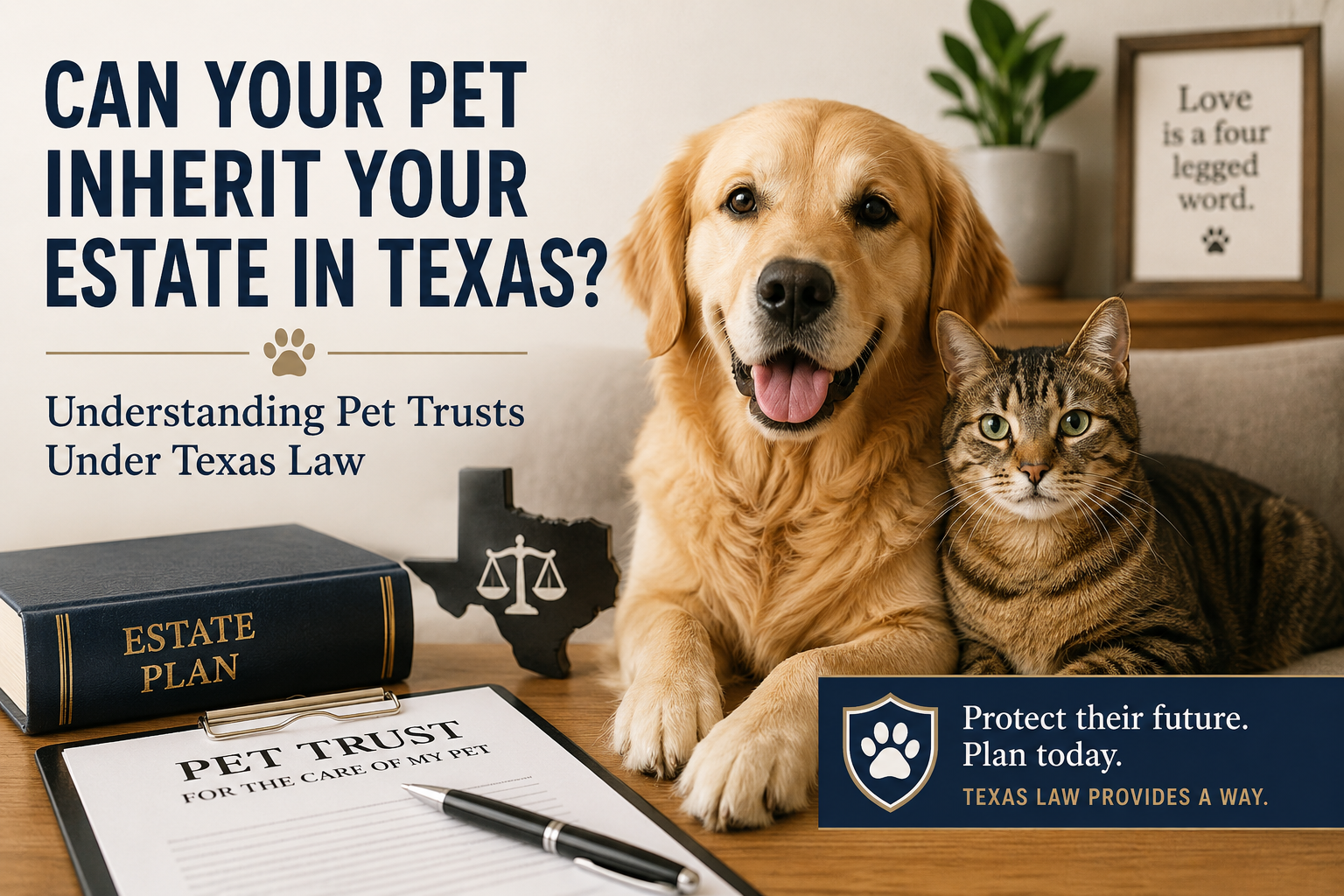
Many Texans consider their pets members of the family. It is therefore common to hear someone say, "I'm leaving everything to my dog," or "My cat will inherit my house."
While the sentiment is understandable, Texas law does not allow animals to directly inherit property. Fortunately, Texas law provides an elegant solution through a special type of trust designed specifically for the care of animals.
If you want to ensure that your beloved companion is cared for after your death or incapacity, a Texas pet trust may be one of the most effective estate planning tools available.
Can a Pet Legally Inherit Property?
No.
Under Texas law, only legal persons or entities can own property. Although animals receive legal protections against cruelty and neglect, they are not legal persons capable of taking title to property or serving as beneficiaries in the traditional sense.
That means language such as:
"I leave my house to my Labrador."
does not accomplish what most people intend.
Instead, Texas law allows you to leave money to a trustee, who then uses those funds for the benefit of the animal.
Texas Specifically Authorizes Pet Trusts
Texas expressly recognizes trusts created for the care of animals.
Texas Property Code § 112.037(a) provides:
"A trust may be created to provide for the care of an animal alive during the settlor's lifetime."
This statute allows a person creating the trust (the "settlor") to designate money or other assets that must be used to care for one or more animals that were alive while the owner was living.
Unlike an honorary promise, a properly drafted pet trust is legally enforceable.
How Does a Texas Pet Trust Work?
A typical pet trust includes several important components:
- Identification of the animal(s)
- Appointment of a trustee to manage the money
- Appointment of a caregiver (who may or may not be the trustee)
- Instructions regarding veterinary care
- Food and grooming standards
- Housing requirements
- End-of-life instructions
- What happens to any remaining funds after the animal dies
This provides much greater certainty than simply asking a friend or family member to "take care of the dog."
How Long Can a Pet Trust Last?
Texas law also answers this question.
Texas Property Code § 112.037(b) provides that the trust terminates upon the death of the animal or, if created for multiple animals, upon the death of the last surviving animal covered by the trust.
This is an important exception to many traditional trust duration rules because the trust exists solely to care for the designated animal or animals.
What Happens If Too Much Money Is Left?
One of the more interesting provisions of Texas law prevents owners from leaving grossly excessive amounts solely for animal care.
Texas Property Code § 112.037(c) authorizes a court to reduce trust property if it determines that the amount substantially exceeds what is required for the intended use.
Any excess property is distributed according to the terms of the trust or, if the trust does not specify, according to applicable law.
This prevents unusual situations where millions of dollars remain locked away unnecessarily while still protecting the owner's intent.
Who Can Enforce the Trust?
Unlike many traditional trusts, the beneficiary—the pet—cannot appear in court.
Texas addresses this issue by allowing enforcement by designated persons.
Under Texas Property Code § 112.037(d), a person appointed in the trust, or a person appointed by a court if necessary, may enforce the trust on behalf of the animal.
This ensures that someone has legal authority to make certain the trustee is actually using the funds as intended.
Why Not Simply Leave Money to the Caregiver?
Many people choose to leave money directly to a friend or relative with the expectation that they will care for the pet.
While this may work, it creates several risks:
- The caregiver has no legal obligation to spend the money on the animal.
- The caregiver could spend the funds for unrelated purposes.
- The caregiver could become unable or unwilling to care for the pet.
- Family members may dispute whether the gift was intended for the caregiver personally or for the animal's benefit.
A properly drafted pet trust largely eliminates these uncertainties.
Practical Considerations
Pet trusts are particularly useful for owners of:
- Dogs and cats with long life expectancies
- Horses
- Birds
- Exotic animals
- Animals requiring expensive medical care
- Multiple pets
The more specialized the animal's care, the more valuable detailed trust instructions become.
Final Thoughts
Most people never expect their pets to outlive them, but estate planning is designed for exactly those unexpected situations.
Texas has recognized that pets occupy an important place in many families. Rather than allowing uncertainty or relying on informal promises, Texas law provides a clear statutory mechanism for ensuring that animals continue to receive proper care after an owner's death.
If your pet is an important part of your family, discussing a pet trust with an experienced Texas estate planning attorney may provide both peace of mind and long-term protection for the companion who depends on you.
Disclaimer: This article is for informational purposes only and does not constitute legal advice. Every estate plan is unique. Consult a qualified Texas attorney regarding your specific circumstances.
At David C. Barsalou, Attorney at Law, PLLC, we help clients navigate business, family, tax, estate planning, and real estate matters ranging from document drafting to litigation with clarity and confidence. If you’d like guidance on your situation, schedule a consultation today. Call us at (713) 397-4678, email barsalou.law@gmail.com, or reach us through our Contact Page. We’re here to help you take the next step.
