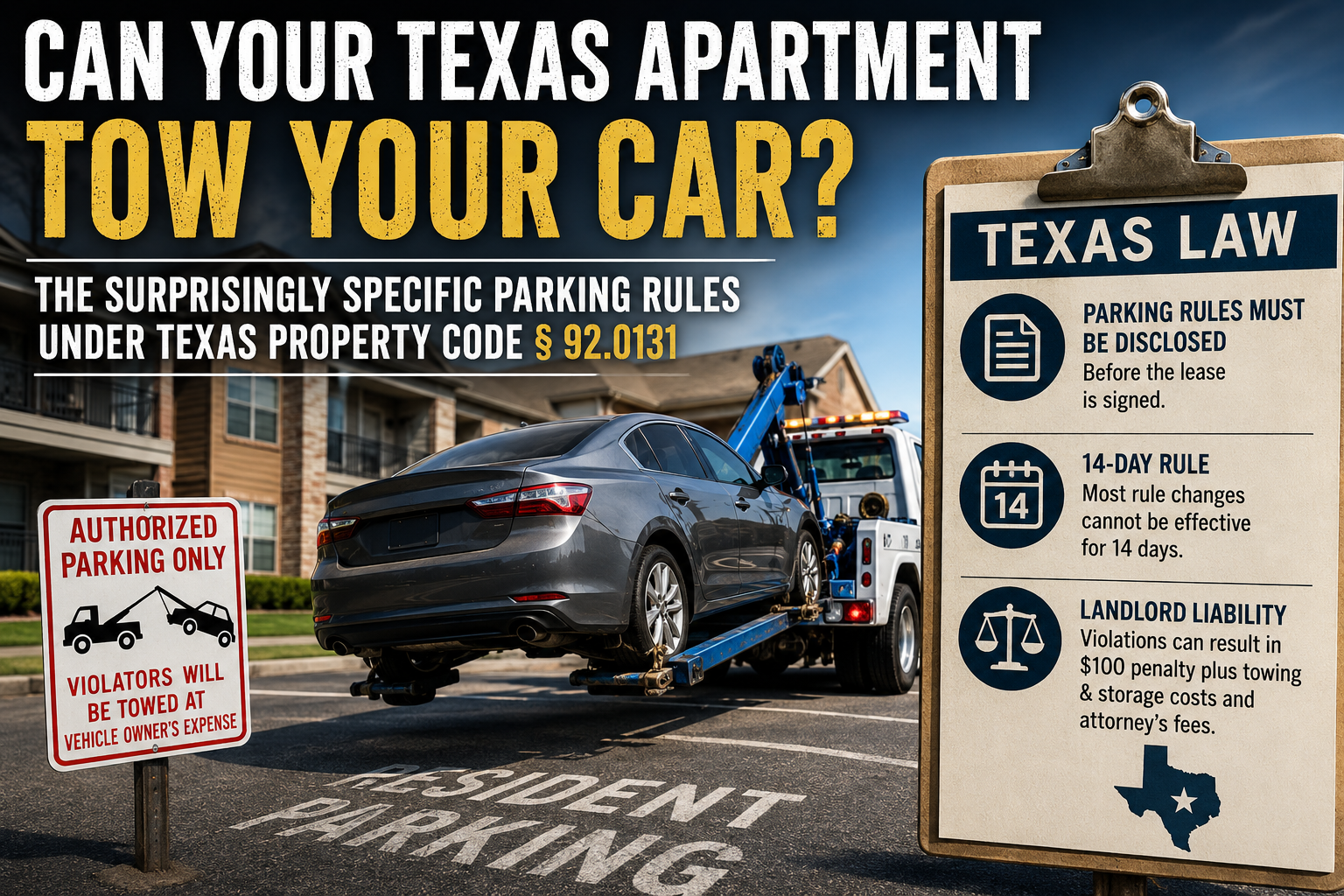
Few experiences are more irritating than walking outside your apartment and discovering that your car is gone.
At first, you may think it was stolen.
Then you notice the towing sign.
Texas landlords can impose parking rules and, under appropriate circumstances, vehicles parked in violation of those rules may be towed. But Texas law does not simply give apartment complexes unlimited discretion to invent parking restrictions and tow first and explain later.
Texas Property Code § 92.0131 contains surprisingly detailed requirements governing vehicle towing and parking rules at multiunit residential complexes.
The statute regulates how parking rules must be disclosed, how they may be changed during a lease, what information a landlord may demand about a tenant's vehicle, and what can happen when a landlord fails to follow the law.
For Texas landlords and tenants alike, something as ordinary as apartment parking can therefore become a genuine legal issue.
Texas Apartment Parking Rules Must Be Disclosed Before the Lease Is Signed
Texas Property Code § 92.0131 applies to tenants in a multiunit complex, as that term is defined by Texas Property Code § 92.151.
If a landlord already has vehicle towing or parking rules when the lease is executed, the landlord must provide those rules to the tenant before the lease agreement is executed.
Section 92.0131(b) provides:
“the landlord shall provide to the tenant a copy of the rules or policies before the lease agreement is executed.”
The statute also regulates how those rules are documented.
The parking rules must be:
- signed by the tenant;
- included in a lease agreement signed by the tenant; or
- included in a signed attachment that is expressly referenced in the lease.
That means parking rules at a Texas apartment complex are not necessarily something management can simply reveal after the tenant has already signed the lease.
Texas Law Even Specifies What the Parking Paragraph Must Be Called
This is where the statute becomes unusually specific.
Texas Property Code § 92.0131(c) provides that if the parking rules are contained in the lease or an attachment, the paragraph containing them must be titled:
“Parking” or “Parking Rules”
And that is not all.
The heading must also be capitalized, underlined, or printed in bold print.
That may sound like an insignificant formatting requirement, but the Texas Legislature expressly included it in the statute.
The apparent purpose is straightforward: parking and towing restrictions can have immediate financial consequences, so the rules should not be buried inconspicuously in several pages of unrelated lease language.
What Vehicle Information Can a Texas Landlord Require?
Apartment complexes commonly require residents to register their vehicles.
But Texas law places limits on what information a landlord generally may require as a precondition for allowing a tenant to use tenant parking.
Under Texas Property Code § 92.0131(c-1), the landlord may require only specified information concerning the vehicle:
- make;
- model;
- color;
- year;
- license number; and
- state of registration.
There is a statutory exception applicable to certain municipal housing authorities and related entities.
For the ordinary private apartment complex, however, the statute provides a remarkably precise list of the information that may be required as a condition of parking.
Can an Apartment Complex Change the Parking Rules During Your Lease?
Yes—but Texas law restricts how that can happen.
A landlord that changes its towing or parking rules during the lease term must provide the tenant with written notice before requiring compliance with the new rule.
Texas Property Code § 92.0131(d) also places the burden on the landlord to prove that the tenant received the new rules.
The statute identifies methods by which the landlord can establish delivery, including certified mail and certain documented methods of personal delivery.
This matters when a dispute sounds something like this:
Tenant: “Nobody ever told me that rule changed.”
Landlord: “We sent everybody a notice.”
Texas law anticipates that dispute and expressly places the burden of proving receipt on the landlord.
A Landlord Cannot Necessarily Invent Any New Parking Rule It Wants
There is another important restriction.
Under Texas Property Code § 92.0131(e), a parking-rule change during the lease generally must either apply to all tenants in the same multiunit complex and be based upon one of several recognized grounds, or be adopted with the particular tenant's written consent.
The statutory grounds include:
- necessity;
- tenant safety or security;
- reasonable requirements for construction on the premises; and
- respect for other tenants' parking rights.
This prevents a landlord from casually using mid-lease parking changes as an arbitrary device against individual tenants.
The 14-Day Rule
Even when a parking-rule change is otherwise permissible, it ordinarily cannot become effective immediately.
Texas Property Code § 92.0131(e)(2) states that the change:
“may not be effective before the 14th day after the date notice of the change is delivered to the tenant”
unless the change results from a construction or utility emergency.
That distinction can become extremely important if a tenant's vehicle is towed shortly after management announces a new parking restriction.
The relevant question may not simply be whether the vehicle violated the new rule.
The question may be whether that new rule had legally become effective yet.
What Happens If the Landlord Violates the Parking-Notice Statute?
Texas law provides an actual statutory remedy.
Under Texas Property Code § 92.0131(f), a landlord who violates certain requirements of the statute is liable for:
“a civil penalty in the amount of $100 plus any towing or storage costs”
incurred by the tenant as a result of the towing.
The statute also contains an attorney's-fee provision.
The nonprevailing party in a lawsuit under § 92.0131 is liable to the prevailing party for reasonable attorney's fees and court costs.
That provision cuts both ways.
A tenant with a legitimate statutory claim may potentially recover fees and costs. But a tenant who brings an unsuccessful lawsuit under the statute may also face exposure to the landlord's reasonable attorney's fees and court costs.
What If the Tow Truck Damages the Tenant's Car?
The statute contains one more unusual provision.
Texas Property Code § 92.0131(g) can make a landlord liable for damage to a tenant's vehicle caused by the negligence of a towing service that contracts with the landlord or the landlord's agent if the towing company does not carry insurance covering the damage.
That does not mean a landlord automatically becomes responsible for every scratch or mechanical problem allegedly caused during a tow.
But it demonstrates how extensively Texas law regulates the relationship among apartment landlords, tenants, and towing companies.
Other Texas Parking and Towing Laws May Also Apply
Section 92.0131 is not the entire universe of Texas towing law.
Depending on the circumstances, towing from private property may also implicate Texas Occupations Code Chapter 2308, signage requirements, parking-facility rules, towing-company requirements, and procedures for challenging certain nonconsent tows.
A valid tow therefore may require more than simply showing that the apartment complex had a parking rule somewhere in its records.
Likewise, a landlord's failure to comply with § 92.0131 does not necessarily mean that every other legal requirement applicable to a towing dispute has been violated.
The facts matter.
Practical Advice for Texas Tenants
If your vehicle is towed from your apartment complex, preserve the documents before arguing about what happened.
Keep copies of:
- your lease;
- every parking addendum;
- your parking permit;
- vehicle-registration communications;
- emails and notices from management;
- photographs of parking and towing signs;
- the towing receipt;
- storage-fee receipts; and
- any notice announcing a change in parking rules.
If the dispute concerns a newly adopted rule, determine when you actually received notice and when the new rule supposedly became effective.
Those dates can matter under § 92.0131.
Practical Advice for Texas Landlords
Landlords and property managers should treat parking rules as part of lease compliance rather than merely an operational matter.
Before authorizing towing, management should know:
- what parking rule was allegedly violated;
- whether that rule was properly provided to the tenant;
- whether a mid-lease change was properly delivered;
- whether the rule had become effective;
- whether the statutory requirements governing the change were satisfied; and
- whether other Texas towing laws have been followed.
A $100 statutory penalty may sound small.
A dispute involving towing charges, storage fees, attorney's fees, court costs, and vehicle damage can become substantially more expensive.
The Bottom Line
Yes, a Texas apartment complex can establish parking rules and vehicles can be towed under appropriate circumstances.
But the landlord does not have unlimited freedom to change those rules without notice.
Texas Property Code § 92.0131 regulates parking rules in remarkable detail. Existing rules generally must be provided before the lease is executed. Mid-lease changes require written notice. The landlord bears the burden of proving receipt. Most changes cannot become effective for at least 14 days. And violations can expose the landlord to statutory penalties, towing and storage costs, and attorney's fees.
So if you walk outside your Texas apartment and discover an empty parking space where your car used to be, the legal question may be more complicated than:
“Was I parked in the wrong place?”
It may also be:
“Was this actually an enforceable parking rule—and did the landlord follow Texas law before having my car towed?”
This article is for general informational purposes only and does not constitute legal advice. The application of Texas landlord-tenant and towing laws depends on the specific facts and documents involved.
At David C. Barsalou, Attorney at Law, PLLC, we help clients navigate business, family, tax, estate planning, and real estate matters ranging from document drafting to litigation with clarity and confidence. If you’d like guidance on your situation, schedule a consultation today. Call us at (713) 397-4678, email barsalou.law@gmail.com, or reach us through our Contact Page. We’re here to help you take the next step.