Receiving a letter from an insurance company stating that it no longer wants to insure your home, automobile, rental property, or business can be alarming.
But an important question comes first:
Is the insurance company canceling the policy, or simply refusing to renew it?
Those concepts sound similar, but Texas law treats them differently.
A cancellation generally ends an insurance policy before its scheduled expiration date. A nonrenewal generally means that the insurer allows the existing policy to reach its expiration date but declines to issue another policy for the next term.
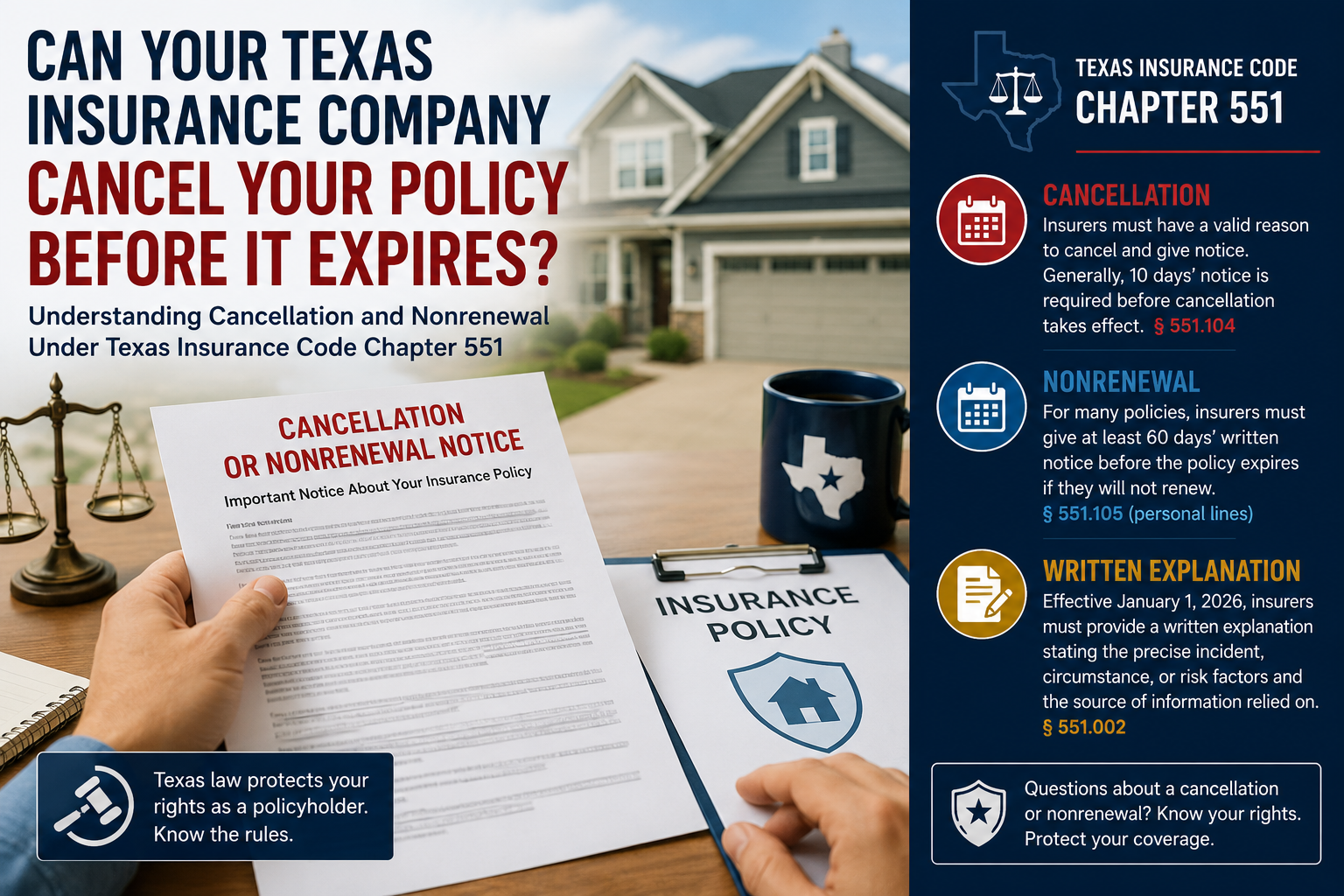
Texas Insurance Code Chapter 551 regulates cancellation and nonrenewal of numerous insurance policies and imposes important notice requirements on insurers.
Texas law also changed effective January 1, 2026, giving many Texas insurance applicants and policyholders greater access to the specific reasons why an insurer declined, canceled, or refused to renew coverage.
For Texas homeowners, landlords, businesses, drivers, and other policyholders, understanding the distinction between cancellation and nonrenewal can be extremely important.
Cancellation and Nonrenewal Are Not the Same Thing
Suppose a homeowner purchases a one-year insurance policy running from January 1 through December 31.
If the insurer attempts to terminate the coverage effective September 1, that is generally a cancellation because the existing policy is being terminated before the end of its term.
If the insurer instead allows the policy to remain effective through December 31 but advises the homeowner that it will not issue another policy beginning January 1, that is a nonrenewal.
The practical difference can be enormous.
An insured facing cancellation may unexpectedly lose existing coverage. An insured facing nonrenewal ordinarily has coverage until the current policy expires but must obtain replacement insurance before that date.
Chapter 551 contains different rules governing these situations.
Texas Law Restricts When Certain Policies Can Be Canceled
Texas Insurance Code § 551.104 governs cancellation of certain personal automobile and residential or other property insurance policies.
The statute states:
“An insurer may cancel an insurance policy only as provided by this section.”
After the period during which broader cancellation rights may apply to a newly issued policy, Texas law substantially restricts an insurer's ability to terminate coverage before expiration.
Among other circumstances, § 551.104 permits cancellation if:
- the named insured fails to pay a portion of the premium when due;
- the insured submits a fraudulent claim;
- the Texas Department of Insurance determines that continuation of the policy would violate applicable law; or
- for certain policies, there is an increase in the covered hazard that is within the insured's control and would produce an increase in the premium rate.
Personal automobile policies are also subject to specific provisions involving suspension or revocation of a driver's license or motor vehicle registration.
The precise rules depend upon the type of insurance involved and the circumstances surrounding the policy.
An Insurance Company Generally Must Give Notice Before Cancellation
Even when an insurer has a lawful basis to cancel a policy, cancellation generally does not become effective immediately.
Texas Insurance Code § 551.104 provides:
“Cancellation of a policy under Subsection (b), (c), or (d) does not take effect until the 10th day after the date the insurer mails notice of the cancellation to the insured.”
That notice period can be extremely important.
An insured who receives a cancellation notice should determine both why the insurer is canceling the policy and whenthe cancellation is supposed to become effective.
A cancellation dispute can become particularly serious when a loss occurs around the purported cancellation date. Whether coverage was still in force at the time of a fire, accident, storm, or other loss may become a significant legal issue.
Nonrenewal Usually Happens at the End of the Policy
Nonrenewal is different because the insurer is generally declining to continue the insurance relationship after the current policy expires.
Texas Insurance Code § 551.105 contains an important notice requirement for certain policies.
The statute generally provides that unless the insurer mails the required written notice of nonrenewal or renewal with an applicable notice of change in coverage not later than the 60th day before the policy expires, the insurer must renew the policy at the insured's request.
The statute applies to specified categories that include personal automobile insurance and insurance covering homes, farms, ranches, dwellings, duplexes, apartments, and other real or personal property.
The 60-day requirement gives an insured an important opportunity to find replacement coverage before the existing policy ends.
Commercial Property and Liability Insurance Have Their Own Rules
Chapter 551 also separately regulates certain liability and commercial property insurance policies.
Under Texas Insurance Code § 551.053, an insurer generally must provide written notice of cancellation to the first-named insured not later than the 10th day before the cancellation takes effect.
Nonrenewal receives substantially more advance notice.
Texas Insurance Code § 551.054 provides:
“The notice must be delivered or mailed not later than the 60th day before the date on which the policy expires.”
The statute contains an especially important consequence when the notice arrives late.
If the insurer delivers or mails the nonrenewal notice later than the statutory deadline, coverage generally remains in effect until the 61st day after the notice is delivered or mailed, subject to the statute's terms.
That provision can matter significantly to Texas businesses and commercial property owners who receive a last-minute notice that an insurer does not intend to renew their coverage.
Texas Law Now Requires More Specific Explanations
One of the more interesting recent developments in Texas insurance law took effect on January 1, 2026.
House Bill 2067 amended Chapter 551's requirements concerning explanations for adverse insurance decisions.
Texas Insurance Code § 551.002 requires an insurer covered by the statute to provide a written statement explaining the reasons for a declination, cancellation, or nonrenewal.
The statute does not contemplate an entirely generic explanation.
Section 551.002(c) requires the insurer's statement to:
“state the precise incident, circumstance, or risk factors applicable to the applicant for insurance or the policyholder that violates any applicable guidelines”
and to identify the source of information upon which the insurer relied regarding those factors.
This can be extremely useful to an insured.
Instead of simply learning that an insurance company does not want the risk anymore, the policyholder may learn that the decision was based upon prior claims, the condition of property, underwriting information, driving history, or some other specific factor.
The Texas Department of Insurance has explained that the 2026 law requires insurers to provide written reasons for covered decisions involving declination, cancellation, and nonrenewal.
Why the Difference Matters for Texas Property Owners
Insurance cancellation can create consequences extending far beyond the relationship between the policyholder and insurance company.
Consider a mortgaged home.
The deed of trust will ordinarily require the borrower to maintain appropriate property insurance. If the homeowner loses insurance and fails to replace it, the mortgage servicer may obtain force-placed insurance or exercise other contractual remedies.
The same issue can arise in commercial transactions.
A commercial lease may require a tenant to maintain liability or property insurance. A loan agreement may require a business borrower to maintain particular coverage. Construction and service contracts routinely contain insurance requirements.
Accordingly, an insurer's cancellation or nonrenewal may potentially create a second contractual problem between the insured and another party.
That is one reason an insurance notice should not simply be placed in a drawer and forgotten.
A Nonrenewal Does Not Necessarily Mean the Insurer Did Something Wrong
It is also important not to assume that every cancellation or nonrenewal creates a lawsuit.
Insurance companies are generally permitted to make legitimate underwriting decisions within the limits established by Texas law.
A property may have deteriorated. The insured may have accumulated claims. The risk may have changed. Premiums may not have been paid. An insurer may decide to reduce its exposure to a particular type of risk or market, subject to applicable Texas law.
The legal questions are usually more specific:
Was the insurer permitted to take the action it took?
Did it provide the notice required by law?
Did it provide the required explanation?
When did the termination of coverage legally become effective?
Those questions become particularly important when a covered loss occurs during a disputed period.
What Should You Do After Receiving a Cancellation or Nonrenewal Notice?
A Texas policyholder receiving a cancellation or nonrenewal notice should carefully review the notice and the underlying insurance policy.
Important information includes:
- whether the insurer is canceling or nonrenewing the policy;
- the stated reason for the decision;
- the date the notice was mailed or delivered;
- the proposed effective date;
- the expiration date of the existing policy;
- whether the insurer relied upon inaccurate information;
- whether replacement insurance is required by a mortgage, lease, loan, or other contract; and
- whether a loss has already occurred that may implicate the disputed coverage.
The insured should also begin investigating replacement coverage promptly rather than assuming that a dispute with the existing insurer will be resolved before coverage ends.
Texas Insurance Disputes Can Become Contract and Litigation Disputes
An insurance policy is a contract.
When a disagreement develops concerning whether a policy was properly canceled, whether coverage remained effective, or whether an insurer complied with statutory notice requirements, the dispute can implicate both the insurance contract and Texas statutory law.
Depending upon the facts, other provisions of the Texas Insurance Code may also become relevant.
For example, Chapter 541 addresses certain unfair methods of competition and unfair or deceptive insurance practices, while Chapter 542 contains important requirements concerning the processing and payment of insurance claims.
Those statutes address different issues from Chapter 551, but an insurance dispute can sometimes involve more than one statutory framework.
The Bottom Line
A Texas insurance company does not necessarily have an unrestricted right to terminate an insurance policy whenever it chooses.
Cancellation generally concerns ending an existing policy before its scheduled expiration, while nonrenewal concerns the insurer's decision not to continue coverage after the existing policy expires.
Texas Insurance Code Chapter 551 establishes important rules governing both situations, including notice requirements and restrictions applicable to particular types of policies.
And beginning in 2026, Texas law requires covered insurers to provide more meaningful written explanations identifying the specific circumstances or risk factors behind many declinations, cancellations, and nonrenewals.
For homeowners, landlords, businesses, and other Texas policyholders, those rules can determine whether insurance coverage ended when the insurer says it did—and, in some cases, whether coverage was still in effect when a loss occurred.
This article is for general informational purposes only and does not constitute legal advice. Insurance coverage disputes are highly dependent upon the language of the particular policy, the type of insurance involved, the applicable statutory provisions, and the specific facts surrounding the cancellation or nonrenewal.
At David C. Barsalou, Attorney at Law, PLLC, we help clients navigate business, family, tax, estate planning, and real estate matters ranging from document drafting to litigation with clarity and confidence. If you’d like guidance on your situation, schedule a consultation today. Call us at (713) 397-4678, email barsalou.law@gmail.com, or reach us through our Contact Page. We’re here to help you take the next step.
