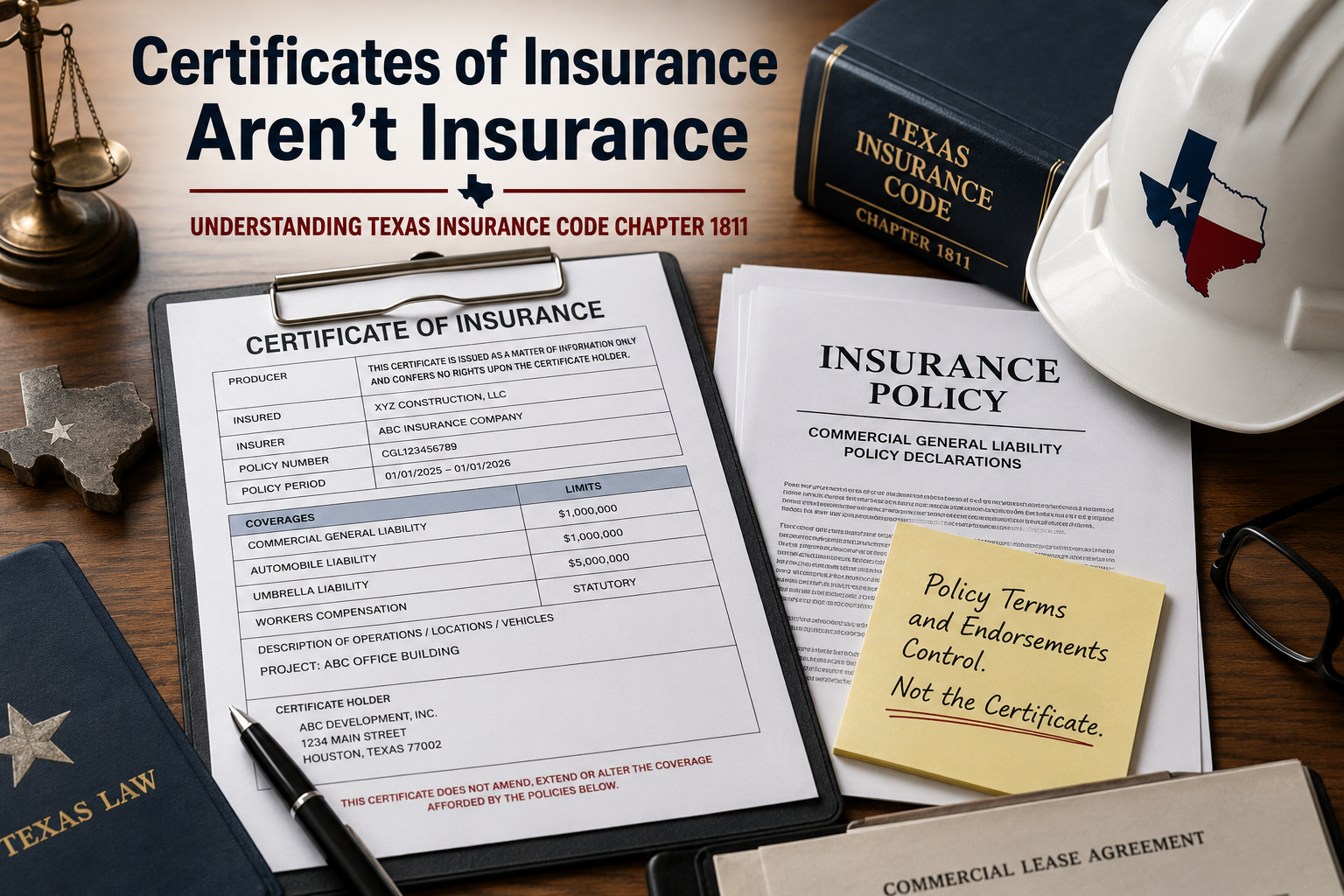
Businesses regularly request certificates of insurance before signing contracts, leasing commercial property, beginning construction projects, or hiring independent contractors. While certificates are extremely common, many people mistakenly believe they change the terms of an insurance policy.
They generally do not.
The Texas Insurance Code specifically regulates certificates of insurance and limits what they can legally say. Understanding these rules can prevent expensive misunderstandings and unnecessary litigation.
What Is a Certificate of Insurance?
A certificate of insurance (often called a "COI") is a document issued by an insurer or insurance producer summarizing certain information about an insurance policy.
It commonly identifies:
- The insured
- The insurance company
- Policy numbers
- Coverage types
- Policy limits
- Effective dates
Certificates are frequently requested by:
- Commercial landlords
- Property managers
- General contractors
- Government agencies
- Lenders
- Business customers
However, the certificate is not the insurance policy itself.
Texas Law Specifically Regulates Certificates of Insurance
Texas Insurance Code Chapter 1811 governs certificates of insurance.
Section 1811.001 defines a certificate of insurance as:
"a document or instrument, regardless of how titled or described, that is prepared or issued by an insurer or insurance producer as evidence of property insurance or casualty insurance coverage."
This definition is intentionally broad and captures virtually every certificate issued to prove liability or property insurance.
A Certificate Cannot Change the Insurance Policy
One of the most important provisions appears in Texas Insurance Code § 1811.051, which provides that a certificate of insurance may not amend, extend, or alter the coverage provided by an insurance policy.
This is an extremely important concept.
Many business owners believe that if a certificate states something, then coverage automatically exists.
That is not necessarily true.
The insurance policy—not the certificate—controls.
Why This Matters
Suppose a contractor provides a certificate showing $2 million in commercial general liability coverage.
Later, a lawsuit occurs.
The owner discovers:
- an exclusion applies,
- the contractor failed to purchase required endorsements,
- additional insured status was never added, or
- coverage had already lapsed.
Even though the certificate appeared satisfactory, the actual insurance policy governs the parties' rights.
This is why sophisticated commercial contracts often require delivery of both:
- a certificate of insurance, and
- copies of specific policy endorsements.
Certificates Cannot Misrepresent Coverage
Texas Insurance Code § 1811.052 prohibits preparing or issuing certificates that contain false or misleading information regarding insurance coverage.
Likewise, parties generally cannot create custom certificates that suggest broader protection than the policy actually provides.
The Legislature recognized that certificates had increasingly been used as substitutes for actual policy language, creating confusion and disputes.
Why Additional Insured Endorsements Matter
One of the biggest misunderstandings involves "additional insured" status.
A certificate that merely lists another company in a description box does not necessarily make that company an additional insured.
Instead, additional insured status usually arises through:
- the insurance policy itself,
- an endorsement attached to the policy, or
- language specifically incorporated into the policy.
Without the endorsement, the certificate alone may not provide the legal protection the requesting party expected.
Common Commercial Situations
Texas businesses encounter certificates of insurance in numerous transactions, including:
- Commercial construction contracts
- Office leases
- Shopping center leases
- Vendor agreements
- Property management contracts
- Independent contractor agreements
- Equipment rental agreements
In each situation, reviewing the underlying insurance requirements can be just as important as reviewing the certificate itself.
Practical Advice
If insurance coverage is important to your transaction:
- Read the contract carefully.
- Request required endorsements—not just a certificate.
- Verify coverage remains active throughout the project.
- Confirm any required additional insured provisions actually appear in the policy.
- Keep updated certificates whenever policies renew.
These simple steps can help avoid significant disputes if a claim later arises.
When Litigation Happens
Disagreements involving certificates of insurance often arise after someone has already been injured or property damage has occurred.
The litigation may involve questions such as:
- Was someone actually an additional insured?
- Did the insurer owe a defense?
- Did the contract require broader coverage?
- Did someone misrepresent the insurance that existed?
- Was the certificate consistent with the policy?
Because these disputes frequently involve both contract interpretation and insurance law, careful review of the governing documents is critical.
Conclusion
Certificates of insurance are useful business tools, but they are not substitutes for the insurance policy itself. Texas Insurance Code Chapter 1811 makes clear that a certificate generally cannot alter, expand, or create insurance coverage. Before relying on a certificate, businesses should ensure the underlying policy and endorsements actually provide the protection required by their contracts.
If your business is involved in a dispute concerning commercial contracts, insurance requirements, construction agreements, or other Texas civil litigation matters, obtaining legal advice early can help identify issues before they become costly lawsuits.
At David C. Barsalou, Attorney at Law, PLLC, we help clients navigate business, family, tax, estate planning, and real estate matters ranging from document drafting to litigation with clarity and confidence. If you’d like guidance on your situation, schedule a consultation today. Call us at (713) 397-4678, email barsalou.law@gmail.com, or reach us through our Contact Page. We’re here to help you take the next step.