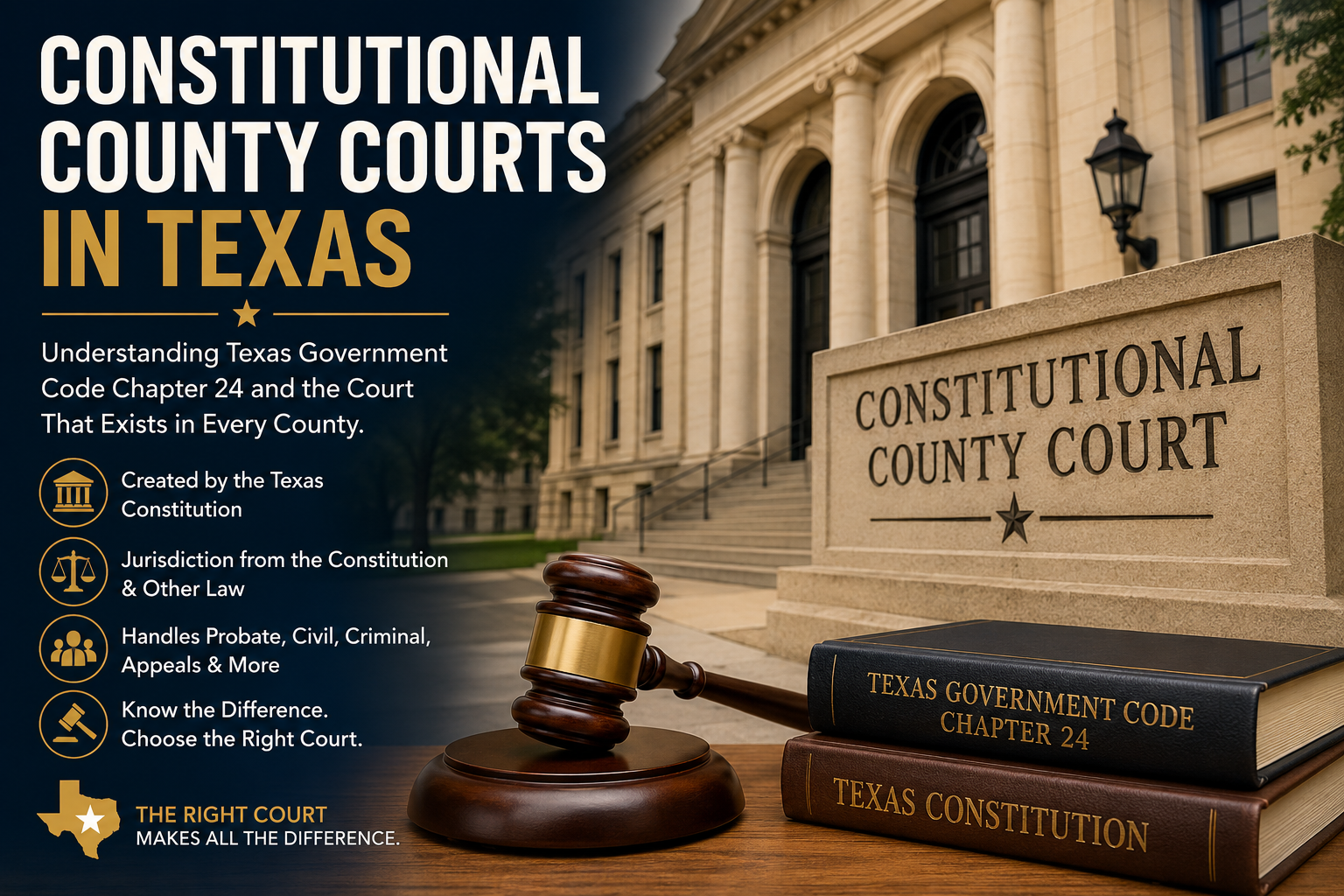
Most Texans know they can file a lawsuit, probate an estate, or appeal a justice court case, but few understand that not all county courts are the same.
Texas has two very different types of county-level trial courts:
- Constitutional county courts
- Statutory county courts
The distinction can determine whether your case belongs in one court or another and whether a court even has authority to hear your dispute.
This article focuses on the often-overlooked constitutional county court created by the Texas Constitution and governed in part by Chapter 24 of the Texas Government Code.
Every Texas County Has a Constitutional County Court
The Texas Government Code provides:
"There is in each county in the state a constitutional county court."
Texas Government Code § 24.001
Unlike statutory county courts—which only exist because the Legislature created them—constitutional county courts exist in every county.
Constitutional County Courts Have Limited Jurisdiction
Texas Government Code § 24.007 provides:
"The county court has the jurisdiction provided by Article V, Section 16, of the Texas Constitution and by other law."
This is an important provision because it tells us something lawyers sometimes overlook:
The Government Code itself does not define the court's complete authority.
Instead, jurisdiction comes from:
- the Texas Constitution,
- the Government Code,
- and numerous other Texas statutes.
That means determining the correct court often requires reading multiple statutes together.
Why Does This Matter?
Filing in the wrong court can create significant problems, including:
- dismissal,
- transfer,
- unnecessary delay,
- additional attorney's fees,
- jurisdictional challenges,
- and even void orders if the court lacks authority.
Jurisdiction is not simply a procedural technicality.
It determines whether the court has legal power to hear the dispute at all.
Constitutional County Courts Hear Many Different Types of Cases
Depending upon the county and applicable statutes, constitutional county courts commonly handle matters involving:
- probate proceedings,
- guardianships,
- misdemeanor criminal cases,
- civil disputes,
- appeals from justice courts,
- administrative matters, and
- various county governmental functions.
However, in larger counties, many of these responsibilities have been reassigned to statutory county courts or district courts through legislation.
Constitutional County Courts Are Different From Statutory County Courts
This distinction often surprises clients.
A constitutional county court exists because the Texas Constitution requires one in every county.
A statutory county court exists because the Legislature created it through statute.
Many metropolitan counties—including Harris County—have numerous statutory county courts with specialized jurisdiction.
Smaller counties often rely much more heavily upon the constitutional county court.
The court's name may sound similar, but the source and scope of its authority can be significantly different.
Appeals Frequently End Up Here
Many litigants first encounter the constitutional county court after losing a case in justice court.
For example:
- certain eviction appeals,
- small claims matters,
- debt collection cases,
- and other justice court proceedings
may proceed into a county court depending upon the applicable statutes and local court structure.
Understanding which county court receives the appeal is essential because procedural rules, scheduling, and jurisdiction may differ.
Jurisdiction Is One of the First Questions Lawyers Ask
Experienced litigators rarely begin with the facts alone.
Instead, they first ask:
- Does this court have subject-matter jurisdiction?
- Is venue proper?
- Is another court required to hear the case?
- Has the Legislature assigned jurisdiction elsewhere?
Those questions often determine whether the lawsuit can proceed before anyone reaches the merits.
Practical Takeaway
The phrase "county court" does not always refer to the same type of court in Texas.
A constitutional county court differs from a statutory county court, and understanding that distinction can prevent costly procedural mistakes.
Whether your matter involves probate, real estate, landlord-tenant disputes, commercial litigation, or an appeal from justice court, identifying the proper court at the outset is one of the most important decisions in any case.
Need Help Filing a Lawsuit or Determining the Proper Texas Court?
Choosing the correct court is often more complicated than it appears. Filing in the wrong court can delay your case or require starting over. If you have questions about jurisdiction, civil litigation, probate, real estate disputes, or appeals, an experienced Texas attorney can help determine where your case belongs before valuable time and money are lost.
At David C. Barsalou, Attorney at Law, PLLC, we help clients navigate business, family, tax, estate planning, and real estate matters ranging from document drafting to litigation with clarity and confidence. If you’d like guidance on your situation, schedule a consultation today. Call us at (713) 397-4678, email barsalou.law@gmail.com, or reach us through our Contact Page. We’re here to help you take the next step.