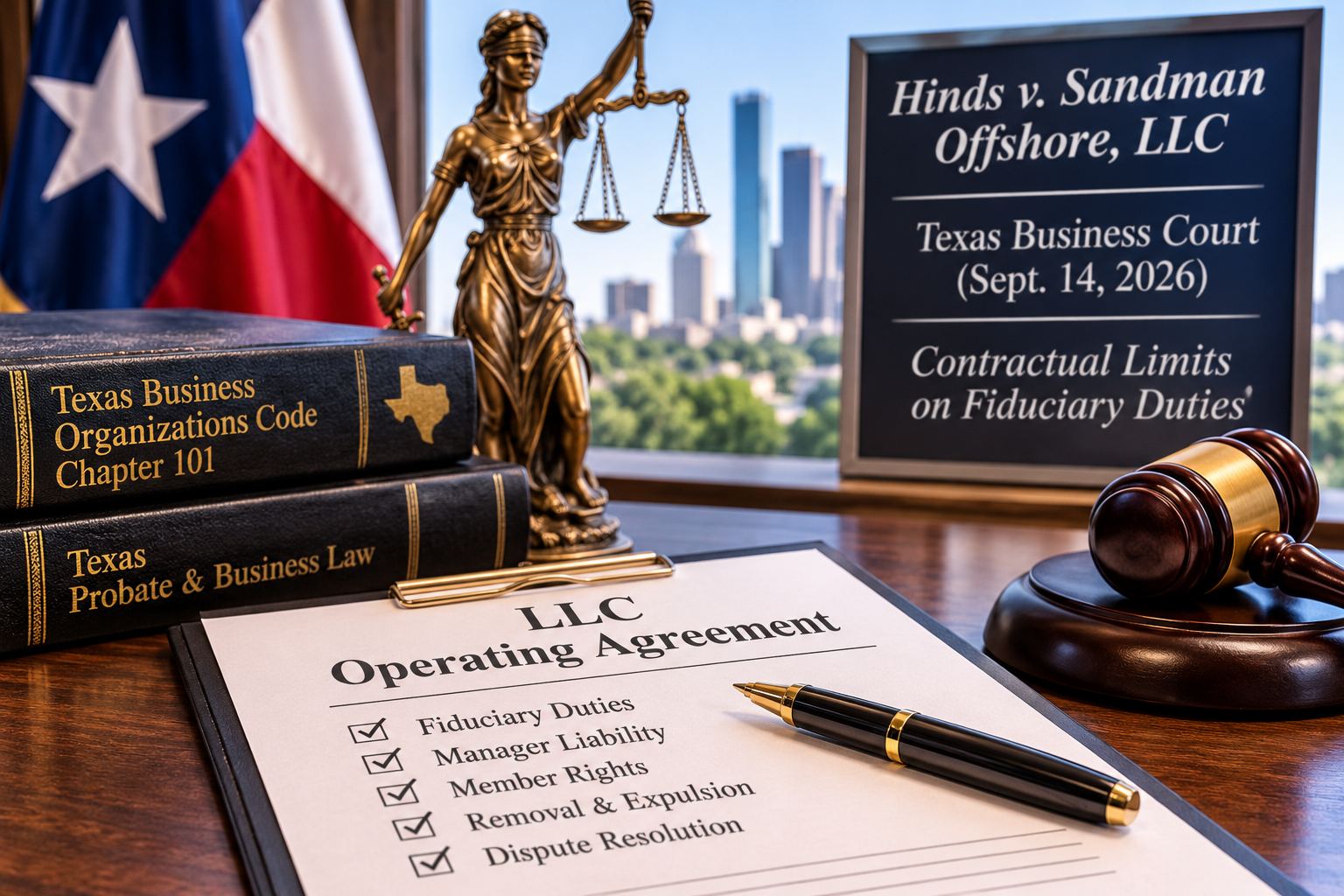
Understanding Texas Business Organizations Code § 101.401 and Hinds v. Sandman Offshore, LLC
When business partners form a limited liability company, they often assume that the individuals managing the company owe them certain basic obligations.
They expect managers to act honestly, disclose conflicts of interest, protect company property, and refrain from using their positions for improper personal gain.
But what happens when the company's operating agreement expressly limits those obligations?
Can LLC members agree that managers will not owe traditional fiduciary duties? Can a majority remove a minority member without advance notice? And can a longstanding relationship of trust create duties that the parties deliberately excluded from their written agreement?
A September 14, 2026 decision from the Texas Business Court provides important guidance.
In Hinds v. Sandman Offshore, LLC, 2026 Tex. Bus. 63 (11th Div.), the court enforced contractual limitations on fiduciary duties and dismissed several claims arising from the removal and expulsion of an LLC member.
However, the court allowed certain fiduciary-duty allegations involving willful misconduct to survive.
The decision illustrates a fundamental principle of Texas business law:
The duties that LLC members and managers owe one another may depend as much on their written company agreement as on traditional fiduciary principles.
For business owners, investors, and attorneys drafting LLC agreements, the consequences can be substantial.
1. What Are Fiduciary Duties in a Texas LLC?
A fiduciary duty is a legal obligation arising from a relationship in which one party must act with particular loyalty, care, or regard for another party's interests.
Depending on the relationship, fiduciary obligations may include duties concerning:
- Loyalty to the company;
- Avoidance or proper handling of conflicts of interest;
- Protection of company property;
- Disclosure of material information;
- Avoidance of improper self-dealing; and
- Compliance with obligations imposed by law or agreement.
However, Texas law does not automatically impose every traditional fiduciary duty on every LLC member.
In Bertucci v. Watkins, 709 S.W.3d 534 (Tex. 2025), the Texas Supreme Court explained that LLC members do not owe formal fiduciary duties to fellow members merely because they share ownership of the same company.
That distinction is important.
A person who owns 20% of an LLC does not necessarily owe fiduciary duties to every other owner simply because they are members of the same entity.
Managers, by contrast, may owe fiduciary duties arising from their management responsibilities.
Even then, the company agreement may significantly alter the scope of those obligations.
2. Texas Business Organizations Code § 101.401: The Statute That Allows Fiduciary Duties to Be Modified
The starting point is Texas Business Organizations Code § 101.401.
The statute provides that an LLC company agreement may:
"expand, restrict, or eliminate any duties, including fiduciary duties, and related liabilities"
owed by a member, manager, officer, or other person to the company or another member or manager.
This is unusually important statutory language.
Texas law expressly recognizes that LLC participants may structure their legal relationships differently from the traditional fiduciary model.
For example, a company agreement might:
- Impose heightened fiduciary obligations on managers;
- Limit certain duties concerning business opportunities;
- Authorize specified transactions involving conflicts of interest;
- Restrict monetary liability for ordinary negligence;
- Preserve liability for gross negligence or willful misconduct; or
- Eliminate certain duties that might otherwise arise from the management relationship.
The statute does not mean that every conceivable contractual provision will necessarily be enforceable regardless of other applicable law.
But it establishes a strong statutory preference for respecting the parties' chosen allocation of duties and responsibilities.
An LLC operating agreement is therefore more than an administrative document. It can define the substantive legal obligations that govern the company's owners and managers.
3. What Happened in Hinds v. Sandman Offshore?
The dispute involved Sandman Offshore, LLC, an oil-and-gas business with five members, each holding a 20% membership interest.
Russell Hinds and David Wegner served as co-managers.
According to the pleadings, Hinds performed substantial day-to-day management services for the business.
In March 2026, the company's members removed Hinds as a co-manager. The following month, they expelled him as a member.
Hinds alleged that these actions occurred without advance notice or an opportunity to be heard.
The company, however, alleged that Hinds had engaged in conflicting business activities involving another company in which he possessed an ownership interest.
Hinds disputed those accusations and alleged that Wegner had acted for improper personal reasons.
The resulting litigation included claims for breach of contract, breach of fiduciary duty, fraud, and other alleged misconduct.
The defendants sought dismissal of several claims under Texas Rule of Civil Procedure 91a.
That procedural posture matters.
The court was not conducting a trial or deciding every factual dispute. It was determining whether the claims, as pleaded and considered under Rule 91a, possessed a legally sufficient basis.
4. The Company Agreement Expressly Limited Fiduciary Duties
The central provision was Section 5.10 of Sandman's company agreement.
That provision generally limited managerial liability to circumstances involving gross negligence, willful misconduct, or breach of the agreement.
It also stated that managers would not be subject to fiduciary duties except those expressly preserved in the agreement.
The court treated this language as a meaningful contractual limitation.
Hinds argued that Wegner breached fiduciary duties by participating in his removal and expulsion, concealing the plan, and failing to provide advance notice.
But the company agreement expressly authorized certain company actions without a meeting or advance notice.
Consequently, the court concluded that the parties could not simultaneously agree that advance notice was unnecessary and then impose an inconsistent fiduciary duty requiring that notice.
The court relied in part on the Texas Supreme Court's reasoning in Pitts v. Rivas, 709 S.W.3d 517 (Tex. 2025), emphasizing that courts should not impose duties inconsistent with the contractual relationship the parties established.
The practical consequence is substantial.
When an LLC agreement expressly authorizes a particular procedure, a dissatisfied member may have difficulty converting the exercise of that contractual authority into a fiduciary-duty violation.
5. Can a Texas LLC Remove a Member Without Notice?
Potentially, yes.
The answer depends on the company's governing documents and applicable law.
Texas Business Organizations Code § 101.358 generally permits certain LLC actions to be taken through written consent without holding a meeting, providing notice, or conducting a vote at a meeting, when the statutory requirements are satisfied.
Section 101.359 further recognizes action by members or managers in manners permitted by the governing documents and applicable law.
In Hinds, the company agreement specifically authorized action by written consent without prior notice when the required majority approved the action.
It also established procedures governing removal and expulsion.
The court therefore rejected the argument that the company was independently required to provide advance notice or an opportunity to be heard merely because Hinds considered those protections appropriate.
This illustrates why removal provisions deserve careful attention when an LLC is formed.
A minority member may believe that ownership carries a practical right to participate in major decisions.
However, the governing agreement may permit the majority to act without that member's advance participation.
A well-drafted agreement should clearly address the grounds for removal, required voting thresholds, notice requirements, opportunities to respond, and the economic consequences of expulsion.
These are not merely procedural details.
They can determine whether an owner retains management authority, voting rights, or an economic interest in the business.
6. The Court Did Not Eliminate Every Fiduciary-Duty Claim
One of the most important aspects of Hinds is what the court did not decide.
The court did not hold that Sandman's managers could engage in any conduct they wished without liability.
Instead, the company agreement preserved certain obligations and liability for specified misconduct.
In particular, Section 5.10 preserved liability for willful misconduct.
Hinds alleged that Wegner had engaged in intentional misconduct involving company management, business opportunities, and royalty interests.
The court concluded that the allegations involving willful misconduct were sufficient to survive the Rule 91a challenge.
Accordingly, the fiduciary-duty claims were dismissed only in part.
This distinction is particularly important for attorneys drafting company agreements.
A clause limiting liability for ordinary negligence may operate differently from a clause preserving liability for gross negligence, fraud, intentional misconduct, or specified contractual violations.
The precise language matters.
A provision that appears to eliminate fiduciary duties may nevertheless preserve meaningful causes of action through its exceptions.
The important question is not simply whether an agreement contains a fiduciary-duty waiver, but which duties and liabilities remain after the agreement is read as a whole.
7. Can a Longstanding Relationship of Trust Create Fiduciary Duties Anyway?
Business partners frequently describe their relationships in personal terms.
They may have worked together for decades, invested substantial money, relied on one another's judgment, and developed considerable mutual trust.
But does that relationship create an informal fiduciary duty?
Not necessarily.
In Hinds, the plaintiff alleged a longstanding relationship of trust and confidence with Wegner.
The court nevertheless declined to recognize an additional informal fiduciary relationship.
Its reasoning relied on Texas Supreme Court precedent explaining that ordinary commercial trust, even when substantial, does not automatically establish fiduciary obligations.
This is particularly significant when sophisticated parties have entered into a written agreement defining their relationship.
The court was unwilling to impose additional duties inconsistent with the agreement merely because the parties had trusted one another over many years.
The lesson is straightforward:
Trust between business partners is not necessarily a substitute for contractual protection.
An investor who expects disclosure, consultation, or loyalty obligations should consider ensuring that those duties are expressly established in the company's governing documents.
8. Can an LLC Agreement Eliminate the Duty of Good Faith and Fair Dealing?
Another important issue in Hinds concerned the alleged duty of good faith and fair dealing.
Texas law does not generally impose a free-standing duty of good faith and fair dealing in every contractual relationship.
Such a duty may arise in particular relationships recognized by law, but it does not automatically follow from the existence of a business contract.
Hinds asserted a claim based on an implied covenant of good faith and fair dealing.
The court rejected the claim because the pleaded facts did not establish the special relationship necessary to support that obligation.
This is another reason attorneys should avoid assuming that a court will supply protective obligations omitted from an LLC agreement.
If the parties want specific standards governing the exercise of discretionary authority, those standards should be considered during drafting.
For example, an agreement may expressly establish procedures for determining conflicts of interest, approving related-party transactions, or reviewing decisions affecting minority members.
Clear contractual obligations can provide greater predictability than relying on a generalized expectation that the other party will act fairly.
9. What Does This Mean for Minority LLC Members?
Minority owners should pay particular attention to fiduciary-duty limitations.
Suppose three individuals form an LLC.
One member owns 60% of the company, while the other two each own 20%.
The majority owner also serves as manager.
If the company agreement allows majority action without notice, permits removal under broadly defined circumstances, and substantially limits fiduciary duties, the minority owners may have fewer protections than they expect.
The problem may not become apparent until a disagreement arises.
By then, the minority owners may discover that the company agreement authorizes conduct they believed would be prohibited.
Before signing, minority members should consider whether the agreement provides meaningful protections concerning access to financial records, related-party transactions, distributions, dilution, removal, expulsion, and valuation of membership interests.
Texas Business Organizations Code § 101.502 also provides certain statutory rights concerning company information, subject to applicable conditions and limitations.
However, information rights are not a substitute for carefully negotiated governance provisions.
An owner who lacks meaningful voting power may still need contractual protections against actions that substantially affect the value of the investment.
10. What Should Attorneys Consider When Drafting Texas LLC Agreements?
The Hinds decision reinforces the importance of precision.
An attorney drafting a Texas LLC agreement should consider several distinct questions.
A. Who Owes Fiduciary Duties?
The agreement should distinguish among members, managers, officers, and other persons acting on behalf of the company.
Not every participant occupies the same legal position.
B. Which Duties Are Being Modified?
A general waiver may create uncertainty concerning which obligations remain.
Specific provisions can address conflicts of interest, business opportunities, disclosure, and managerial discretion.
C. What Conduct Creates Liability?
The agreement should identify whether liability is preserved for ordinary negligence, gross negligence, willful misconduct, fraud, or breach of express contractual obligations.
These categories should not be treated as interchangeable.
D. How Can Members Be Removed?
Removal and expulsion provisions should address the required approval, applicable grounds, procedural requirements, and consequences for the affected member's ownership interest.
E. How Are Conflicts of Interest Determined?
An agreement may establish standards or procedures for determining whether a member has engaged in competing or conflicting business activities.
The identity of the decision-maker can be particularly important.
F. What Happens When a Dispute Arises?
The agreement should also address dispute resolution, venue, applicable remedies, and whether certain claims must be pursued by the company rather than an individual member.
The goal is not necessarily to eliminate fiduciary duties.
Rather, it is to create a governance structure that accurately reflects the parties' expectations and allocation of risk.
11. What Does Hinds Mean for Texas Business Litigation?
The decision has important implications for plaintiffs and defendants.
For plaintiffs, it demonstrates the danger of asserting fiduciary-duty claims without first examining the operative company agreement.
A claim that might otherwise appear viable may be foreclosed by an express contractual limitation.
For defendants, it illustrates how company agreements may support an early motion to dismiss under Texas Rule of Civil Procedure 91a.
When the agreement is properly before the court as part of the pleadings, its express provisions may establish that certain alleged duties do not exist.
However, defendants should not assume that an exculpatory clause automatically defeats every claim.
As Hinds demonstrates, allegations falling within expressly preserved exceptions may survive.
The decision therefore encourages careful attention to the interaction among contractual language, statutory authority, and the specific misconduct alleged.
12. Frequently Asked Questions
Do Texas LLC members automatically owe fiduciary duties to one another?
No. Under Texas Supreme Court precedent, LLC membership alone does not automatically create formal fiduciary duties between members. Other relationships, managerial responsibilities, or express agreements may affect the analysis.
Can a Texas LLC operating agreement eliminate fiduciary duties?
Texas Business Organizations Code § 101.401 permits company agreements to expand, restrict, or eliminate duties, including fiduciary duties, and related liabilities, subject to other applicable law.
Can a majority owner expel a minority member?
Potentially. The governing documents and applicable law determine the authority and procedures for expulsion. The existence of a majority interest does not, by itself, answer every question concerning removal or the member's economic rights.
Can a manager still be sued after signing a fiduciary-duty waiver?
Yes. A claim may remain available if the alleged conduct violates duties or liability exceptions preserved by the agreement, or if another legally viable cause of action exists.
Does a 20-year business relationship create fiduciary duties?
Not automatically. Texas courts distinguish ordinary commercial trust from legally recognized informal fiduciary relationships.
Should a single-member LLC address fiduciary duties?
Even a single-member LLC may benefit from clear management and liability provisions, particularly if additional owners, managers, or investors may eventually become involved.
Conclusion: In Texas LLCs, the Agreement Can Define the Relationship
The Texas Business Court's decision in Hinds v. Sandman Offshore, LLC reinforces an important principle of Texas business law.
LLC participants possess substantial freedom to define the duties and liabilities governing their business relationships.
That freedom can be beneficial.
It allows business owners to create governance structures suited to their particular circumstances rather than relying entirely on default legal principles.
But contractual flexibility also creates risk.
An owner who signs an agreement without understanding its fiduciary-duty limitations may discover that important protections have been restricted or eliminated.
Likewise, a manager who assumes that a waiver provides complete immunity may overlook obligations expressly preserved in the agreement.
For Texas business owners, the lesson is to take company agreements seriously before disputes arise.
For attorneys, the lesson is that careful drafting can be just as important as litigation strategy.
A well-drafted LLC agreement does more than describe how a business operates. It can determine which legal duties exist, which remedies remain available, and how disputes will ultimately be resolved.
Speak With a Texas Business Attorney
David C. Barsalou, Attorney at Law, PLLC, assists clients with LLC formation, company agreements, business transactions, contract disputes, and civil litigation throughout Texas.
Whether you are forming a new company, reviewing an existing operating agreement, or facing a dispute among LLC members, understanding the contractual and statutory framework is essential.
Visit barsalou-law.com for additional information.
Disclaimer: This article is for general informational purposes only and does not constitute legal advice. Legal rights and obligations depend on the governing documents, applicable law, and the particular circumstances of each dispute.
Principal Legal Authorities
- Texas Business Organizations Code §§ 101.052, 101.358, 101.359, 101.401, and 101.502.
- Hinds v. Sandman Offshore, LLC, 2026 Tex. Bus. 63 (11th Div. Sept. 14, 2026).
- Bertucci v. Watkins, 709 S.W.3d 534 (Tex. 2025).
- Pitts v. Rivas, 709 S.W.3d 517 (Tex. 2025).
- Tall v. Vanderhoef, 2025 Tex. Bus. 15 (8th Div. Apr. 21, 2025).
- Enosis Investments, LLC v. Jensen, 2026 Tex. Bus. 19 (3d Div. Apr. 23, 2026).
At David C. Barsalou, Attorney at Law, PLLC, we help clients navigate business, family, tax, estate planning, and real estate matters ranging from document drafting to litigation with clarity and confidence. If you’d like guidance on your situation, schedule a consultation today. Call us at (713) 397-4678, email barsalou.law@gmail.com, or reach us through our Contact Page. We’re here to help you take the next step.