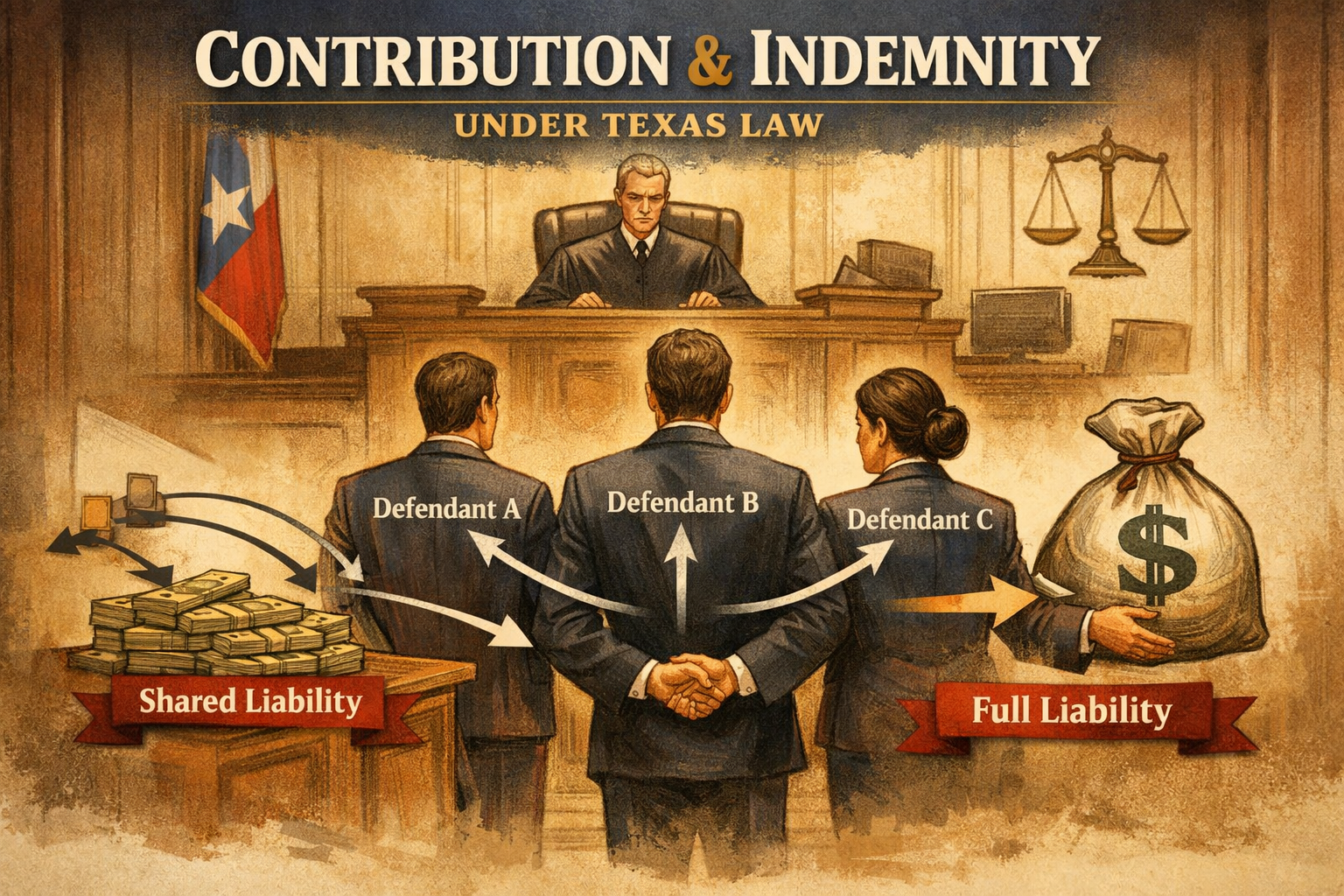
When multiple people or companies are responsible for causing harm, an important question arises: who ultimately pays the judgment?
Texas law provides two mechanisms that help allocate financial responsibility between defendants:
- Contribution
- Indemnity
Although the terms are often used interchangeably in everyday conversation, they are very different legal doctrines with different consequences.
Understanding these concepts can significantly affect how lawsuits are defended, settled, and ultimately paid.
The Texas Proportionate Responsibility System
Texas uses a proportionate responsibility system, which allows courts and juries to allocate fault among responsible parties.
Under Texas Civil Practice and Remedies Code § 33.003(a):
“The trier of fact, as to each cause of action asserted, shall determine the percentage of responsibility… for each claimant, each defendant, each settling person, and each responsible third party.”
This means the jury may assign percentages such as:
- Defendant A: 40%
- Defendant B: 30%
- Responsible third party: 20%
- Plaintiff: 10%
The allocation of responsibility directly impacts how damages are distributed among defendants.
What Is Contribution?
Contribution allows a defendant who paid more than their fair share of damages to recover the excess from another responsible party.
Texas recognizes contribution through the proportionate responsibility framework.
For example:
- Two contractors negligently cause property damage.
- One contractor pays the entire $200,000 judgment.
- If the jury allocated responsibility 50/50, that contractor may pursue contribution from the other contractor for $100,000.
Texas Civil Practice and Remedies Code § 33.015(b) provides:
“Each liable defendant is liable to a claimant only for the percentage of damages found by the trier of fact equal to that defendant’s percentage of responsibility.”
Contribution therefore equalizes financial responsibility among defendants.
What Is Indemnity?
Indemnity is far more powerful than contribution.
Indemnity allows one party to shift the entire loss to another party, rather than merely sharing it.
Indemnity may arise in two primary ways:
1. Contractual Indemnity
Many commercial contracts include clauses where one party agrees to defend and indemnify another.
For example:
- A subcontractor agrees to indemnify a general contractor.
- If a worker is injured, the subcontractor may have to pay 100% of the damages and legal fees, even if the contractor was partly responsible.
However, Texas imposes strict requirements on certain indemnity provisions.
For example, Texas Civil Practice and Remedies Code § 127.003 limits indemnity clauses in certain construction contracts.
2. Common Law Indemnity
Texas recognizes a limited form of common-law indemnity.
It generally applies when:
- One party is only vicariously liable, and
- Another party is actually responsible for the wrongdoing.
Texas courts have described this doctrine as allowing a party who is “without fault” to recover from the true wrongdoer.
For instance:
- An employer is held liable for an employee’s negligence under respondeat superior.
- The employer may seek indemnity from the negligent employee.
Contribution vs. Indemnity: The Key Difference
The easiest way to distinguish these doctrines is this:
Doctrine
Result
Contribution
Parties share the loss proportionally
Indemnity
One party shifts the entire loss to another
Contribution spreads the damage, while indemnity moves the entire burden.
Responsible Third Parties in Texas Lawsuits
Texas law also allows defendants to designate responsible third parties, even if they are not formally sued.
Under Texas Civil Practice and Remedies Code § 33.004(a):
“A defendant may seek to designate a person as a responsible third party by filing a motion for leave to designate that person.”
This strategy allows defendants to reduce their percentage of responsibility, which can dramatically affect contribution exposure.
Why Contribution and Indemnity Matter in Real Litigation
These doctrines influence several strategic decisions in litigation:
Settlement Strategy
A defendant who settles early may still seek contribution from others.
Contract Drafting
Indemnity clauses can shift massive liability in construction and business agreements.
Insurance Coverage
Insurers frequently litigate indemnity obligations between contractors and subcontractors.
Litigation Tactics
Designating responsible third parties can lower a defendant’s ultimate exposure.
For these reasons, experienced litigation counsel will evaluate contribution and indemnity rights from the very beginning of a case.
Final Thoughts
When multiple parties are involved in causing harm, Texas law provides mechanisms to ensure that liability is distributed fairly—or shifted entirely when appropriate.
Contribution and indemnity doctrines often determine who ultimately pays the judgment, and they frequently shape settlement negotiations, contract drafting, and litigation strategy.
Anyone facing a lawsuit involving multiple defendants should understand how these rules may affect their financial exposure.
At David C. Barsalou, Attorney at Law, PLLC, we help clients navigate business, family, tax, estate planning, and real estate matters ranging from document drafting to litigation with clarity and confidence. If you’d like guidance on your situation, schedule a consultation today. Call us at (713) 397-4678, email barsalou.law@gmail.com, or reach us through our Contact Page. We’re here to help you take the next step.