When people think of Texas probate, they usually hear that Texas favors independent administration, where an executor can administer an estate with relatively little court involvement. That is generally true.
However, not every estate qualifies.
In some situations, the probate court requires a dependent administration, meaning the personal representative must obtain court approval before taking many actions that an independent executor could ordinarily perform without permission.
Understanding the difference can significantly affect the cost, complexity, and length of a probate case.
What Is a Dependent Administration?
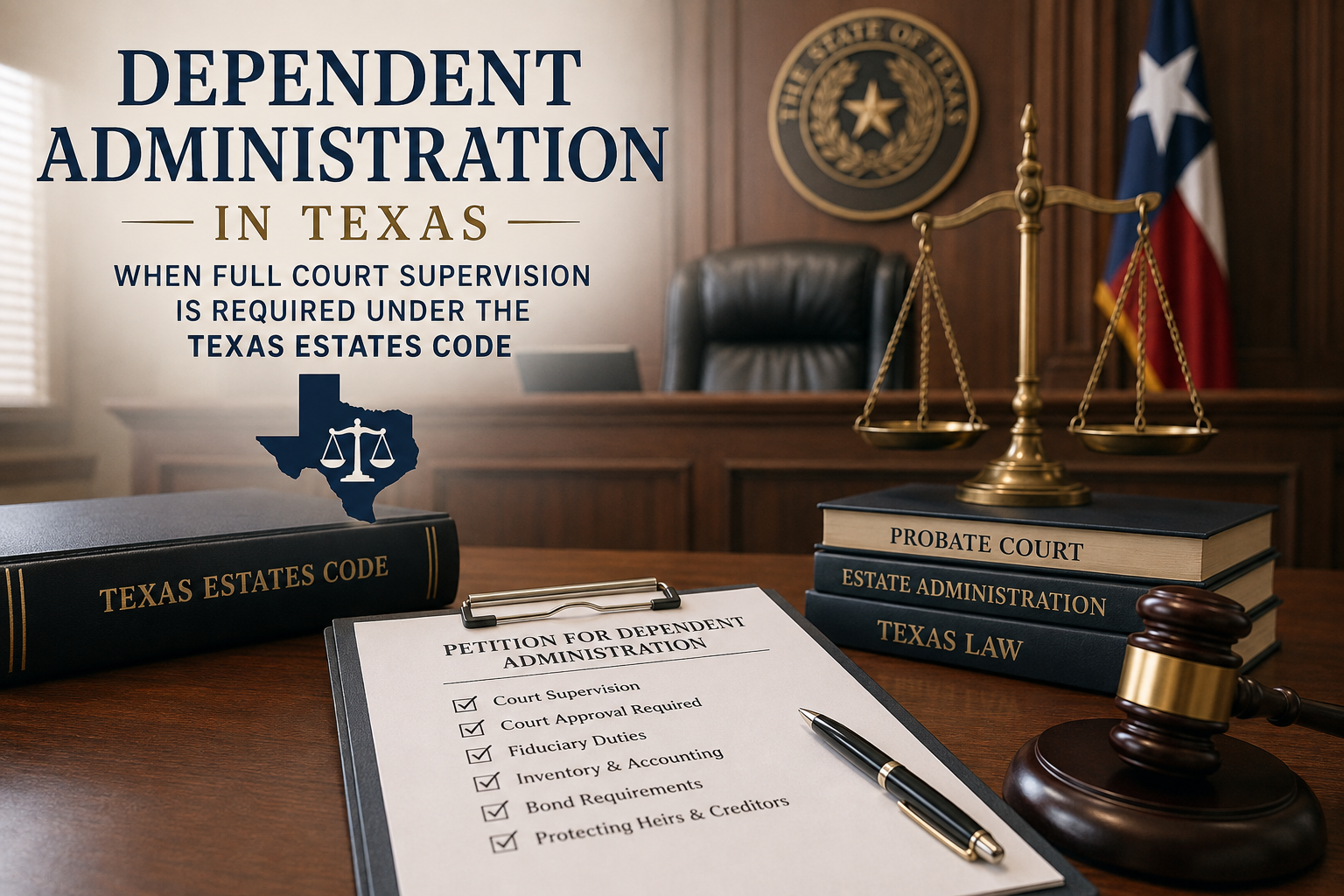
A dependent administration is a probate proceeding in which the personal representative remains under continuing supervision of the probate court.
Unlike an independent executor, a dependent administrator typically cannot simply sell estate property, pay claims, or distribute assets without first obtaining court authorization.
Instead, the administrator frequently files applications, obtains court orders, and submits reports throughout the administration.
Texas Law
The Texas Estates Code expressly recognizes dependent administrations.
Texas Estates Code § 351.051 provides:
"Except as otherwise provided by this title, a personal representative may not sell property of the estate unless the sale is authorized by court order."
This is one of the defining characteristics of dependent administration.
Where an independent executor often has broad authority under a will or statute, a dependent administrator generally must seek court approval before selling estate property.
Why Would a Court Require a Dependent Administration?
Dependent administrations commonly arise when:
- There is no valid will creating an independent administration.
- The heirs cannot agree to an independent administration.
- There are disputes among beneficiaries.
- Creditors' rights require greater judicial supervision.
- A court determines that closer oversight is appropriate to protect the estate.
Sometimes a family believes probate will be straightforward, only to discover that disagreements among heirs make independent administration impossible.
What Court Approval Is Often Required?
Although every estate is different, a dependent administrator may need court approval to:
- Sell real estate
- Sell personal property
- Compromise certain claims
- Pay attorney's fees
- Settle litigation
- Distribute estate assets
Each required court order adds time and expense compared with an independent administration.
Bond Requirements
Dependent administrators are frequently required to post a bond.
The purpose of the bond is to protect heirs and creditors if the administrator improperly handles estate assets.
The amount is generally determined by the probate court based upon the value of the estate and other relevant circumstances.
Inventory and Accounting Requirements
Dependent administrations also involve more extensive reporting obligations.
The administrator may be required to:
- File inventories
- Account for estate income
- Report expenditures
- Seek approval for transactions
- Submit annual accountings in many cases
These safeguards provide transparency but also increase administrative costs.
Independent Administration vs. Dependent Administration
Independent Administration
Dependent Administration
Minimal court supervision
Ongoing court supervision
Many actions require no court approval
Many actions require court approval
Lower legal costs
Higher legal costs
Faster administration
Often slower
Greater flexibility
Greater judicial oversight
Is Dependent Administration Bad?
Not necessarily.
While independent administration is generally more efficient, dependent administration exists for an important reason.
When family members disagree, creditors present substantial claims, or questions arise about the handling of estate property, court supervision can help protect everyone involved.
In many contested estates, the additional oversight ultimately reduces the likelihood of fraud or mismanagement.
Can a Dependent Administration Become Independent?
Sometimes.
If the statutory requirements are later satisfied and all necessary parties consent, it may be possible to seek an independent administration. Whether that option exists depends on the facts of the particular estate and the governing provisions of the Texas Estates Code.
Conclusion
Texas is known for its efficient probate system, but not every estate qualifies for that efficiency. A dependent administration places the estate under ongoing court supervision, requiring judicial approval for many significant transactions that an independent executor could otherwise perform without prior permission.
If you have been appointed as an administrator—or expect disagreements among heirs—it is important to understand which form of administration applies. The difference can affect nearly every aspect of the probate process, from selling property to distributing inheritances.
Disclaimer: This article is for general educational purposes only and is not legal advice. Probate law is highly fact-specific, and anyone dealing with the administration of an estate should consult a qualified Texas probate attorney regarding their particular circumstances.
At David C. Barsalou, Attorney at Law, PLLC, we help clients navigate business, family, tax, estate planning, and real estate matters ranging from document drafting to litigation with clarity and confidence. If you’d like guidance on your situation, schedule a consultation today. Call us at (713) 397-4678, email barsalou.law@gmail.com, or reach us through our Contact Page. We’re here to help you take the next step.