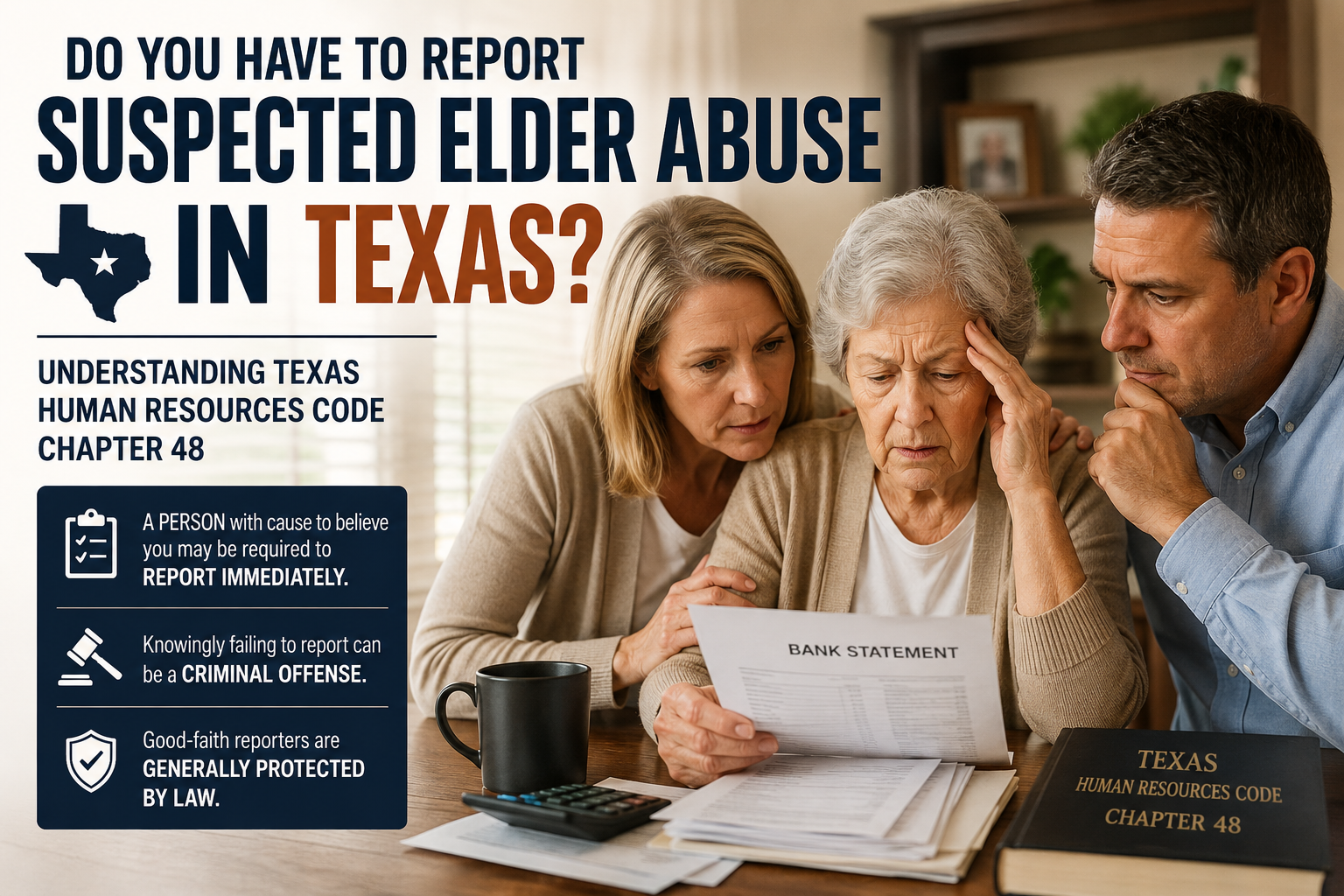
Many Texans probably assume that reporting suspected abuse of an elderly person is primarily the responsibility of doctors, nurses, social workers, nursing-home employees, or law enforcement officers.
Texas law is considerably broader than that.
Under Chapter 48 of the Texas Human Resources Code, the obligation to report suspected abuse, neglect, or exploitation of certain elderly persons and persons with disabilities can apply to ordinary individuals. The statute can become particularly important when family members begin fighting over an aging parent's care, finances, housing, powers of attorney, or estate planning.
For families confronting those situations, understanding the difference between a family disagreement and suspected abuse or exploitation can be important.
Texas Human Resources Code § 48.051 Creates a Broad Reporting Requirement
Texas Human Resources Code § 48.051(a) provides, subject to statutory exceptions and specialized rules for certain facilities and providers, that:
“a person having cause to believe” that an elderly person or person with a disability is in a state of abuse, neglect, or exploitation must report the required information immediately.
The wording matters.
The statute does not merely say that a physician, attorney, caregiver, or government employee must report. It uses the much broader term “a person.”
It also does not require someone to conclusively prove abuse before making a report. The statutory trigger is having cause to believethat the covered person is in a state of abuse, neglect, or exploitation.
That distinction makes sense. A private individual ordinarily will not have the investigative tools necessary to determine conclusively whether exploitation has occurred. Chapter 48 instead establishes a reporting and investigative system.
Who Is an “Elderly Person” Under Texas Law?
For purposes of Chapter 48, Texas Human Resources Code § 48.002 defines an “elderly person” as a person who is 65 years of age or older.
The statute also protects certain persons with disabilities. Accordingly, Chapter 48 is not exclusively an “elder abuse” statute even though elder abuse may be one of its most familiar applications.
The chapter expressly states that its purpose is to provide authority to investigate abuse, neglect, or exploitation and provide protective services to qualifying individuals.
What Counts as Exploitation?
One of the most legally interesting situations involves financial exploitation.
Families sometimes encounter suspicious transactions involving an elderly relative:
- unexplained withdrawals from a bank account;
- a relative suddenly obtaining control over finances;
- questionable transfers of property;
- misuse of a debit or credit card;
- suspicious changes involving financial accounts;
- a caregiver using the elderly person's money for the caregiver's own purposes; or
- pressure to transfer assets to someone who has recently assumed a position of trust.
Not every unusual financial decision is exploitation. Elderly Texans retain their own legal rights, including the right to make decisions other people consider unwise.
Chapter 48 therefore should not be viewed as a mechanism for family members to veto an elderly person's legitimate financial choices merely because they disagree with them.
The concern becomes substantially different when someone is improperly using the elderly person's resources for another person's monetary or personal benefit without informed consent.
Neglect Can Be Different From Intentional Abuse
Chapter 48 also addresses neglect.
That is significant because people sometimes associate protective-services laws exclusively with affirmative misconduct: hitting someone, stealing money, threatening someone, or deliberately withholding care.
Neglect can present a different problem.
An elderly person may be living alone without adequate food, medication, hygiene, utilities, or necessary medical attention. Alternatively, someone who has undertaken responsibility for the person's care may fail to provide necessary goods or services.
This means a Chapter 48 issue can arise even when nobody is accused of intentionally injuring the person.
Family Disputes Can Make the Issue Complicated
These cases can become particularly difficult when several family members disagree about what is happening.
Suppose an 82-year-old widower has three adult children. One child lives nearby and begins handling most of his finances. Another child notices large withdrawals from his bank account and believes money is disappearing. The nearby child responds that every expenditure was authorized by their father.
That dispute may eventually implicate several areas of Texas law.
There may be questions concerning powers of attorney, fiduciary duties, ownership of property, guardianship, probate planning, contractual authority, or civil claims involving improperly transferred assets.
But Chapter 48 creates a separate question:
Does someone have cause to believe that the elderly person is being abused, neglected, or exploited?
The answer does not necessarily depend on whether a civil lawsuit has already been filed.
Failing to Report Can Have Criminal Consequences
The reporting requirement has teeth.
Texas Human Resources Code § 48.052 provides that a person commits an offense when the person has cause to believe that an elderly person or person with a disability has been abused, neglected, or exploited and knowingly fails to report as required by the chapter.
Ordinarily, the statute makes the offense a Class A misdemeanor.
There is also a more serious state-jail-felony provision applicable under particular circumstances involving certain persons with intellectual disabilities, specified facilities, and serious bodily injury.
The important practical point is straightforward: Texas does not treat the reporting obligation merely as a recommendation.
What About a False Report?
The opposite problem also deserves attention.
People should not weaponize Adult Protective Services during an inheritance fight, divorce-related family dispute, guardianship controversy, or personal feud.
Texas Human Resources Code § 48.053 addresses knowingly or intentionally reporting information that the reporter knows is false or lacks a factual foundation.
Thus, Chapter 48 attempts to address both sides of the problem. Texas encourages and, in qualifying circumstances, requires legitimate reports while providing consequences for knowingly false reports.
Does a Good-Faith Reporter Risk Being Sued?
Chapter 48 also contains an important protection for people who participate appropriately in the reporting process.
Texas Human Resources Code § 48.054 generally provides immunity from civil or criminal liability to a person filing a report or participating in a resulting judicial proceeding, unless the person acted “in bad faith or with a malicious purpose.”
That protection is important because otherwise people could be reluctant to report legitimate concerns out of fear that the suspected exploiter would sue them.
The statute does not, however, give someone a free license to fabricate allegations maliciously.
APS Reports and Civil Litigation Are Different Things
A report under Chapter 48 does not automatically determine that abuse or exploitation occurred.
That distinction can become important in civil and probate disputes.
An APS investigation and a civil lawsuit serve different functions. An investigation may determine whether protective intervention is appropriate, while a civil case may concern ownership, damages, fiduciary duties, rescission of transactions, guardianship, or recovery of property.
Likewise, the mere existence of an allegation does not establish liability.
Evidence still matters.
Elder Financial Exploitation Can Overlap With Probate Law
The issue frequently becomes especially important near the end of someone's life.
Imagine that an elderly parent transfers substantial assets to one child shortly before death. After the parent's death, the other heirs discover the transfers.
The resulting dispute may involve questions such as:
- Was the transfer actually authorized?
- Did the parent understand the transaction?
- Was a power of attorney involved?
- Did an agent exceed his or her authority?
- Was the recipient in a confidential or fiduciary relationship with the parent?
- Was there undue influence?
- Was property improperly converted?
- Does the estate have a claim to recover the property?
Those are not all Chapter 48 questions. They may implicate the Texas Estates Code, common-law causes of action, fiduciary principles, and other statutes.
But suspected exploitation discovered while the elderly person is still alive may also trigger the separate reporting framework established by the Human Resources Code.
Do Attorneys Have Special Considerations?
Attorneys encountering suspected exploitation must consider professional duties and applicable privilege and confidentiality rules in addition to Chapter 48.
The facts matter considerably.
A lawyer representing an elderly client, an adult child, an agent under a power of attorney, a proposed guardian, or an estate may occupy very different legal positions. Questions involving confidential client information should therefore be analyzed carefully rather than assuming that the ordinary reporting rule answers every professional-responsibility question.
Special Rules Apply to Certain Facilities
Chapter 48 also contains specialized provisions concerning reports and investigations involving particular facilities, providers, and governmental agencies.
For example, § 48.051 itself distinguishes certain situations involving facilities operated, licensed, certified, or registered by state agencies.
Additionally, § 48.052 expressly states that its failure-to-report provision does not apply in the same manner to alleged abuse, neglect, or exploitation occurring in a facility licensed under Chapter 242 of the Texas Health and Safety Code. Those facilities are governed by a separate statutory reporting framework.
Accordingly, determining where the alleged conduct occurred and what type of facility or provider is involved can be legally significant.
Why Texas's Reporting Law Matters
Texas's approach reflects a difficult balance.
Adults—including elderly adults—retain autonomy. Getting older does not transfer control over someone's life or property to that person's children, relatives, neighbors, or the government.
At the same time, age, disability, isolation, dependency, and declining physical capacity can create opportunities for genuine abuse and financial exploitation.
Chapter 48 attempts to address that vulnerability without requiring private citizens to conduct their own investigations.
When the statutory threshold is met, the law generally requires the concern to be reported so that the appropriate agency can investigate it.
The Bottom Line
Texas law imposes a broader duty to report suspected abuse, neglect, or exploitation of elderly persons and certain persons with disabilities than many people may realize.
Under Texas Human Resources Code § 48.051, the obligation is not limited to doctors or professional caregivers. A person with cause to believe that qualifying abuse, neglect, or exploitation is occurring may have a statutory obligation to report it immediately.
Knowingly failing to make a required report can carry criminal consequences under § 48.052, while § 48.054 generally protects legitimate reporters from liability unless they act in bad faith or with a malicious purpose.
These issues can also intersect with guardianship, powers of attorney, probate disputes, fiduciary litigation, and contested transfers of property. When significant money or family conflict is involved, what initially appears to be a private disagreement may raise considerably broader legal questions.
This article is for general informational purposes only and does not constitute legal advice. The application of Texas law depends on the particular facts and circumstances of each matter.
At David C. Barsalou, Attorney at Law, PLLC, we help clients navigate business, family, tax, estate planning, and real estate matters ranging from document drafting to litigation with clarity and confidence. If you’d like guidance on your situation, schedule a consultation today. Call us at (713) 397-4678, email barsalou.law@gmail.com, or reach us through our Contact Page. We’re here to help you take the next step.