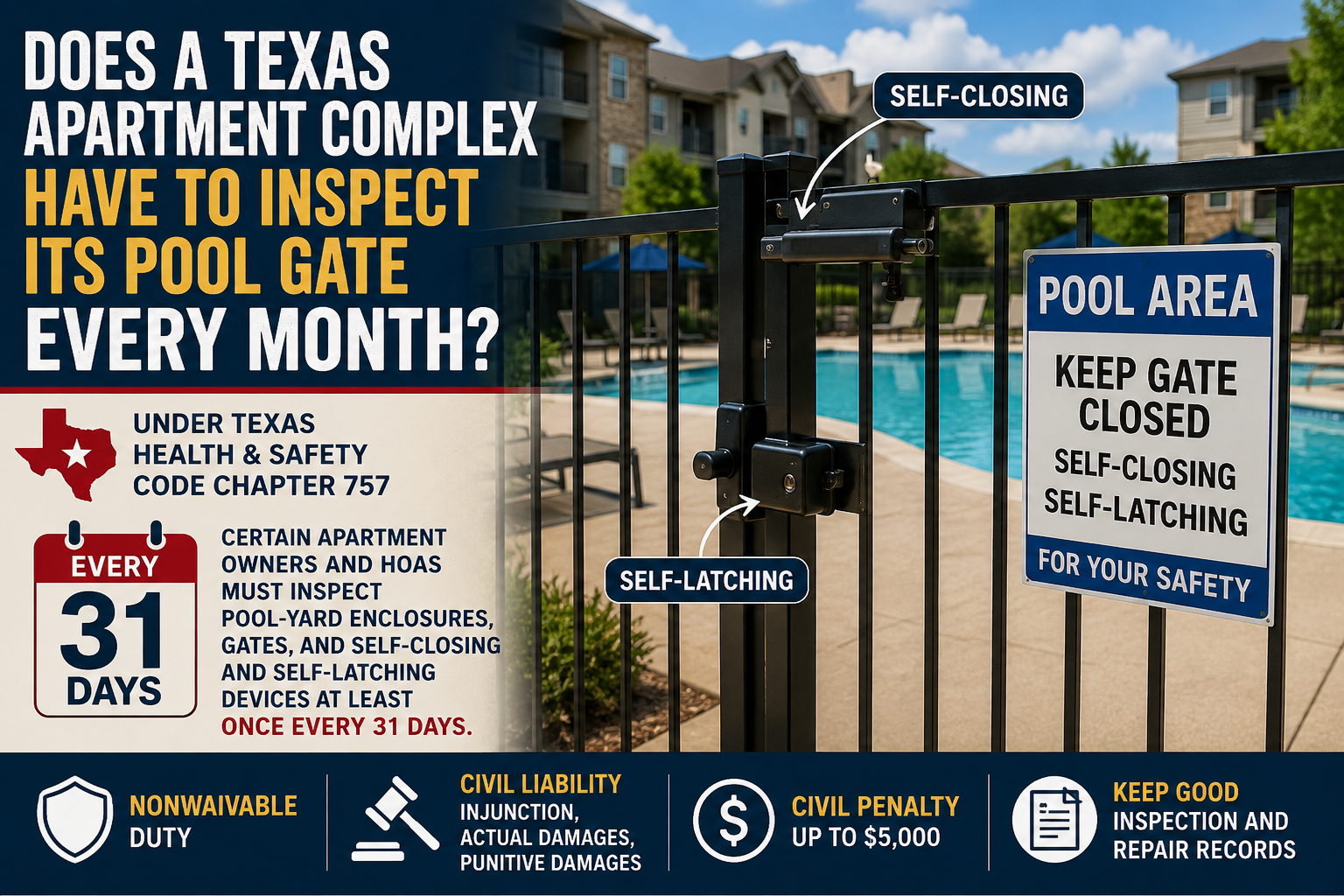
A swimming pool is one of the most common amenities at a Texas apartment complex.
But Texas law regulates something surprisingly specific about that pool: the gate around it.
In fact, Texas Health and Safety Code Chapter 757 imposes detailed requirements concerning pool-yard enclosures at multiunit rental properties and certain properties governed by property owners associations.
Those requirements go well beyond simply putting a fence around a swimming pool.
Texas law regulates gates, latches, doors, windows, and other potential points of access to a pool yard. More remarkably, the law requires certain owners and property owners associations to inspect pool-yard enclosures and gates at least once every 31 days.
Failure to comply can potentially result in an injunction, actual damages, punitive damages in appropriate cases, and even a civil penalty.
For Texas apartment owners, property managers, HOAs, tenants, and personal-injury litigants, Chapter 757 is an unusually specific statute worth understanding.
What Properties Are Covered by Texas Health and Safety Code Chapter 757?
Texas Health and Safety Code § 757.002 defines the basic scope of the chapter.
The statute applies to:
“a pool owned, controlled, or maintained by the owner of a multiunit rental complex or by a property owners association”
and to certain doors and windows of rental dwellings that open into the pool yard.
That makes the statute particularly important for Texas apartment complexes, condominiums, cooperatives, townhome projects, and property owners associations.
The statute is not simply a general rule governing every privately owned backyard swimming pool in Texas. Its application is specifically defined by Chapter 757.
Texas Law Requires a Pool-Yard Enclosure
Texas Health and Safety Code § 757.003 establishes detailed requirements for pool-yard enclosures.
The statute regulates matters such as the height and construction of the enclosure, openings within it, and structures or equipment that might make it easier for someone to climb over the enclosure.
The basic policy is easy to understand: a fence is not particularly useful as a safety device if a child or other unauthorized person can simply climb through, over, or around it.
The statute even addresses objects placed near the fence. Section 757.003 provides that permanent equipment or structures may not be positioned so that they are readily available for climbing over the pool-yard enclosure.
Texas law therefore looks not only at whether a fence technically exists, but also at whether the surrounding arrangement undermines the fence's protective function.
Texas Pool Gates Must Be Self-Closing and Self-Latching
The gate receives its own statutory treatment.
Texas Health and Safety Code § 757.004(a) generally provides that a gate in a required pool-yard fence or wall must:
“have a self-closing and self-latching device”
and must have hardware permitting the gate to be locked.
The gate generally must also:
“open outward away from the pool yard.”
Those details may sound like building-code trivia until an accident occurs.
If a gate is supposed to close and latch automatically but remains hanging open because the mechanism is broken, the enclosure may no longer perform its basic safety function.
That is one reason Chapter 757 does not stop at construction requirements.
It also imposes continuing inspection and maintenance duties.
The 31-Day Inspection Requirement
This is perhaps the most surprising provision in the chapter.
Texas Health and Safety Code § 757.009(c) provides:
“An owner of a multiunit rental complex or a rental dwelling in a condominium, cooperative, or town home project with a pool or a property owners association that owns, controls, or maintains a pool shall inspect the pool yard enclosures, gates, and self-closing and self-latching devices on gates no less than once every 31 days.”
In other words, this is not merely a vague instruction to keep the pool area reasonably safe.
The Texas Legislature created a specific recurring inspection requirement.
For an apartment complex with a swimming pool, checking the gate once when the property opens and assuming it will remain functional indefinitely is not enough.
The inspection must occur no less than once every 31 days.
Owners Must Exercise Ordinary and Reasonable Care
Section 757.009(a) also imposes a broader maintenance obligation.
An owner or property owners association subject to the statute must exercise:
“ordinary and reasonable care to inspect, maintain, repair, and keep in good working order”
the required pool-yard enclosures, gates, and self-closing and self-latching devices within its control.
This distinction matters.
The 31-day requirement creates a minimum inspection schedule, but the statute separately imposes a duty of ordinary and reasonable care concerning inspection, maintenance, and repair.
A property owner therefore should not assume that performing an inspection every 31 days necessarily resolves every possible issue.
For example, if management learns on day five that the gate no longer closes, waiting until the next monthly inspection would raise a very different question from whether the regularly scheduled inspection occurred.
The Statute Also Regulates Doors and Windows
Chapter 757 becomes even more unusual when a residential building itself forms part of the pool enclosure.
Texas Health and Safety Code §§ 757.006 through 757.008 contain requirements governing doors, sliding glass doors, windows, and window screens in certain circumstances.
For example, § 757.007 distinguishes between buildings constructed before and after January 1, 1994.
For certain older buildings, windows forming part of a pool-yard enclosure must have latches, and window screens must be secured by specified means.
For buildings constructed on or after January 1, 1994, the statute provides that certain ground-floor windows in a wall used as part of the pool-yard enclosure must be:
“permanently closed and unable to be opened.”
The reason again is practical. If an apartment wall is effectively serving as part of the barrier surrounding the pool, an easily opened window in that wall can become another means of entering the pool area.
Can a Tenant Request Repairs?
Yes.
Section 757.009(b) addresses specified window latches and door-security devices and requires ordinary and reasonable care in maintaining and repairing those devices after a tenant gives notice or requests repair.
Interestingly, the statute provides that such a request or notice may be oral, unless the lease or applicable written rules require it to be written.
If written notice is required, the statute imposes formatting requirements on that provision.
This is another reason landlords and property managers should be careful about treating Chapter 757 as merely a construction-code issue. The chapter regulates ongoing landlord-tenant relationships as well as physical pool barriers.
The Inspection Duty Cannot Simply Be Waived in the Lease
A particularly important provision appears in § 757.009(d).
It provides that the owner's or property owners association's duty of inspection, repair, and maintenance under that section:
“may not be waived under any circumstances”
and generally may not be enlarged except by written agreement or as otherwise permitted by the chapter.
That language significantly limits the usefulness of lease provisions attempting to transfer responsibility for statutory pool-safety duties to tenants.
A landlord generally cannot take a statutory duty that the Legislature expressly declared nonwaivable and simply make it disappear through boilerplate in a lease.
Can Someone Sue an Apartment Complex for Violating Chapter 757?
Yes.
Texas Health and Safety Code § 757.012 expressly provides an enforcement mechanism.
A tenant, member of a property owners association, governmental entity, or other person or representative may maintain an action against an owner or property owners association for failure to comply with Chapter 757.
Depending on the circumstances, available relief can include a court order requiring compliance and actual damages resulting from the violation.
The statute therefore does considerably more than establish regulatory standards.
It expressly contemplates civil litigation.
Punitive Damages May Be Available in Serious Cases
Chapter 757 also addresses particularly serious conduct.
Section 757.012 permits punitive damages when actual damages were caused by conduct meeting the statutory standard, including intentional, malicious, or grossly negligent actions.
Perhaps even more strikingly, the statute separately addresses a situation in which the owner or association technically complied with Chapter 757 at the time of an accident but was:
“consciously indifferent to access being repeatedly gained to the pool yard by unauthorized persons.”
That is an important provision.
Technical compliance with the physical requirements of the statute does not necessarily give a property owner permission to ignore a known pattern of unauthorized access.
Imagine, for example, that an apartment complex repeatedly discovers children entering the pool area through some recurring means, but management does nothing meaningful about it because the fence and gate technically satisfy the statutory specifications.
Chapter 757 specifically anticipates that type of problem.
A Civil Penalty of Up to $5,000 May Also Be Available
Section 757.012 contains another enforcement mechanism.
If an owner or property owners association fails to comply with the chapter within a reasonable time after receiving the type of written notice described by the statute, a court may award:
“a civil penalty of not more than $5,000”
against the owner or property owners association.
The statute also authorizes a court to award reasonable attorney's fees and costs to the prevailing party in an action involving that civil-penalty provision.
Thus, a broken pool gate can potentially become much more than an ordinary maintenance complaint.
Governmental Authorities Can Enforce the Law Too
Private lawsuits are not the only enforcement mechanism.
Section 757.012(c) authorizes enforcement by the attorney general, local health departments, municipalities, and counties having jurisdiction.
The statute expressly contemplates enforcement mechanisms including inspections, permits, fees, civil fines, criminal prosecutions, injunctions, and, after required notice, governmental construction or repair of noncompliant pool-yard enclosures.
The precise consequences in any particular situation will depend on the facts, applicable regulations, and local governmental authority.
Why the 31-Day Rule Matters in Litigation
Chapter 757 creates an unusually concrete issue for discovery in a lawsuit involving an apartment or HOA swimming pool.
If an accident occurs because a pool gate allegedly failed to close or latch, several obvious questions arise:
When was the gate last inspected?
Who performed the inspection?
Was the self-closing mechanism tested?
Was the latch actually functioning?
Was the inspection documented?
Were there prior complaints?
Had management previously discovered the gate standing open?
Had unauthorized people repeatedly entered the pool yard?
Were repair requests made?
Those questions can lead directly to maintenance logs, work orders, emails, inspection records, surveillance footage, photographs, witness testimony, and other evidence.
And because § 757.009(c) supplies a concrete 31-day inspection requirement, the records can potentially be compared against an objective statutory timeline rather than merely a property's informal maintenance practices.
Chapter 757 Is Particularly Important for Texas Apartment Owners and Property Managers
For landlords and property managers, the practical lesson is straightforward.
A pool fence is not something that should simply be installed and forgotten.
Chapter 757 requires ongoing attention to the enclosure, gates, self-closing mechanisms, latches, and certain doors and windows.
Apartment management should consider maintaining clear inspection and repair records showing when required components were examined, what condition they were in, what problems were identified, and when repairs were completed.
Those records may become extremely important if an accident later occurs.
The Bottom Line
Texas law is surprisingly specific about swimming-pool gates at apartment complexes and certain properties controlled by property owners associations.
Texas Health and Safety Code Chapter 757 regulates pool-yard enclosures, gates, doors, windows, locks, latches, inspection, repair, and maintenance.
Most notably, § 757.009 requires covered owners and property owners associations to inspect pool-yard enclosures, gates, and required self-closing and self-latching gate devices at least once every 31 days.
That duty cannot simply be waived away.
And if Chapter 757 is violated, the consequences can potentially include injunctive relief, actual damages, punitive damages in appropriate cases, civil penalties, attorney's fees in specified circumstances, and governmental enforcement.
For something as ordinary as an apartment swimming-pool gate, Texas law provides a remarkably detailed legal framework.
This article is for general informational purposes only and does not constitute legal advice. The application of Texas law depends on the particular facts and circumstances of each case.
At David C. Barsalou, Attorney at Law, PLLC, we help clients navigate business, family, tax, estate planning, and real estate matters ranging from document drafting to litigation with clarity and confidence. If you’d like guidance on your situation, schedule a consultation today. Call us at (713) 397-4678, email barsalou.law@gmail.com, or reach us through our Contact Page. We’re here to help you take the next step.