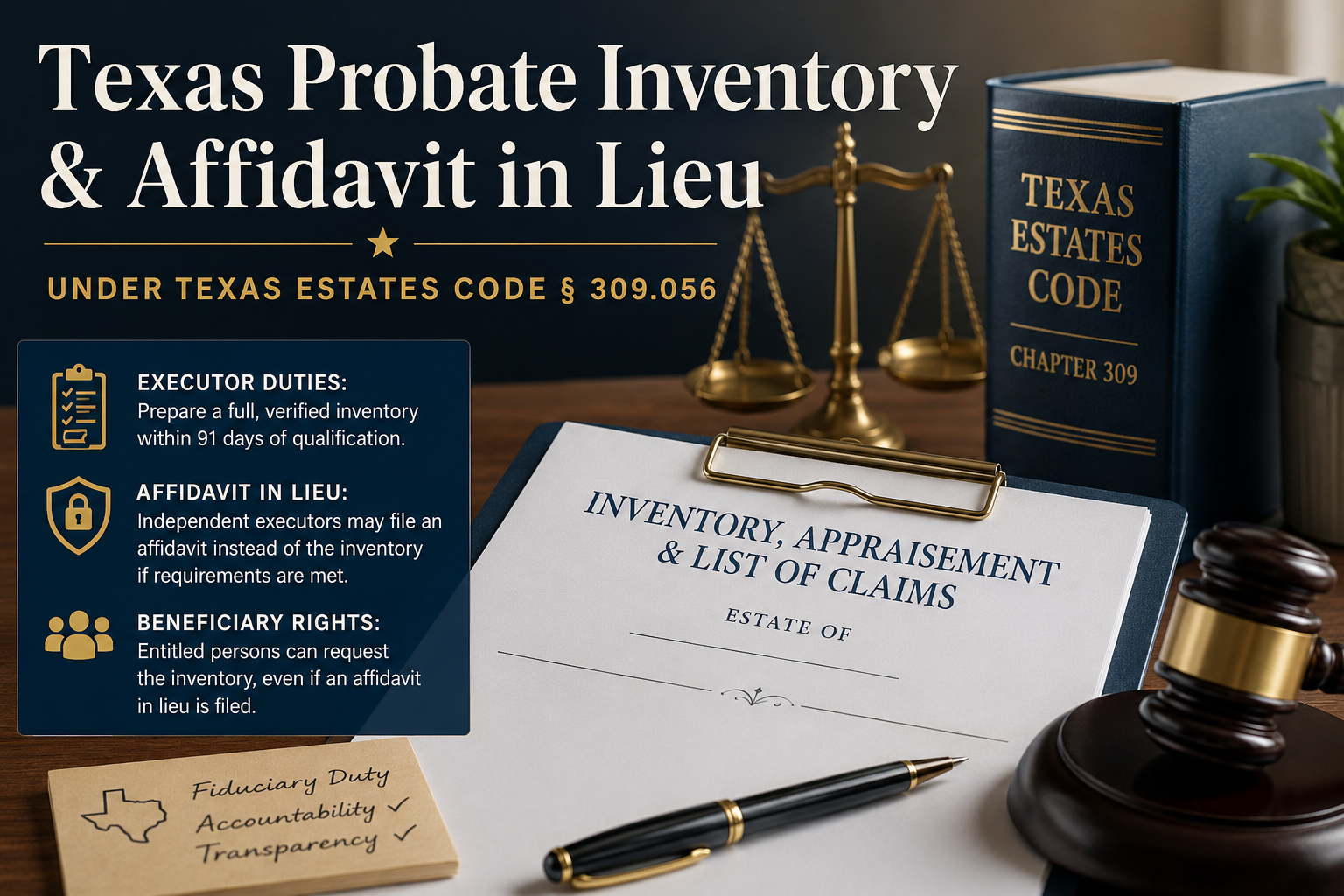
One of the first substantial duties facing a personal representative in a Texas probate proceeding is figuring out exactly what the estate owns.
Texas law generally requires a personal representative to prepare a detailed inventory, appraisement, and list of claims shortly after qualifying to administer an estate.
But there is an important exception.
In many independent administrations, the executor may be able to file an affidavit in lieu of the inventory with the probate court. The detailed inventory still has to be prepared and provided to the appropriate beneficiaries, but it does not necessarily have to become part of the public probate file.
The distinction is technical, but it can matter considerably for privacy, probate administration, and compliance with an executor's statutory duties.
What Is a Texas Probate Inventory?
Texas Estates Code § 309.051 generally requires a personal representative to prepare and file a verified, full, and detailed inventory of estate property.
The statute provides in part that the representative must prepare:
“a verified, full, and detailed inventory of all estate property that has come into the representative's possession or of which the representative has knowledge.”
The inventory must generally include all estate real property located in Texas and all estate personal property regardless of where that personal property is located.
That geographic distinction is easy to overlook.
For example, Texas real estate belonging to the estate generally belongs in the inventory. Personal property may also belong in the inventory even when it is physically located outside Texas.
The inventory is therefore considerably more than a casual list of belongings.
The Inventory Must Address Separate and Community Property
Texas's community-property system creates another layer of complexity.
Section 309.051 requires the inventory to state whether the decedent was married when the decedent died.
If so, the inventory must specify which property, if any, is separate property and which property, if any, is community property.
That can turn what appears to be a simple probate inventory into a characterization problem.
Suppose, for example, that a married decedent dies owning:
- a house purchased before marriage;
- a joint checking account;
- brokerage investments accumulated during marriage;
- inherited land;
- household furnishings;
- a vehicle; and
- an ownership interest in a closely held business.
Determining what belongs to the probate estate is not necessarily the same exercise as determining what assets bear the decedent's name.
Ownership, marital-property characterization, beneficiary designations, survivorship rights, and other legal arrangements can affect the analysis.
How Must Property Be Valued?
The inventory is also an appraisement.
Texas Estates Code § 309.051(b) generally requires the personal representative to state the fair market value on the date of the decedent's death for each item included in the inventory.
That date matters.
The relevant figure is not necessarily:
- what the decedent originally paid;
- what the property is worth when the inventory is prepared;
- what an heir thinks it is worth; or
- what the executor eventually receives when the property is sold.
For probate-inventory purposes, the statute looks to fair market value on the date of death.
For some assets, determining that value may be relatively straightforward. For others—such as closely held businesses, unusual real estate, mineral interests, collectibles, or other illiquid property—valuation can become substantially more complicated.
What Is the Deadline for a Texas Probate Inventory?
The deadline comes quickly.
Under the current version of Texas Estates Code § 309.051(a), unless an exception applies or the court grants additional time, the personal representative must prepare and file the required instrument:
“before the 91st day after the date the personal representative qualifies.”
That effectively creates a 90-day period following qualification.
The court may grant a longer period. Interestingly, § 309.051(c) also permits a court, for good cause shown, to require the inventory and appraisement to be filed within a shorter period.
An executor should therefore not assume that the inventory can simply wait until the estate is ready to close.
What Is the “List of Claims”?
The statutory filing is formally called an inventory, appraisement, and list of claims for a reason.
Texas Estates Code § 309.052 requires a complete list of claims due or owing to the estate to accompany an inventory filed under § 309.051.
This refers to obligations owed to the estate, rather than merely debts that the estate owes other people.
The statute requires information concerning each such claim, including matters such as the debtor, nature of the obligation, relevant dates, amount, interest, and—when applicable—whether the claim constitutes separate or community property.
This is another reason probate administration can require considerably more investigation than simply finding the decedent's bank accounts.
Does the Executor Always Have to File the Detailed Inventory With the Court?
No.
This is where Texas Estates Code § 309.056 becomes especially important.
The statute permits an independent executor, when the statutory requirements are satisfied, to file an affidavit in lieu of the inventory, appraisement, and list of claims.
That can keep the estate's detailed asset information from being placed directly into the probate court's public file.
But the affidavit is not a way to avoid preparing the inventory.
That distinction is crucial.
When Can an Independent Executor Use an Affidavit in Lieu of Inventory?
Section 309.056(b) establishes the principal requirements.
Among other things, at the time the inventory is due, including any extensions, there generally must be no unpaid debts other than secured debts, taxes, and administration expenses.
If the requirements are satisfied, the independent executor may file an affidavit stating that the applicable debts have been paid and that the beneficiaries who are entitled to receive the inventory have received:
“a verified, full, and detailed inventory and appraisement.”
Thus, the statute changes where the detailed inventory goes.
Instead of filing the complete inventory with the court clerk, the independent executor can provide it to the appropriate beneficiaries and file the statutory affidavit with the court.
Why Would an Executor Choose the Affidavit Instead?
Privacy is an obvious reason.
A traditional filed inventory can contain substantial information about the estate's assets and their values.
Depending on the estate, that might include information about:
- real estate;
- bank and investment accounts;
- business interests;
- valuable personal property;
- money owed to the decedent; and
- other significant assets.
Using the affidavit procedure can therefore reduce the amount of detailed financial information placed into the court record.
It does not, however, make the information secret from beneficiaries and other persons who may have statutory rights to obtain it.
Does Every Beneficiary Have to Receive the Inventory Automatically?
Not necessarily.
Section 309.056(b-1) identifies certain beneficiaries to whom an independent executor does not automatically have to provide the verified inventory absent a written request.
These include, subject to the statute's precise requirements, certain beneficiaries whose aggregate devises have an estimated value of $2,000 or less, beneficiaries who have already received everything to which they are entitled, and beneficiaries who have waived in writing their right to receive the inventory and appraisement.
But the written-request provisions remain important.
Section 309.056(c) gives persons interested in the estate certain rights to request the information even when an affidavit in lieu has been filed.
Can an Interested Person Still Obtain the Inventory?
Potentially, yes.
The affidavit-in-lieu procedure should not be confused with a rule allowing an executor to conceal estate property.
Section 309.056(c) provides that a person interested in the estate—including certain possible heirs and beneficiaries under prior wills—is entitled to receive a copy from the independent executor upon written request.
If the executor does not comply, the interested person may apply to the probate court for an order compelling compliance.
The court has statutory discretion concerning that application.
So while the affidavit procedure can keep the detailed inventory outside the ordinary court filing, it does not necessarily keep the information away from people with a legitimate interest in the estate.
What Happens If the Executor Misses the Deadline?
Failing to address the inventory requirement can have consequences.
Texas Estates Code § 309.057 allows an interested person, by written complaint, or the court on its own motion to have a delinquent personal representative cited to file the required inventory or affidavit and explain the failure.
If the representative does not file the required document after being cited or cannot show good cause for the delay, the court may impose a fine of up to $1,000.
The statute further provides that the representative and the representative's sureties, if any, can be liable for the fine as well as damages and costs resulting from the failure.
A probate inventory is therefore not merely an optional piece of estate bookkeeping.
It is a statutory duty.
What If the Executor Lies in the Affidavit?
Texas law separately addresses misrepresentations in an affidavit in lieu.
Under Texas Estates Code § 309.0575, a court may impose a fine of up to $1,000 if it finds, after the required procedure, that an independent executor misrepresented that the required beneficiaries received the verified, full, and detailed inventory and appraisement.
The executor and any applicable sureties may also face liability for resulting damages and costs.
The affidavit procedure is therefore a convenience—not a loophole.
An executor should not sign the affidavit unless its representations are actually true.
What Happens If Additional Property Is Discovered Later?
Probate inventories are not necessarily frozen forever on the day they are prepared.
Texas Estates Code § 309.101 addresses property or claims discovered later.
If a representative who filed an inventory later obtains possession or knowledge of additional estate property or claims, the representative generally must promptly file a supplemental inventory, appraisement, and list of claims.
When an affidavit in lieu was used, the statute instead provides for a supplemental affidavit stating that the beneficiaries have received a verified, full, and detailed supplemental inventory and appraisement.
This situation is not particularly exotic.
An executor may discover an old bank account, mineral interest, promissory note, forgotten parcel of land, refund, business interest, or other asset months after probate begins.
Finding another asset does not necessarily mean the original administration was defective. But it can create an additional statutory obligation.
Can Someone Challenge an Inaccurate Probate Inventory?
Yes.
Texas Estates Code Chapter 309 contains procedures for dealing with omitted, erroneous, or unjust inventory items.
For example, § 309.102 permits an interested person to complain that estate property or claims were omitted. If the court determines that the complaint is valid, it can order an additional inventory, appraisement, or list of claims.
Section 309.103 separately permits challenges to particular items alleged to be erroneous or unjust.
That can matter when beneficiaries disagree with the executor about whether property belongs to the estate, how it has been characterized, or how it has been valued.
Is the Probate Inventory Conclusive Evidence of Ownership or Value?
No.
Texas Estates Code § 309.151 gives an approved inventory evidentiary significance, but it does not make the inventory infallible.
The statute expressly provides circumstances in which the inventory is not conclusive for or against the personal representative, including when estate property or claims were omitted or their actual value exceeded the value stated in the appraisement.
That distinction is important.
An inventory is an important probate document. It is not necessarily a final judicial determination resolving every possible dispute over title, characterization, or value.
The Practical Difference: Filing an Inventory vs. Filing an Affidavit in Lieu
The distinction can be summarized fairly simply.
With a traditional inventory, the personal representative prepares the detailed inventory, appraisement, and list of claims and files the instrument with the probate court.
With a qualifying affidavit in lieu, an independent executor still prepares the detailed information and provides it as required, but files the statutory affidavit with the court instead of putting the complete inventory into the court record.
In either situation, the executor must take the inventory process seriously.
The affidavit in lieu eliminates a filing requirement under specified circumstances. It does not eliminate the underlying obligation to identify and value the estate.
Why This Technical Requirement Matters
Probate administration involves considerably more than obtaining letters testamentary and distributing property.
A personal representative is taking control of property belonging to an estate and ultimately to creditors and beneficiaries. Texas law therefore imposes formal accounting and disclosure obligations early in the administration.
The inventory requirement helps establish what property exists, how it is characterized, and what it was worth when the decedent died.
The affidavit-in-lieu procedure balances that accountability against another legitimate concern: there is not always a good reason to put a family's complete financial inventory into a public court record.
For independent executors who qualify, Texas Estates Code § 309.056 can therefore be an extremely useful probate tool.
But the procedure is technical. The executor still must prepare the required information, satisfy the statutory debt requirements, provide the inventory to the appropriate beneficiaries, meet the filing deadline, and respond appropriately to requests from persons entitled to the information.
For executors and beneficiaries alike, understanding the difference between the inventory itself and the affidavit filed in lieu of that inventory can prevent unnecessary confusion during a Texas probate administration.
This article is for general informational purposes only and does not constitute legal advice. Probate requirements depend on the facts of the particular estate and the type of administration involved.
At David C. Barsalou, Attorney at Law, PLLC, we help clients navigate business, family, tax, estate planning, and real estate matters ranging from document drafting to litigation with clarity and confidence. If you’d like guidance on your situation, schedule a consultation today. Call us at (713) 397-4678, email barsalou.law@gmail.com, or reach us through our Contact Page. We’re here to help you take the next step.