When someone dies and a will is admitted to probate in Texas, beneficiaries sometimes assume the probate court will automatically contact everyone named in the will.
That is not generally how the process works.
Instead, the Texas Estates Code places an important notice obligation on the personal representative of the estate. In many probate administrations, the executor or administrator must notify beneficiaries that the will has been admitted to probate—and Texas law establishes specific deadlines and requirements for doing so.
The rule can be easy to overlook because it operates alongside several other early probate deadlines involving inventories, creditors, bonds, and administration of estate property.
For executors and beneficiaries alike, Texas Estates Code Chapter 308 is worth understanding.
The General Rule: Beneficiaries Must Be Notified Within 60 Days
Texas Estates Code § 308.002 establishes the basic deadline.
The statute provides, subject to certain exceptions, that:
“not later than the 60th day after the date of an order admitting a decedent's will to probate”
the personal representative must give the statutorily required notice to beneficiaries whose identity and address are known or can be determined through reasonable diligence. Tex. Est. Code § 308.002(a). (Texas Legislature Online)
Importantly, the statute expressly includes an independent executor or independent administrator within this requirement.
That means independent administration does not generally eliminate the beneficiary-notice requirement merely because the executor is administering the estate with relatively little court supervision.
The triggering event is also important.
The statute measures the 60-day period from the order admitting the will to probate, rather than simply from the date of death or the date someone files a probate application.
What If the Executor Cannot Find a Beneficiary?
An executor is not necessarily excused merely because the beneficiary's address is not immediately known.
Section 308.002(a) applies when the beneficiary's identity and address are known or “through reasonable diligence, can be ascertained.”
That language effectively requires the representative to make a reasonable effort to determine where the beneficiary can be reached.
The statute also anticipates that information sometimes turns up later.
If the representative learns the identity and address of a beneficiary only after the original 60-day deadline, the statute provides that the representative must give the required notice “as soon as possible”after becoming aware of that information. Tex. Est. Code § 308.002(a). (Texas Legislature Online)
Thus, reaching day 61 does not necessarily make the obligation disappear.
What Must the Beneficiary Notice Actually Say?
Sending a beneficiary a vague letter saying, “You may be interested in an estate” is not necessarily enough.
Texas Estates Code § 308.003 prescribes the contents of the notice.
Among other things, the notice must identify the beneficiary and decedent, state that the decedent's will has been admitted to probate, state that the recipient is named as a beneficiary, and provide the personal representative's name and contact information.
The statute then requires either:
“a copy of the will that was admitted to probate and of the order admitting the will to probate”
or specified information summarizing the beneficiary's gifts and identifying the probate proceeding. Tex. Est. Code § 308.003(6). (Texas Legislature Online)
That second option can be particularly useful.
Instead of necessarily providing the entire will and probate order, the representative may provide a summary of the beneficiary's gifts together with information including the court, docket number, date the will was admitted to probate, and—if different—the date the representative was appointed.
Does Every Person Named in the Will Have to Receive Notice?
No.
Section 308.002 contains several important exceptions.
For example, notice is not required under this provision for a beneficiary who made an appearance in the estate proceeding before the will was admitted to probate.
There is also an exception for a beneficiary who:
“is entitled to receive aggregate gifts under the will with an estimated value of $2,000 or less.”
Tex. Est. Code § 308.002(c)(2). (Texas Legislature Online)
Another exception applies when the beneficiary has already received all gifts to which the beneficiary is entitled under the will within the statutory 60-day period.
The statute also permits a beneficiary, under specified circumstances, to waive the notice after receiving a copy of the admitted will or a written summary of the beneficiary's gifts. The waiver must satisfy the statutory requirements, including being signed by the beneficiary and filed with the court.
These exceptions matter because an executor should not simply assume that every name appearing anywhere in a will requires an identical notice.
Special Rules Apply to Certain Beneficiaries
The statute also recognizes that notice cannot always simply be mailed directly to the person ultimately benefiting from the will.
Section 308.002 contains special provisions addressing certain beneficiaries, including beneficiaries of trusts and minors. For example, if a beneficiary is a minor and no guardian or conservator has been appointed, the statute generally directs notice to a parent of the minor. If a charitable beneficiary cannot be notified for some reason, notice is directed to the Texas Attorney General. (Justia Law)
Trust interests can be even more technical because the identity of the person who should receive notice may depend upon the nature of the beneficiary's interest.
This is one reason beneficiary-notice compliance should involve actually reading the will rather than simply generating letters from a list of names.
The Notice Must Use a Qualified Delivery Method
Texas law also regulates how the notice is delivered.
Section 308.002(d) provides:
“The notice required by this section must be sent by a qualified delivery method.”
Tex. Est. Code § 308.002(d). (Texas Statutes)
This is an important procedural point. Executors should preserve documentation showing when and how the notices were sent rather than treating beneficiary notification as an informal communication.
A telephone call, text message, or family conversation may tell someone that he or she is a beneficiary, but informal knowledge is not necessarily the same thing as statutory compliance with Chapter 308.
There Is Another Deadline at 90 Days
The 60-day deadline is not the end of the process.
Texas Estates Code § 308.004 imposes a second requirement.
Generally, no later than the 90th day after the order admitting the will to probate, the personal representative must file either a sworn affidavit or a certificate signed by the representative's attorney addressing compliance with the beneficiary-notice requirements.
The statute begins:
“Not later than the 90th day after the date of an order admitting a will to probate”
the required affidavit or certificate must be filed with the clerk. Tex. Est. Code § 308.004(a). (FindLaw)
The filing identifies beneficiaries who received required notice, beneficiaries falling within specified exceptions, and beneficiaries whose identity or address could not be determined despite reasonable diligence.
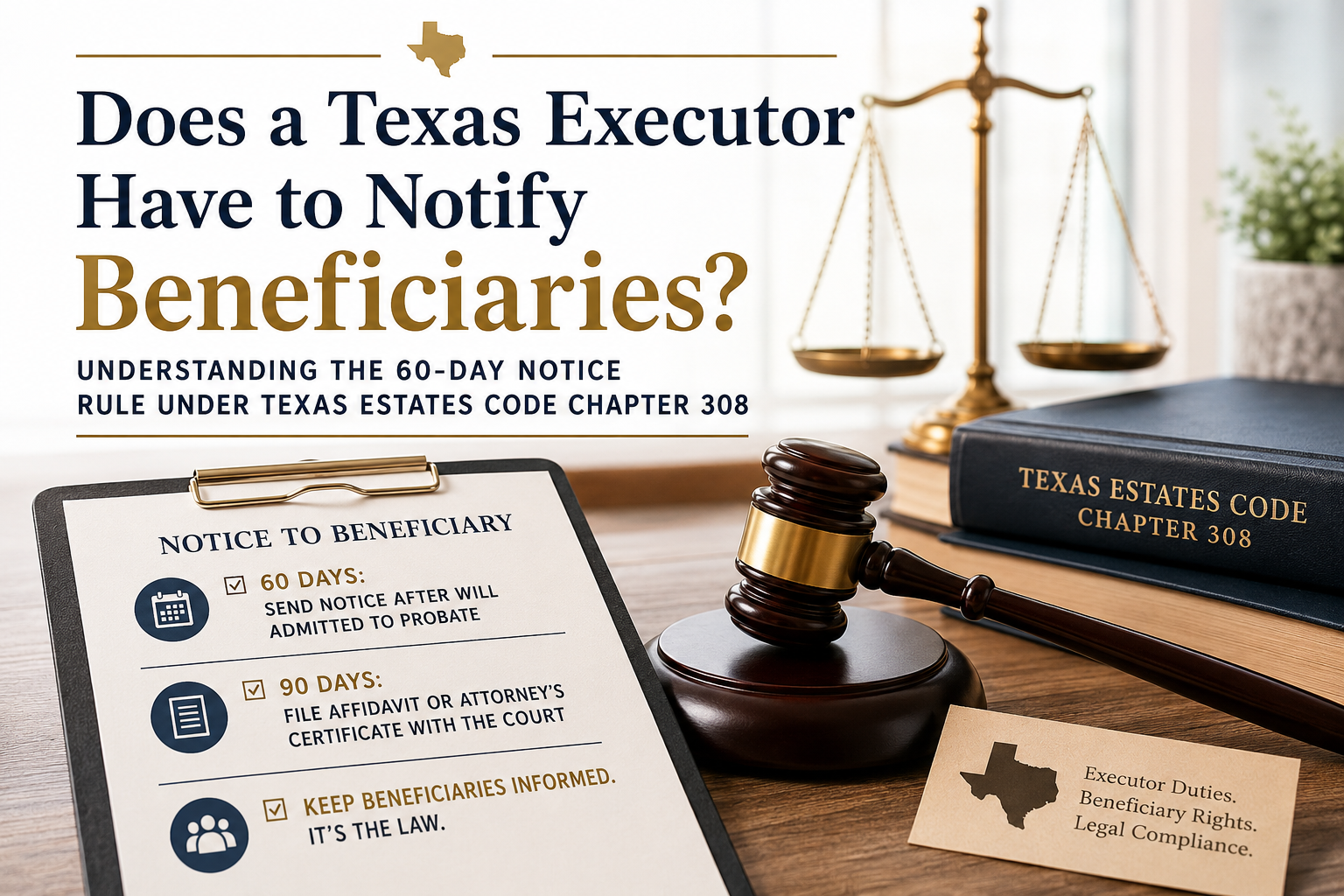
In practical terms, Chapter 308 therefore creates a useful two-stage calendar:
60 days: generally send the required beneficiary notices.
90 days: generally file the affidavit or attorney's certificate concerning compliance.
That distinction is easy to miss.
The Certificate Can Be Combined With Other Probate Filings
Texas law provides some procedural flexibility.
Section 308.004(b) permits the required affidavit or certificate to be included with another document filed in the probate case, including the estate's inventory or an affidavit in lieu of inventory, provided the document is filed by the applicable deadline. (Justia Law)
That can simplify administration, but it does not eliminate the deadline.
An executor who plans to combine filings still needs to ensure that the combined document reaches the clerk on time.
Does This Rule Apply to a Muniment of Title?
There is an important exception that illustrates why probate procedures should not be treated as interchangeable.
Texas Estates Code § 308.0015 states:
“This subchapter does not apply to the probate of a will as a muniment of title.”
Tex. Est. Code § 308.0015. (Texas Legislature Online)
That makes sense structurally. A muniment-of-title proceeding is fundamentally different from an ordinary estate administration involving a personal representative carrying out continuing administrative duties.
Accordingly, someone should not assume that every probate proceeding creates precisely the same Chapter 308 obligations.
Why Beneficiary Notice Matters
The requirement serves a straightforward purpose.
A person can be named in a will without knowing it.
The beneficiary may not have participated in the probate proceeding, may live in another state, may have had little recent contact with the decedent, or may not even know that the decedent has died.
Chapter 308 creates a formal mechanism for informing that beneficiary that:
- the decedent's will has been admitted to probate;
- the beneficiary is named in that will;
- an estate administration is underway; and
- there is an identified personal representative administering the estate.
For beneficiaries, receipt of the notice can be the first indication that they have an interest in an estate.
For executors, the requirement is another example of why serving as executor involves much more than simply collecting property and eventually writing checks.
Executors Should Calendar Probate Deadlines Immediately
Texas probate law contains numerous deadlines that can arise shortly after an executor qualifies.
The beneficiary-notice requirements under Chapter 308 are particularly easy to overlook because they may seem administrative rather than substantive.
But the statute uses mandatory language: the personal representative “shall give notice” and later “shall file” the required affidavit or certificate. Tex. Est. Code §§ 308.002, 308.004. (Texas Legislature Online)
A prudent executor should therefore identify the beneficiaries, determine which statutory exceptions apply, locate beneficiaries whose addresses are not immediately known, send compliant notices through the proper delivery method, preserve proof of delivery, and calendar the separate filing deadline.
The Bottom Line
In a typical Texas probate administration involving a will, the executor cannot simply assume that beneficiaries will learn about their inheritance on their own.
Texas Estates Code § 308.002 generally requires the personal representative to notify qualifying beneficiaries no later than 60 days after the will is admitted to probate. The notice must contain specific information and must be sent using a qualified delivery method.
Then, under § 308.004, a separate affidavit or attorney's certificate generally must be filed with the probate court by the 90th day.
There are important exceptions—including certain small gifts, beneficiaries who have already received everything they are entitled to receive, qualifying waivers, and muniment-of-title proceedings—but those exceptions should be evaluated carefully rather than assumed.
For executors, these rules are another reminder that probate administration is a deadline-driven legal process. For beneficiaries, they provide a statutory mechanism designed to ensure that being named in a will does not remain a secret indefinitely.
At David C. Barsalou, Attorney at Law, PLLC, we help clients navigate business, family, tax, estate planning, and real estate matters ranging from document drafting to litigation with clarity and confidence. If you’d like guidance on your situation, schedule a consultation today. Call us at (713) 397-4678, email barsalou.law@gmail.com, or reach us through our Contact Page. We’re here to help you take the next step.