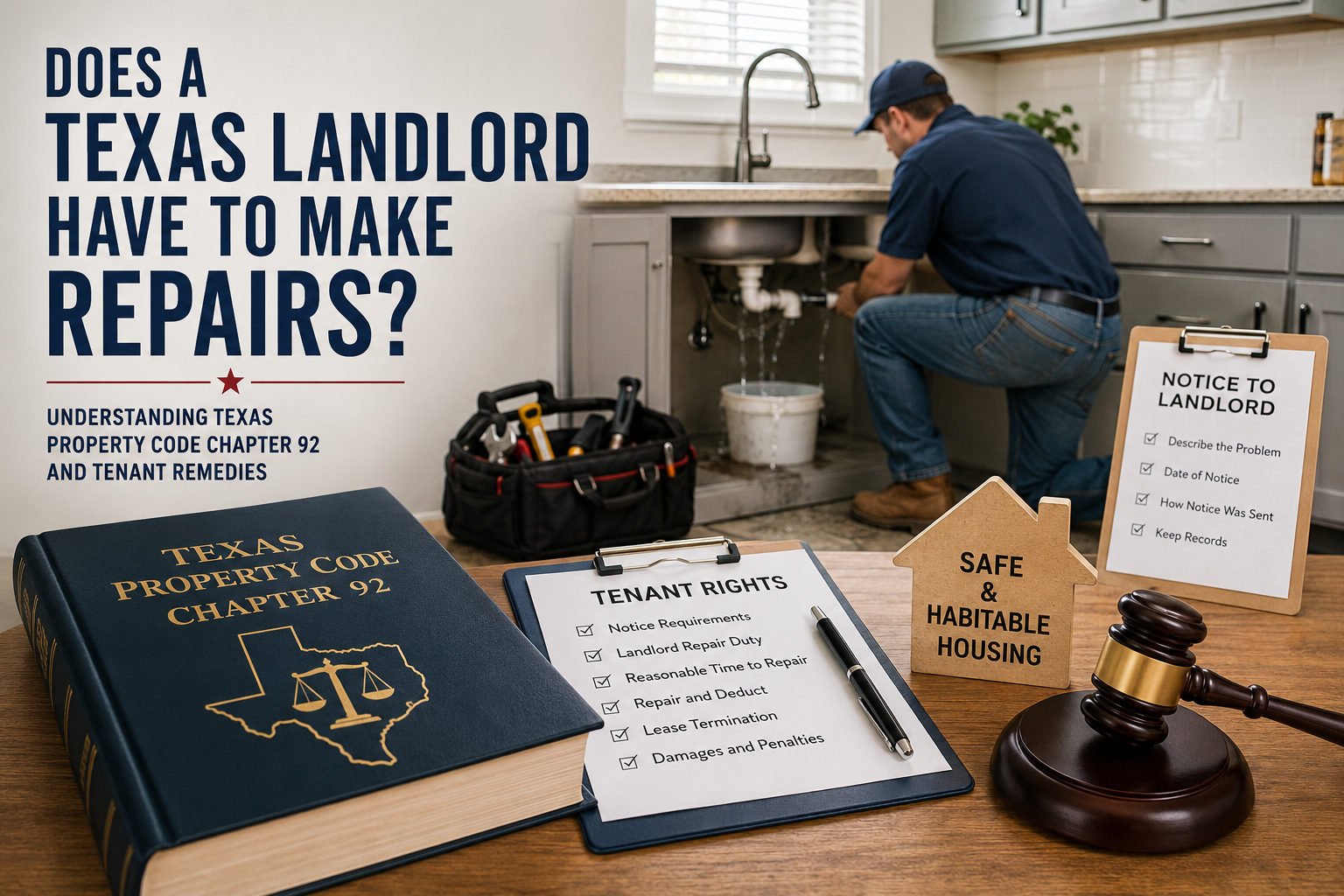
A broken air conditioner in August. A leaking roof. Sewage backing up into a bathroom. An electrical problem that makes part of a house unsafe.
When something serious goes wrong in a Texas rental property, one of the first questions is usually simple:
Does the landlord legally have to fix it?
The answer is often yes—but Texas law does not require landlords to repair every inconvenience, and tenants generally must follow specific procedures before many statutory remedies become available.
The principal rules governing residential repairs appear in Subchapter B of Chapter 92 of the Texas Property Code. Those provisions establish when a landlord has a duty to repair, what notice a tenant must provide, how long a landlord ordinarily has to respond, and what remedies may become available if the landlord does not comply.
Understanding those requirements matters to both landlords and tenants because seemingly minor procedural mistakes can substantially change their legal rights.
The Basic Texas Landlord Repair Duty
Texas Property Code § 92.052 establishes the basic repair obligation.
Generally, a landlord must make a diligent effort to repair or remedy a condition when the tenant has given the landlord proper notice and the condition:
“materially affects the physical health or safety of an ordinary tenant.”
That language is important.
Texas law does not simply say that a landlord must repair anything a tenant dislikes. The statutory standard focuses on conditions materially affecting the physical health or safety of an ordinary tenant.
That distinction can separate a genuine statutory repair case from an ordinary maintenance disagreement.
A serious plumbing failure, dangerous electrical condition, lack of essential utilities caused by a condition the landlord is responsible for, or similar substantial problem may implicate the statute.
A cosmetic defect ordinarily presents a very different question.
The Tenant Generally Must Be Current on Rent
Section 92.052 also contains a requirement tenants sometimes overlook.
Subject to the statute's particular provisions and exceptions, the landlord's repair duty is tied to the tenant being current on rent when the required notice is given.
This can become extremely important in an actual dispute.
Suppose a tenant stops paying rent because the tenant believes the property needs repairs and then demands that the landlord perform them. The tenant should not automatically assume that withholding rent was authorized.
Texas provides specific statutory remedies for repair disputes. Simply deciding not to pay rent can create a separate lease-default problem.
Notice Matters
A landlord generally cannot repair a condition the landlord does not know exists.
Texas Property Code § 92.056 therefore establishes notice requirements before many tenant remedies become available.
The manner in which notice is delivered can matter. In particular, the statute distinguishes certain notices sent by certified mail, return receipt requested, registered mail, or another form of mail that allows tracking of delivery from other forms of notice.
Depending on how notice was provided, a tenant may need to give a second notice before exercising certain statutory remedies.
This is one reason both landlords and tenants should keep good records.
A tenant should be able to establish:
- what condition was reported;
- when it was reported;
- how notice was delivered; and
- what the landlord did in response.
Likewise, a landlord receiving a repair request should document the request, inspections, communications with the tenant, contractor scheduling, attempted access, and completed repairs.
How Long Does a Texas Landlord Have to Make a Repair?
One of the most common misconceptions is that Texas law imposes a universal deadline—24 hours, three days, seven days, or some other fixed period—for every residential repair.
The actual rule is more nuanced.
Section 92.056 uses a “reasonable time” standard.
The statute creates a rebuttable presumption that seven days is a reasonable time, but seven days is not an absolute deadline applicable to every situation. The nature and severity of the condition and the reasonable availability of labor, materials, and utilities can affect the analysis.
That makes practical sense.
A dangerous electrical condition may demand much faster action than a comparatively minor repair. Conversely, a landlord may have difficulty obtaining a specialized replacement component immediately after a hurricane or other event that creates widespread shortages.
The question is ultimately whether the landlord acted reasonably under the circumstances.
Can a Texas Tenant Terminate the Lease Because Repairs Were Not Made?
Potentially.
If the statutory requirements are satisfied and the landlord remains liable under § 92.056, the tenant may have several options.
One of the most significant is termination of the lease.
Section 92.056 provides that an eligible tenant may:
“terminate the lease.”
A tenant who properly terminates under the statute may also be entitled to a prorated refund of rent and treatment of the security deposit as provided by the statute.
But this remedy should not be confused with simply moving out because the tenant is unhappy with the condition of the property.
Whether a tenant had the legal right to terminate can depend upon compliance with the statutory prerequisites.
That distinction can become enormously important when a landlord later seeks unpaid rent or other damages.
Can a Texas Tenant Repair the Problem and Deduct the Cost From Rent?
Texas does recognize a repair-and-deduct remedy, but it is not an unrestricted right to hire a contractor and subtract the bill from next month's rent.
Texas Property Code § 92.0561 establishes detailed requirements governing when and how the remedy may be used.
The tenant must satisfy the applicable statutory prerequisites, and the statute places restrictions on qualifying conditions, procedures, repair costs, and the persons who may perform certain work.
Section 92.056 expressly identifies one available remedy as having the condition repaired according to § 92.0561 and deducting the permissible cost from rent.
This is an area where tenants should be particularly cautious.
A tenant who deducts money from rent without actually qualifying for the statutory remedy may inadvertently create a rent delinquency.
A Tenant Can Also Go to Court
Repair-and-deduct is not the tenant's only potential remedy.
Texas Property Code § 92.0563 provides significant judicial remedies.
A court may order the landlord to take reasonable action to repair the condition. It may also reduce the tenant's rent from the date of the first repair notice in proportion to the reduction in the property's rental value until the condition is repaired.
The statute goes further.
A qualifying tenant's remedies may include:
“a judgment against the landlord for a civil penalty of one month’s rent plus $500”
as well as actual damages, court costs, and certain attorney's fees.
Thus, ignoring a legitimate repair problem can become considerably more expensive than simply paying for the repair.
Justice Courts Can Hear Repair Cases
Another useful feature of the statute is accessibility.
Section 92.0563 provides that justice, county, and district courts have concurrent jurisdiction over the statutory judicial remedies. For repair cases filed in justice court, the statute also provides an expedited hearing mechanism.
The hearing generally must occur not earlier than the sixth day and not later than the tenth day after service of citation.
That makes sense because many habitability problems cannot realistically wait through months of ordinary civil litigation.
Justice courts are also familiar territory for landlord-tenant disputes because they handle eviction cases.
Can a Lease Waive the Landlord's Duty to Repair?
Generally, landlords should not assume that inserting broad “as-is” or tenant-responsibility language into a residential lease eliminates Chapter 92.
Texas Property Code § 92.006 regulates attempts to waive or expand the statutory duties and remedies.
Indeed, § 92.0563 provides potentially substantial consequences where a landlord knowingly violates § 92.006 by contracting with a tenant to waive the landlord's statutory repair duty.
In that circumstance, the statute provides for actual damages, a civil penalty of one month's rent plus $2,000, and reasonable attorney's fees.
Residential landlords therefore should be careful about assuming that contractual language overrides statutory protections.
What About Mold?
Mold presents a particularly interesting example because Texas has an entirely separate statutory framework regulating professional mold assessment and remediation.
Texas Occupations Code Chapter 1958 defines “mold assessment” and “mold remediation” and regulates persons engaged professionally in those activities. The statute also contains exemptions for certain owners, tenants, employees, and relatively small remediation projects.
The existence of mold, however, does not automatically answer a landlord-tenant dispute.
The relevant questions may include the source and extent of the mold, whether it materially affects health or safety, whether the landlord received proper notice, whether the landlord had a reasonable opportunity to address the underlying condition, and whether the tenant complied with Chapter 92 before attempting a statutory remedy.
In other words, “there is mold” is usually the beginning of the legal analysis rather than the end.
Tenants Should Not Assume They Can Simply Stop Paying Rent
This deserves emphasis because it is probably the most dangerous practical misconception in repair disputes.
A tenant may have legitimate complaints about the condition of a property and still create additional legal problems by unilaterally withholding rent.
Chapter 92 creates specific procedures and remedies.
Those procedures matter.
If a tenant believes the landlord has violated the statutory repair duty, the safer legal analysis is to determine which Chapter 92 remedy actually applies rather than improvising a remedy that the statute does not authorize.
Landlords Should Take Written Repair Requests Seriously
The same lesson applies from the landlord's perspective.
A written complaint concerning a potentially serious health or safety condition should not simply disappear into an email inbox.
Even when the landlord disputes the severity of the condition, documentation is valuable.
The landlord should ordinarily preserve evidence showing when notice was received, when the property was inspected, what was found, when contractors were contacted, whether the tenant provided access, and when the condition was repaired.
Those records can become critical if the parties later disagree about whether the landlord made a diligent effort to repair within a reasonable time.
The Bottom Line
Texas residential tenants have meaningful statutory repair rights, but those rights operate through a fairly technical procedural framework.
The law does not give tenants an unlimited right to demand every desired improvement, nor does it allow landlords to ignore conditions materially affecting an ordinary tenant's physical health or safety.
Texas Property Code Chapter 92 instead creates a structured process involving notice, an opportunity to repair, and specific remedies when the landlord fails to comply.
Depending on the circumstances, those remedies can include lease termination, repair and deduction, a court order requiring repairs, rent reduction, actual damages, statutory penalties, court costs, and attorney's fees.
For landlords, the practical lesson is straightforward: document repair requests and respond reasonably.
For tenants, it is equally important: follow the statutory procedure before taking matters into your own hands.
Because a repair dispute can quickly turn into an eviction, lease-termination, damages, or security-deposit dispute, either side may benefit from legal advice before making a decision that cannot easily be undone.
At David C. Barsalou, Attorney at Law, PLLC, we help clients navigate business, family, tax, estate planning, and real estate matters ranging from document drafting to litigation with clarity and confidence. If you’d like guidance on your situation, schedule a consultation today. Call us at (713) 397-4678, email barsalou.law@gmail.com, or reach us through our Contact Page. We’re here to help you take the next step.