Flooding is a fact of life in many parts of Texas. Hurricanes, tropical storms, overflowing creeks, drainage problems, and exceptionally heavy rainfall can turn a seemingly ordinary home or apartment into a serious financial risk.
That raises an important question for renters: Does a Texas landlord have to tell a prospective tenant that a rental property is in a floodplain or has flooded before?
In many residential leases, the answer is yes.
Texas Property Code § 92.0135 imposes specific flood-disclosure requirements on residential landlords. The law requires disclosures concerning both a property's location in a 100-year floodplain and certain known flooding during the preceding five years.
For landlords, overlooking these requirements can create consequences if a tenant later suffers substantial property damage. For tenants, understanding the disclosure can help them evaluate a rental property and decide whether additional insurance protection is appropriate.
What Is a "100-Year Floodplain" Under Texas Law?
The phrase "100-year floodplain" can be misleading. It does not mean that flooding occurs only once every 100 years.
Texas Property Code § 92.0135(a)(1) defines a 100-year floodplain as an area designated by the Federal Emergency Management Agency as having a one percent or greater chance of flooding each year.
The statute also broadly defines "flooding" to include inundation caused by overflowing inland or tidal waters, rapid accumulation of runoff or surface water from sources such as rivers and drainage ditches, or excessive rainfall.
In other words, the statute is concerned with the practical risk of water entering the dwelling—not merely whether a hurricane caused it.
Texas Landlords Must Give a Floodplain Notice
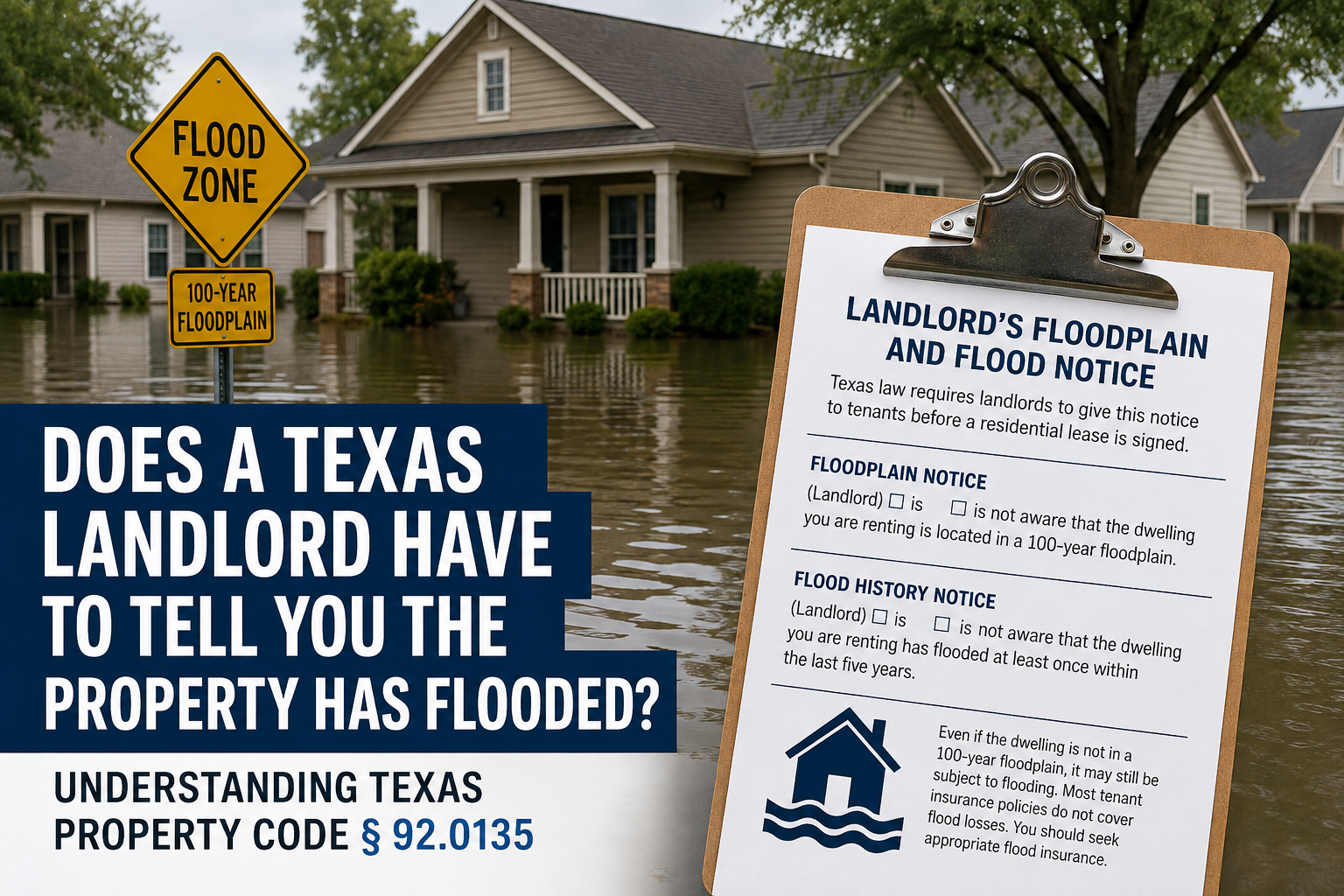
Section 92.0135(b) generally requires a landlord to provide the tenant with a written notice concerning whether the landlord is aware that the dwelling is located in a 100-year floodplain.
The statute requires language substantially equivalent to:
"(Landlord) ( ) is or ( ) is not aware that the dwelling you are renting is located in a 100-year floodplain."
The statutory notice goes further. It warns tenants that even property outside a designated 100-year floodplain can still be susceptible to flooding and specifically advises tenants that most tenant insurance policies do not cover flood losses.
That distinction matters. A renter should not assume that "not in the 100-year floodplain" means "cannot flood."
What If the Property Has Actually Flooded Before?
The law contains a separate disclosure requirement for prior flooding.
Under Texas Property Code § 92.0135(d), if the landlord knows that flooding damaged any portion of the dwelling at least once during the five years immediately preceding the effective date of the lease, the landlord must provide a written notice substantially equivalent to:
"(Landlord) ( ) is or ( ) is not aware that the dwelling you are renting has flooded at least once within the last five years."
This is important because floodplain status and actual flooding history are different questions.
A property might be outside a mapped 100-year floodplain and nevertheless have experienced significant flooding because of drainage conditions, excessive rainfall, runoff, or other circumstances.
Accordingly, Texas law addresses both issues.
When Must the Disclosure Be Given?
The timing of the disclosure is important.
Texas Property Code § 92.0135(e) requires the notices to be included in the lease, included as an addendum, or provided in a separate written document at or before execution of the lease. The document containing the required notice must be signed by both landlord and tenant to evidence provision and receipt of the notice.
The Texas Real Estate Commission also publishes a Landlord's Floodplain and Flood Notice that may be used to satisfy § 92.0135.
Landlords should therefore treat the flood disclosure as part of the leasing process rather than something to address only after a tenant asks about flooding.
Are There Exceptions?
Yes.
Among other provisions, § 92.0135(a-1) generally exempts leases with terms of less than 30 days. It also provides an exception for certain temporary residential tenancies associated with real-estate sales when a buyer occupies before closing or a seller remains after closing for a specified term of no more than 90 days.
Section 92.0135(c) also addresses dwellings elevated above the 100-year floodplain flood levels in accordance with federal regulations.
As always, the applicability of an exception depends on the facts of the particular tenancy.
What Happens If a Landlord Fails to Give the Required Notice?
The consequences become particularly significant when flooding actually causes substantial damage to the tenant's personal property.
Texas Property Code § 92.0135(f) provides that if a landlord violates the statute and the tenant suffers a substantial loss or damage to personal property as a result of flooding, the tenant may terminate the lease by giving written notice to the landlord within 30 days after the loss or damage occurred.
The statute defines substantial loss or damage using a 50-percent threshold: the total repair or replacement cost must equal at least 50 percent of the property's market value on the date of the flood.
Termination becomes effective when the tenant surrenders possession of the dwelling.
What Happens to Rent Paid in Advance?
The statute addresses that as well.
When a tenant properly terminates a lease under § 92.0135(f), subsection (g) requires the landlord, within 30 days after the effective date of termination, to refund rent or other amounts paid in advance for periods occurring after the lease terminates.
That does not erase preexisting obligations. Section 92.0135(h) expressly preserves the tenant's liability for delinquent rent or other amounts already owed before termination.
Flood Disclosure Does Not Mean Flood Insurance
One of the most useful parts of the statutory notice may be its warning about insurance.
A tenant may reasonably assume that renters insurance will replace furniture, electronics, clothing, and other belongings destroyed by flooding. The statutory notice itself warns that most tenant insurance policies do not cover flood-related losses and advises tenants to seek appropriate flood coverage.
The disclosure requirement therefore serves two purposes. It provides information about the property, but it also alerts renters that they may need to investigate their own insurance coverage.
Why This Law Matters in Texas
Flood risk is not merely a coastal issue.
Houston and other Texas communities have repeatedly demonstrated that severe rainfall, drainage limitations, overflowing waterways, and rapidly accumulating surface water can damage properties far beyond the places people ordinarily imagine when they hear the word "floodplain."
Texas law consequently does not permit residential leasing to treat known flood risk as irrelevant information.
For landlords, § 92.0135 provides a relatively straightforward compliance requirement: give the required disclosure, give it on time, and document the tenant's receipt.
For tenants, the notice should be taken seriously. A renter considering a property may want to investigate the address, ask questions about previous flooding, review available flood maps, and determine what losses the renter's insurance policy actually covers.
The Bottom Line
Texas residential landlords generally must provide tenants with a written flood disclosure addressing whether the landlord is aware that the dwelling is in a 100-year floodplain. A landlord who knows the dwelling has suffered flood damage during the preceding five years must also disclose that history as required by Texas Property Code § 92.0135.
Failure to comply can become especially important when a subsequent flood substantially damages a tenant's personal property, potentially giving the tenant a statutory right to terminate the lease and recover amounts paid in advance for periods after termination.
For both landlords and tenants, flood disclosure is one of those relatively small pieces of paperwork that can become extremely important after a major storm.
This article is for general informational purposes only and does not constitute legal advice. The application of Texas landlord-tenant law depends on the facts and circumstances of each case.
At David C. Barsalou, Attorney at Law, PLLC, we help clients navigate business, family, tax, estate planning, and real estate matters ranging from document drafting to litigation with clarity and confidence. If you’d like guidance on your situation, schedule a consultation today. Call us at (713) 397-4678, email barsalou.law@gmail.com, or reach us through our Contact Page. We’re here to help you take the next step.