Having a baby is expensive.
Unfortunately, not working while having a baby can be expensive too.
Paid parental leave has become a major subject of public debate in the United States, with employers, employees, parents, and policymakers disagreeing about who should bear the financial cost when a worker temporarily leaves employment following the birth or adoption of a child.
But behind the political debate is a much more immediate legal question:
Does Texas law actually require an employer to give an employee paid parental leave?
For most private-sector employees, the answer is generally no.
That does not mean, however, that Texas employees have no protections relating to parental leave. Federal law may provide job-protected leave to qualifying employees, employers may voluntarily provide paid benefits, and Texas law now expressly provides a legal framework for group family-leave insurance.
Understanding the difference requires separating several concepts that are often lumped together under the term “maternity leave.”
Parental Leave Is Not Necessarily Paid Leave
According to the Texas Workforce Commission, Texas law generally does not require employers to provide vacation, sick, or parental leave. If an employer chooses to provide such leave, it may generally be paid or unpaid, subject to other applicable laws.
This makes the employer's written policies particularly important.
An employer might provide, for example:
- six weeks of paid parental leave;
- accrued paid time off that can be used following childbirth;
- unpaid parental leave;
- short-term disability benefits;
- family-leave insurance benefits; or
- some combination of these benefits.
The fact that an employee has a legal right to be absent from work does not necessarily mean the employee has a legal right to receive wages during that absence.
That distinction becomes especially important under federal law.
The Family and Medical Leave Act Generally Provides Unpaid Leave
The principal federal statute governing family and medical leave is the Family and Medical Leave Act of 1993, commonly known as the FMLA.
For eligible employees of covered employers, the FMLA generally provides up to 12 workweeks of job-protected leave during a 12-month period for qualifying reasons, including the birth of a child and bonding with the newborn, or the placement of a child for adoption or foster care.
The FMLA also generally requires continuation of group health benefits during qualifying leave and protects an eligible employee's right to return to the same or an equivalent position.
But there is an important word missing from that description:
paid.
The FMLA itself generally guarantees unpaid leave.
An employee may sometimes use employer-provided paid vacation, sick leave, family leave, or other qualifying paid leave concurrently with FMLA leave, depending upon the circumstances and applicable policies. But the federal FMLA does not itself create a general requirement that an employer pay an employee's normal salary for 12 weeks following the birth of a child.
Not Every Employee Is Eligible for FMLA Leave
Another common misconception is that every American worker automatically receives 12 weeks of FMLA leave after having a child.
That is not the law.
For most private employers, FMLA coverage generally applies where the employer has 50 or more employees for at least 20 workweeks in the current or preceding calendar year.
An individual employee generally must also have:
- worked for the employer for at least 12 months;
- completed at least 1,250 hours of service during the preceding 12 months; and
- worked at a location where the employer has at least 50 employees within 75 miles.
Consequently, an employee working for a small Texas business may not qualify for federal FMLA protection at all.
This distinction can be particularly important in Texas, where small businesses employ enormous numbers of people.
Texas Now Recognizes Group Family-Leave Insurance
Texas law contains another interesting development that has received considerably less public attention.
In 2023, the Texas Legislature enacted Chapter 1255 of the Texas Insurance Code, governing group family-leave insurance.
Texas Insurance Code § 1255.001 defines “family leave insurance” as an insurance policy issued through an employer in connection with an employee benefit program that pays a portion of an employee's income loss resulting from family leave.
In other words, Texas law expressly permits an insurance-based mechanism for providing income during qualifying family leave.
This is significant because it illustrates an alternative to both of the models commonly discussed in political debates.
The choices are not necessarily limited to:
no paid parental leave
or
a government program requiring universal wage replacement.
Texas law permits employers to offer family-leave benefits through an insurance product.
What Can Texas Family-Leave Insurance Cover?
Texas Insurance Code § 1255.102 permits a group family-leave insurance policy to provide benefits for several categories of leave.
Among them is leave taken to:
“bond with the insured's child during the first 12 months after the child's birth, or the first 12 months after the placement of the child for adoption or foster care with the insured.”
The statute also permits coverage for leave associated with caring for family members with serious health conditions, certain military-related circumstances, and other family-leave reasons specified in the policy.
The concept is relatively straightforward.
Instead of requiring the employer necessarily to continue paying an employee's full salary directly during an extended absence, an insurance policy can replace a specified portion of the income lost while the employee takes qualifying leave.
Paid Leave, FMLA Protection, and Family-Leave Insurance Are Different Things
This is probably the most important practical distinction.
Imagine that a Texas employee has a baby and wants to remain home for eight weeks.
Several separate questions arise:
Can the employee legally take the time away from work?
That may depend upon the FMLA, another applicable law, or the employer's policies.
Does the employer have to hold the employee's job?
That may depend upon whether the employee is entitled to job-protected leave.
Will the employee continue receiving income?
That is a different question. Payment might come from an employer's paid-leave policy, accrued paid time off, an insurance benefit, or another applicable source.
It is therefore possible for an employee to have job-protected but unpaid leave.
It is also possible for an employer voluntarily to provide paid parental benefits beyond what federal law requires.
The phrase “parental leave” alone does not answer any of these questions.
What About Small Texas Employers?
The issue can become especially important for small employers.
A business with ten employees faces a fundamentally different operational problem from a corporation with 20,000 employees.
If one employee disappears from a ten-person company for three months, the employer has temporarily lost ten percent of its workforce.
That does not make parental leave unimportant. It demonstrates why the legal and economic questions surrounding paid parental leave are more complicated than simply deciding whether parental leave is a desirable benefit.
An employer must consider the cost of the benefit, the cost of replacing or redistributing the employee's work, the administrative requirements associated with leave, and the risk of inconsistent treatment among employees.
Employees, meanwhile, face an equally real problem: a legal right to take unpaid leave may have limited practical value to a household that cannot survive for several months without income.
Texas's family-leave insurance framework represents one possible attempt to bridge that gap.
Employer Policies Matter
Texas employers that voluntarily provide parental leave should pay close attention to the language of their written policies.
A policy should make clear such matters as:
- who qualifies for parental leave;
- how much leave is available;
- whether it is paid or unpaid;
- whether employees must first use accrued paid time off;
- how the policy interacts with FMLA leave;
- what notice employees must provide;
- whether birth, adoption, and foster placement are treated similarly; and
- what happens when paid leave expires but an employee remains entitled to additional job-protected leave.
Ambiguous policies can create disputes precisely when both the employee and employer are already dealing with a significant life event.
Employees Should Not Assume “Maternity Leave” Means One Particular Benefit
Employees should likewise avoid assuming that the phrase “maternity leave” appearing in a handbook or conversation necessarily means 12 weeks of paid leave.
Before planning an extended absence, an employee may need to determine separately:
- whether the employer is covered by the FMLA;
- whether the employee personally satisfies the FMLA eligibility requirements;
- how much job-protected leave is available;
- whether any portion of the leave will be paid;
- what employer-provided benefits are available; and
- what notice or documentation must be provided.
Those questions can produce very different answers from one workplace to another.
Paid Parental Leave Is a Policy Debate—But It Is Also a Contract and Compliance Issue
Whether the United States or Texas should require broader paid parental leave is ultimately a political and economic question.
What the law currently requires is a different question.
For many Texas private-sector employees, there is no general state-law entitlement requiring an employer to provide paid parental leave simply because a child is born or placed with the employee.
Federal law may nevertheless provide qualifying employees with unpaid, job-protected FMLA leave. Employers may voluntarily provide additional paid benefits. And Chapter 1255 of the Texas Insurance Code expressly permits group family-leave insurance designed to replace a portion of an employee's lost income during qualifying family leave.
That distinction matters for employees planning for a new child and for Texas businesses designing employee-benefit policies.
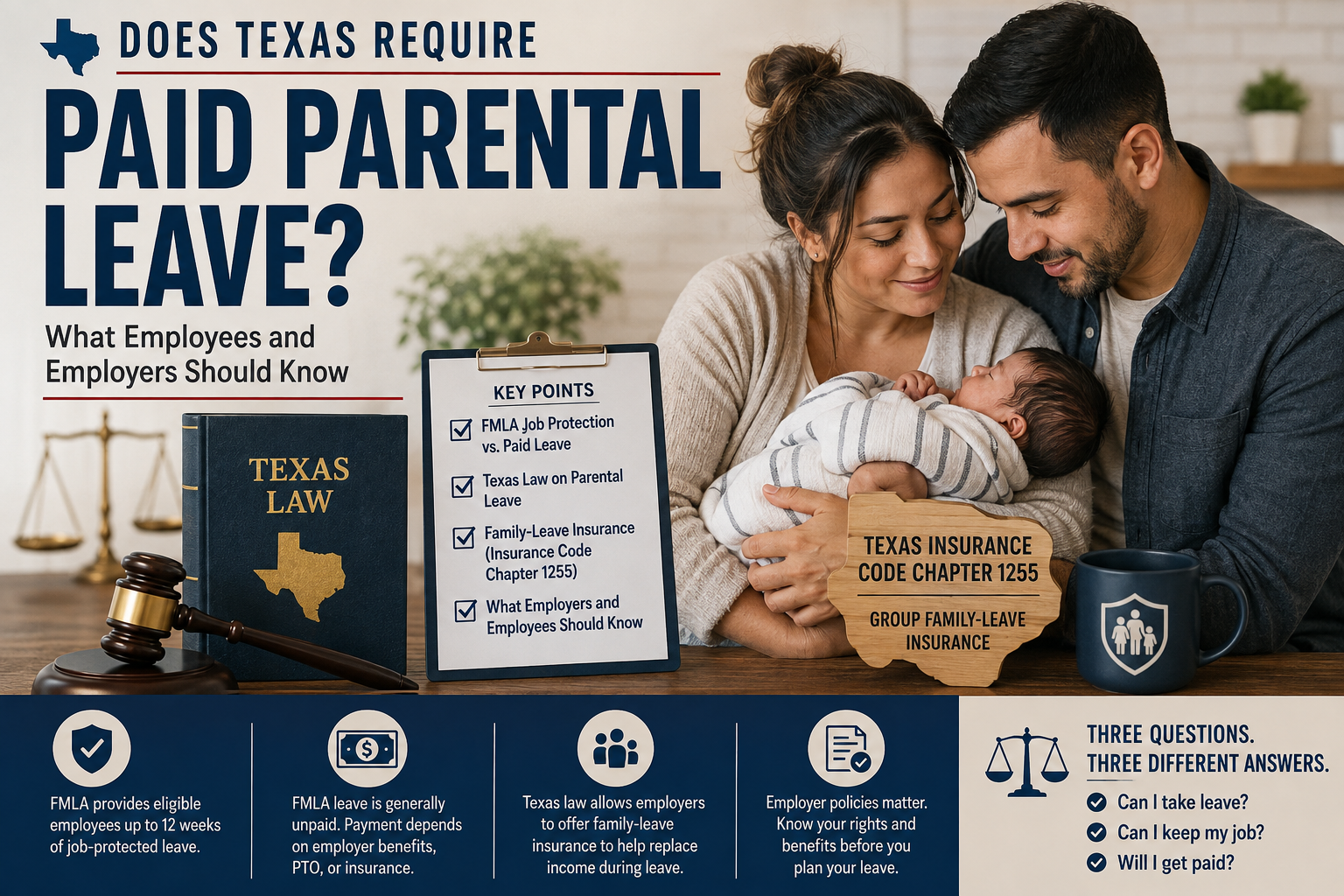
When it comes to parental leave, “Can I take leave?”, “Can I keep my job?”, and “Will I get paid?” are three different legal questions.
And before making plans based on an assumption about any of them, employees and employers should determine exactly which laws, insurance benefits, employment agreements, and workplace policies actually apply.
At David C. Barsalou, Attorney at Law, PLLC, we help clients navigate business, family, tax, estate planning, and real estate matters ranging from document drafting to litigation with clarity and confidence. If you’d like guidance on your situation, schedule a consultation today. Call us at (713) 397-4678, email barsalou.law@gmail.com, or reach us through our Contact Page. We’re here to help you take the next step.