When a parent falls behind on child support in Texas, the financial consequences can extend well beyond the missed payments. Unpaid child support can accumulate into a substantial debt, and Texas law generally imposes interest on qualifying delinquent amounts.
One of the most misunderstood aspects of child support enforcement is that Texas imposes a statutory interest rate of 6% per year on qualifying unpaid child support. Moreover, the obligation does not necessarily disappear when a child turns 18, graduates from high school, or becomes financially independent.
Understanding how child support arrears accumulate, how interest is calculated, and how courts enforce unpaid obligations is important for both parents who owe support and parents attempting to collect it.
What Are Child Support Arrears in Texas?
Child support arrears, sometimes called arrearages, represent child support payments that became due under a court order but were not paid.
For example, suppose a Texas court orders a parent to pay $1,000 per month in child support. If the parent makes no payments for six months, the unpaid principal would ordinarily total $6,000.
However, the actual amount owed may be greater because of statutory interest and potentially other enforceable obligations.
Texas Family Code § 157.261 generally provides that a child support payment becomes a final judgment for the amount due and owing, including applicable interest, when the payment becomes delinquent.
This is important because the parent entitled to receive support does not necessarily need to obtain an entirely new judgment before an unpaid installment acquires the legal status of a judgment.
Nevertheless, a court proceeding may be necessary to determine the precise amount owed and obtain additional enforcement relief.
Does Texas Charge Interest on Unpaid Child Support?
Yes. Texas Family Code § 157.265 establishes the statutory interest rate applicable to qualifying child support arrears.
Section 157.265(a) provides, in relevant part:
"Interest accrues on the portion of delinquent child support that is greater than the amount of the monthly periodic support obligation at the rate of six percent simple interest per year"
This provision is significant for two reasons.
First, the statutory interest rate is 6% simple interest annually, rather than a variable rate tied to ordinary commercial judgments.
Second, the statute does not necessarily impose interest on every dollar immediately after a payment becomes overdue. Section 157.265(a) applies to the portion of delinquent support exceeding the amount of the monthly periodic support obligation.
Consequently, calculating interest requires examining the amount and timing of the delinquency, the monthly obligation, and the history of payments.
How Is Interest on Child Support Arrears Calculated?
Texas generally uses simple interest rather than compound interest for child support obligations governed by § 157.265.
Simple interest means that interest is calculated using the applicable principal balance rather than automatically charging additional interest on previously accrued interest.
Consider a simplified example.
Suppose a parent owes $10,000 in child support arrears that have already been confirmed and reduced to a money judgment.
At the statutory rate of 6% annually, a $10,000 judgment balance would generate approximately $600 in interest over one year if the entire principal remained unpaid.
Over five years, the simple-interest amount would be approximately $3,000, assuming the balance remained unchanged and no other adjustments applied.
The resulting total would be $13,000.
This illustration assumes an existing judgment and a constant unpaid balance. It should not be used to calculate interest on ordinary delinquent installments without applying the threshold and timing requirements of § 157.265(a).
Actual child support calculations can become considerably more complicated when the obligor makes irregular payments, support obligations change, or arrears extend across many years.
What Happens When Child Support Arrears Are Reduced to a Judgment?
Texas Family Code § 157.263 authorizes the court to confirm child support arrearages and render a cumulative money judgment.
Under § 157.263(b), the judgment includes unpaid support, applicable balances from earlier judgments, and accrued interest.
This process is particularly important when the parties disagree about the amount owed.
For example, one parent may claim that $25,000 remains unpaid, while the other maintains that substantial payments were made directly rather than through the state disbursement system.
The court may need to examine payment records, previous orders, and evidence supporting any legally permissible credits or offsets.
Once arrears have been confirmed and reduced to a money judgment, § 157.265(b) provides for 6% simple interest from the date the order is rendered until the judgment is paid.
A court's confirmation of arrearages therefore does not necessarily stop interest from accumulating.
Can a Texas Judge Forgive Unpaid Child Support?
This is an important distinction between child support modification and child support enforcement.
Texas courts have authority, under appropriate circumstances, to modify future child support obligations.
However, they generally cannot simply eliminate previously accrued child support arrears because the amount appears excessive or the obligor is experiencing financial hardship.
Texas Family Code § 157.263(b-3) expressly limits the court's authority to reduce or modify arrearages when rendering a money judgment, while preserving legally authorized counterclaims and offsets.
For example, suppose a parent was ordered to pay $1,500 per month but lost employment and stopped paying.
A subsequent reduction in the monthly child support obligation does not ordinarily erase payments that became due before the effective date of the modification.
The parent may have grounds to seek a modification of future support, but the existing arrears present a separate legal problem.
This is why waiting several months before requesting a modification can be financially damaging.
Can the Parent Receiving Support Agree to Forgive the Debt?
The parties may sometimes resolve disputes involving arrears through legally recognized credits, settlements, or other appropriate procedures.
However, a private agreement should not be assumed to eliminate a court-ordered child support obligation.
The enforceability of any agreement may depend on the circumstances, the nature of the obligation, the applicable statutory provisions, and whether governmental support-enforcement interests are involved.
A parent attempting to resolve a substantial arrearage should ensure that the agreement is legally effective and properly documented.
Can Texas Collect Child Support After a Child Turns 18?
Yes.
One common misconception is that unpaid child support automatically disappears when the child becomes an adult.
The termination of an ongoing support obligation and the enforcement of unpaid support are different legal questions.
Texas Family Code § 157.269 permits a court to retain jurisdiction to enforce support obligations until outstanding amounts, including applicable interest and costs, have been paid.
Therefore, a parent who owes substantial child support arrears may remain responsible for those amounts long after the child reaches adulthood.
The fact that a child is now 25 or 30 years old does not, by itself, establish that an unpaid child support judgment has disappeared.
Nevertheless, statutory deadlines and procedural requirements can affect particular enforcement remedies, including contempt proceedings. Those questions should be evaluated separately.
How Can Unpaid Child Support Be Collected in Texas?
Texas provides several enforcement mechanisms for child support obligations.
Texas Family Code § 157.264 authorizes enforcement of qualifying child support money judgments through means available for enforcing debt judgments or collecting child support.
Depending on the circumstances, available remedies may include:
- Income withholding from wages or other eligible earnings.
- Child support liens against qualifying property or financial assets.
- Court proceedings to confirm arrearages and obtain a money judgment.
- Enforcement proceedings seeking contempt when statutory requirements are satisfied.
- Other collection mechanisms authorized by state or federal law.
Not every remedy is available in every case. Property exemptions, procedural requirements, the nature of the underlying order, and applicable limitations can affect enforcement.
A judgment creditor should also distinguish between ordinary civil debt collection and the special enforcement rules applicable to child support.
How Are Payments Applied When a Parent Owes Both Current Support and Arrears?
The allocation of child support payments can significantly affect the outstanding balance.
Texas Family Code § 157.268 establishes a statutory order of priority for applying collected child support.
Generally, payments are applied first toward current child support and then toward other specified support obligations before reaching unpaid principal, interest, and certain fees.
This matters because a parent who resumes making monthly payments may still have a substantial outstanding arrearage.
For example, suppose a parent owes $900 in current monthly support and has accumulated $15,000 in arrears.
If the parent pays only the current $900 obligation, the payment generally does not eliminate the existing $15,000 debt.
Additional payments or collection efforts may be necessary to reduce the arrears.
The precise allocation should be determined under the applicable statute and the official payment records.
Can Child Support Interest Be More Than the Original Debt?
Yes.
Although Texas uses simple interest, a large unpaid balance can generate significant additional obligations over time.
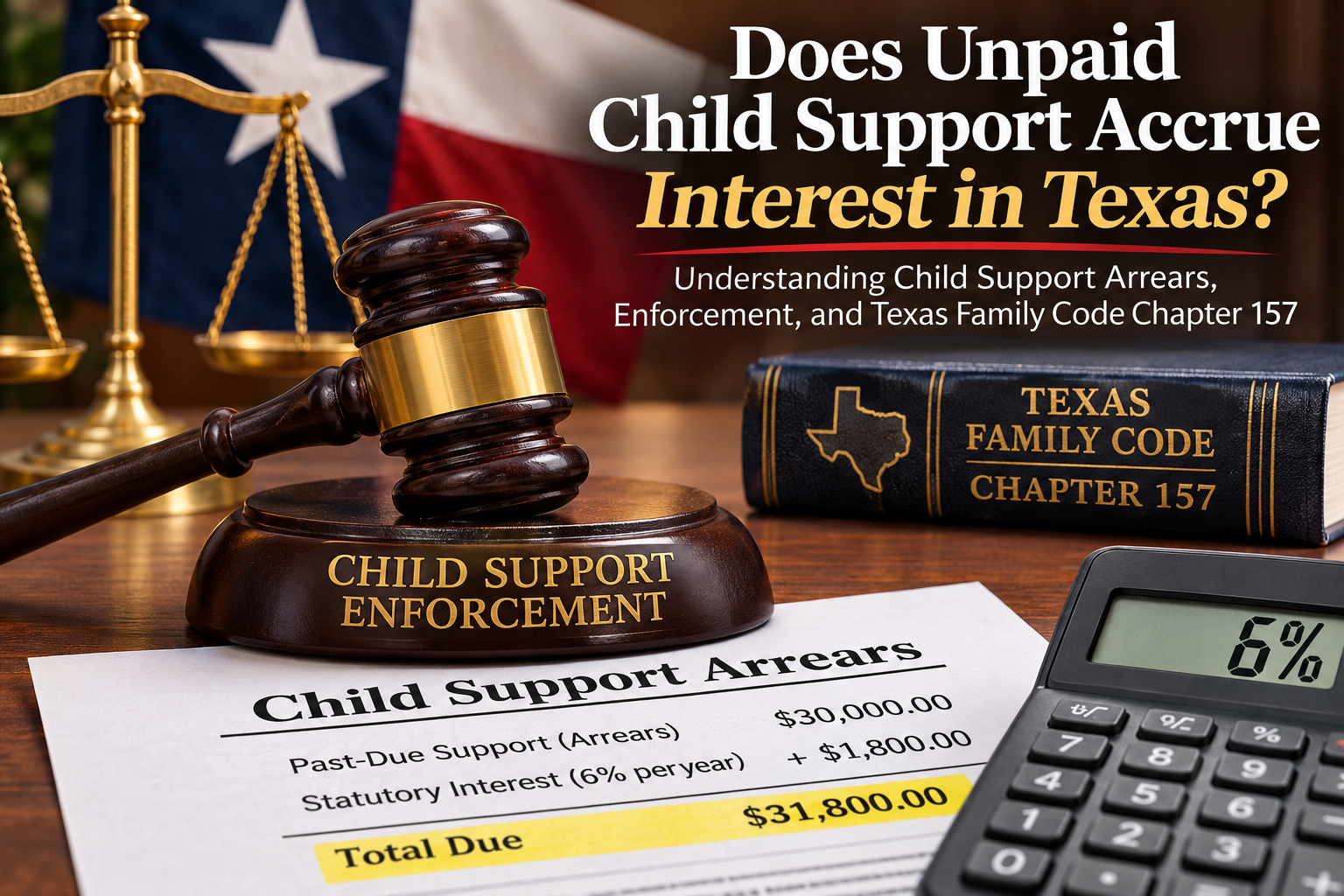
Consider an existing child support judgment for $30,000.
At 6% simple interest, that judgment would generate $1,800 annually if the entire principal remained unpaid.
Over ten years, the interest would total approximately $18,000, assuming no payments, credits, or adjustments.
The total would reach approximately $48,000.
This example demonstrates why long-term nonpayment can create a serious financial problem even without compound interest.
In actual cases, calculating the correct balance requires examining the applicable judgments, payment history, and statutory interest rules.
What Should a Parent Do If the Child Support Balance Is Incorrect?
A parent who believes the claimed arrearage is incorrect should not simply ignore the enforcement proceeding.
Instead, the parent should obtain the relevant court orders, official child support payment history, and documentation of any disputed payments.
Bank records, canceled checks, payment receipts, and other financial records may become important evidence.
The court may consider legally permissible credits or offsets when determining the amount owed.
However, not every payment made to the other parent automatically qualifies as court-ordered child support.
For example, paying for clothing, school supplies, vacations, or other expenses does not necessarily satisfy a separate monthly support obligation.
Whether a particular payment can be credited depends on the applicable law and the evidence.
Frequently Asked Questions About Child Support Interest in Texas
What is the interest rate on unpaid child support in Texas?
Texas Family Code § 157.265 generally imposes 6% simple annual interest on qualifying delinquent child support and child support judgments.
Does interest begin immediately when a payment is missed?
Not necessarily. Section 157.265(a) applies to the portion of delinquent support exceeding the monthly periodic support obligation. The calculation depends on the amount and timing of the unpaid obligations.
Can child support arrears be discharged by bankruptcy?
Child support obligations generally qualify as domestic support obligations and are ordinarily nondischargeable under federal bankruptcy law. The treatment of particular debts should be evaluated under the Bankruptcy Code.
Does getting remarried eliminate child support arrears?
No. Remarriage alone does not extinguish an existing court-ordered child support debt.
Can child support be collected after the child graduates from high school?
Yes. The end of ongoing child support does not automatically eliminate previously accrued arrears.
Can a parent go to jail for unpaid child support?
Contempt may be available in qualifying enforcement proceedings, but incarceration is not automatic. Constitutional protections, statutory requirements, and the obligor's ability to comply may affect the court's authority.
Why Child Support Arrears Should Be Addressed Promptly
Unpaid child support can create financial consequences that continue for years.
For the parent owed support, delays may complicate collection and make it more difficult to reconstruct the payment history.
For the parent obligated to pay, ignoring a support order can allow arrears and interest to accumulate while exposing the parent to additional enforcement proceedings.
The appropriate response depends on the circumstances.
A parent who can no longer afford the existing support obligation may need to seek a modification. A parent who disputes the amount owed may need to challenge the arrearage calculation. A parent attempting to collect unpaid support may need to pursue confirmation of arrears or other enforcement remedies.
The central lesson is that unpaid child support in Texas is not merely an informal debt between parents. It is an enforceable legal obligation governed by specific statutory rules.
Understanding those rules can help parents protect their rights, avoid unnecessary financial consequences, and resolve disputes more effectively.
Speak With a Texas Family Law Attorney
Child support enforcement disputes often involve more than determining whether a payment was missed. The applicable court orders, payment history, interest calculations, and available enforcement remedies can substantially affect the outcome.
David C. Barsalou, Attorney at Law, PLLC, assists clients with Texas family law matters, including child support disputes, enforcement proceedings, and modifications.
If you have questions about unpaid child support, disputed arrears, or enforcement of an existing court order, obtaining legal advice can help you understand your available options.
Disclaimer: This article provides general information about Texas law and does not constitute legal advice. Legal outcomes depend on the particular facts, applicable orders, and governing law.
At David C. Barsalou, Attorney at Law, PLLC, we help clients navigate business, family, tax, estate planning, and real estate matters ranging from document drafting to litigation with clarity and confidence. If you’d like guidance on your situation, schedule a consultation today. Call us at (713) 397-4678, email barsalou.law@gmail.com, or reach us through our Contact Page. We’re here to help you take the next step.