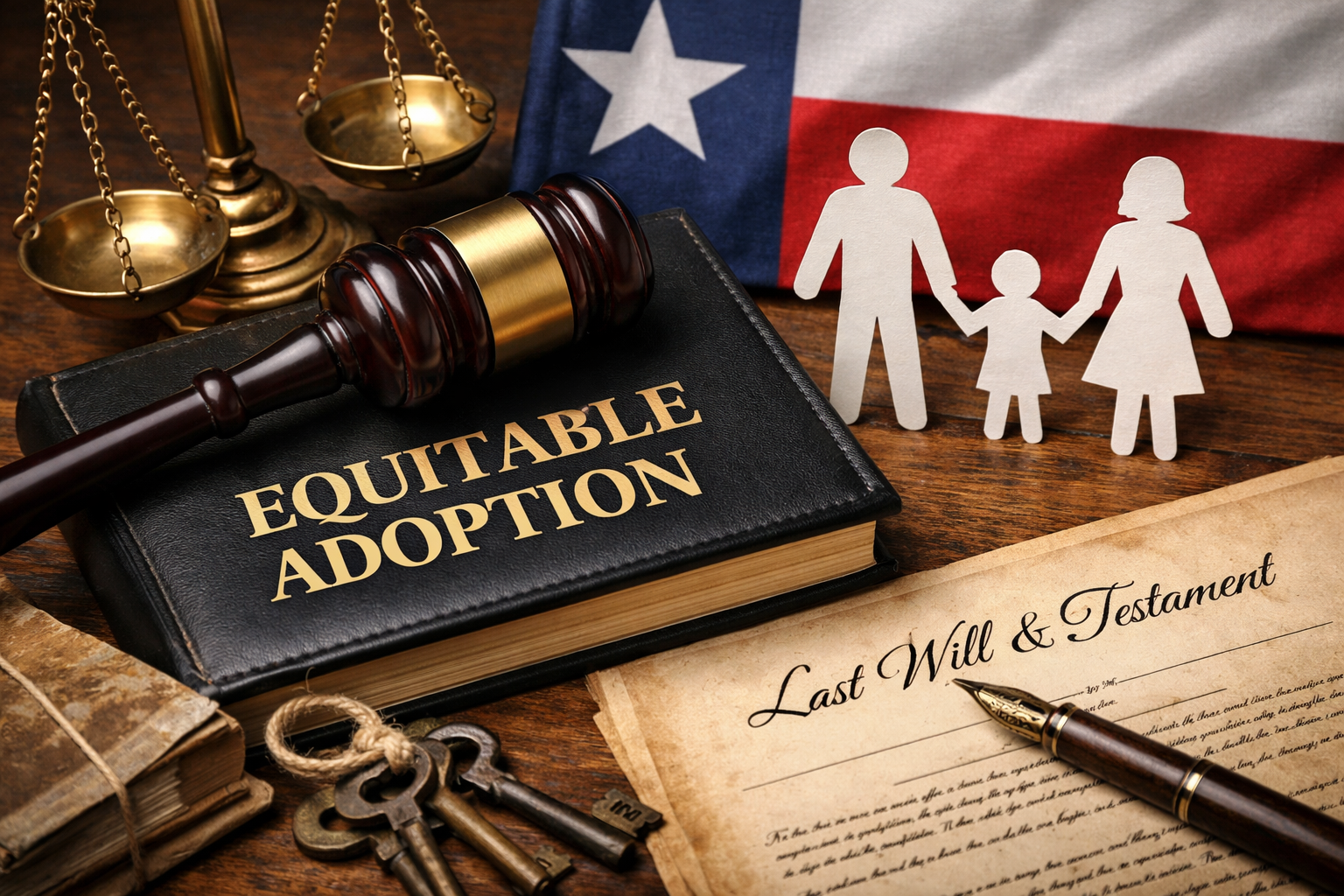
One of the more quirky but deeply important doctrinesin Texas probate law is equitable adoption—sometimes called “adoption by estoppel.”
It arises in emotionally charged situations: a child was raised as someone’s own, but no formal adoption paperwork was ever completed. When the adult who acted as the parent dies intestate (without a will), can that child inherit?
In Texas, under certain circumstances, the answer is yes.
This doctrine does not appear as a simple statutory checklist in the Texas Estates Code. Instead, it is a court-created equitable remedy that works alongside the statutory inheritance scheme.
Let’s break it down.
1. The Statutory Framework: Who Inherits in Texas?
Under Texas Estates Code § 201.001, if a person dies without a will, their estate passes to heirs according to statutory intestacy rules:
“If a person dies intestate, the person’s estate passes to the person’s heirs at law.”
Typically, heirs include:
- Surviving spouse
- Biological children
- Legally adopted children
Under Texas Estates Code § 201.054, adopted children are treated the same as biological children for inheritance purposes.
But what happens if:
- A child was raised by the decedent,
- There was an agreement to adopt,
- But no formal adoption decree was ever entered?
That’s where equitable adoption comes in.
2. What Is Equitable Adoption?
Equitable adoption is a judicial doctrine that prevents injustice when:
- There was an agreement or representation that a child would be adopted;
- The child relied on that agreement; and
- The adopting parent died without completing the formal adoption.
Texas courts have long recognized that equity will intervene to prevent unfairness in these circumstances.
The doctrine does not create a legal parent-child relationship for all purposes. Instead, it creates inheritance rights against the estate of the person who agreed to adopt.
3. Where Does This Authority Come From?
Equitable adoption is not expressly codified in the Texas Estates Code. It developed through case law interpreting inheritance principles in equity.
Texas courts have held that when a person:
- Agrees to adopt a child,
- Accepts the child into the home,
- Treats the child as their own,
- And the child fully performs (i.e., lives as the child of the adopting parent),
equity will estop the estate from denying inheritance rights.
The doctrine operates alongside Texas Family Code Chapter 162, which governs formal adoptions, but it does not replace statutory adoption procedures.
4. Elements of Equitable Adoption in Texas
While wording varies across cases, courts generally look for:
(1) An Agreement to Adopt
There must be evidence—written or oral—that the decedent intended to adopt the child.
(2) Performance by the Child
The child lived with and acted as the child of the decedent.
(3) Reliance
The child relied on the promise or representation.
(4) Failure to Complete Adoption
The adoption was never finalized before death.
Courts are cautious. They require clear and convincing evidence, especially because inheritance rights affect third parties.
5. What Rights Does an Equitably Adopted Child Have?
An equitably adopted child may:
- Inherit from the estate of the adoptive parent if the parent dies intestate.
- Assert heirship in a probate proceeding.
However, the child:
- Does not automatically inherit from other relatives of the adoptive parent.
- Does not retroactively become a legally adopted child for all purposes.
This is a narrow, equitable remedy.
6. Interaction with Heirship Proceedings
When someone dies intestate and heirship is disputed, the court may determine heirs under Texas Estates Code § 202.001, which authorizes a proceeding to declare heirship.
In such a proceeding, a claimant may assert equitable adoption as a basis for heirship.
These cases often involve:
- Competing heirs,
- Blended families,
- Informal family arrangements,
- And emotionally complex factual histories.
7. Why This Doctrine Still Matters
You might assume equitable adoption is rare in modern Texas practice—but it still arises in:
- Grandparent-raised children,
- Step-parent situations,
- Informal custody arrangements,
- Cases where financial hardship delayed formal adoption.
As a practitioner handling probate, heirship, or estate disputes, this doctrine can radically change the distribution of an estate.
8. Practical Litigation Considerations
If you are asserting equitable adoption:
- Gather written evidence (letters, school records, tax returns listing the child).
- Identify witnesses who can testify to the agreement.
- Prepare for a higher evidentiary burden.
If you are defending against such a claim:
- Scrutinize whether a true agreement existed.
- Challenge reliance and evidentiary sufficiency.
- Consider statute of limitations or laches defenses, depending on posture.
These cases are fact-intensive and emotionally charged.
9. Why Formal Adoption Still Matters
The safest course is always compliance with Texas Family Code Chapter 162 formal adoption procedures.
Equity is a remedy of last resort.
If a parent truly intends to adopt, complete the statutory process. Courts will not lightly rewrite inheritance schemes absent compelling evidence.
Final Thoughts
Equitable adoption is one of those uniquely human doctrines in Texas law—where courts step in to prevent injustice when life did not follow paperwork.
But it is not automatic.
It requires:
- Evidence,
- Credibility,
- And strategic litigation.
If you are dealing with a disputed probate estate, heirship conflict, or informal family adoption issue in Texas, careful legal analysis is essential.
At David C. Barsalou, Attorney at Law, PLLC, we help clients navigate business, family, tax, estate planning, and real estate matters ranging from document drafting to litigation with clarity and confidence. If you’d like guidance on your situation, schedule a consultation today. Call us at (713) 397-4678, email barsalou.law@gmail.com, or reach us through our Contact Page. We’re here to help you take the next step.
