Understanding the Surprisingly Powerful Doctrine That Can Transfer Property You Didn't Even Own
Most people assume you cannot sell property you do not own. As a general rule, that is true.
Texas law, however, contains one of the more unusual doctrines in real property law: estoppel by deed. Under the right circumstances, someone who conveys title they do not yet own may later be legally bound when they eventually acquire that title.
Although this doctrine sounds bizarre, it has existed for centuries and still appears in modern Texas real estate litigation.
What Is Estoppel by Deed?
Estoppel by deed prevents a person from denying representations made in a deed.
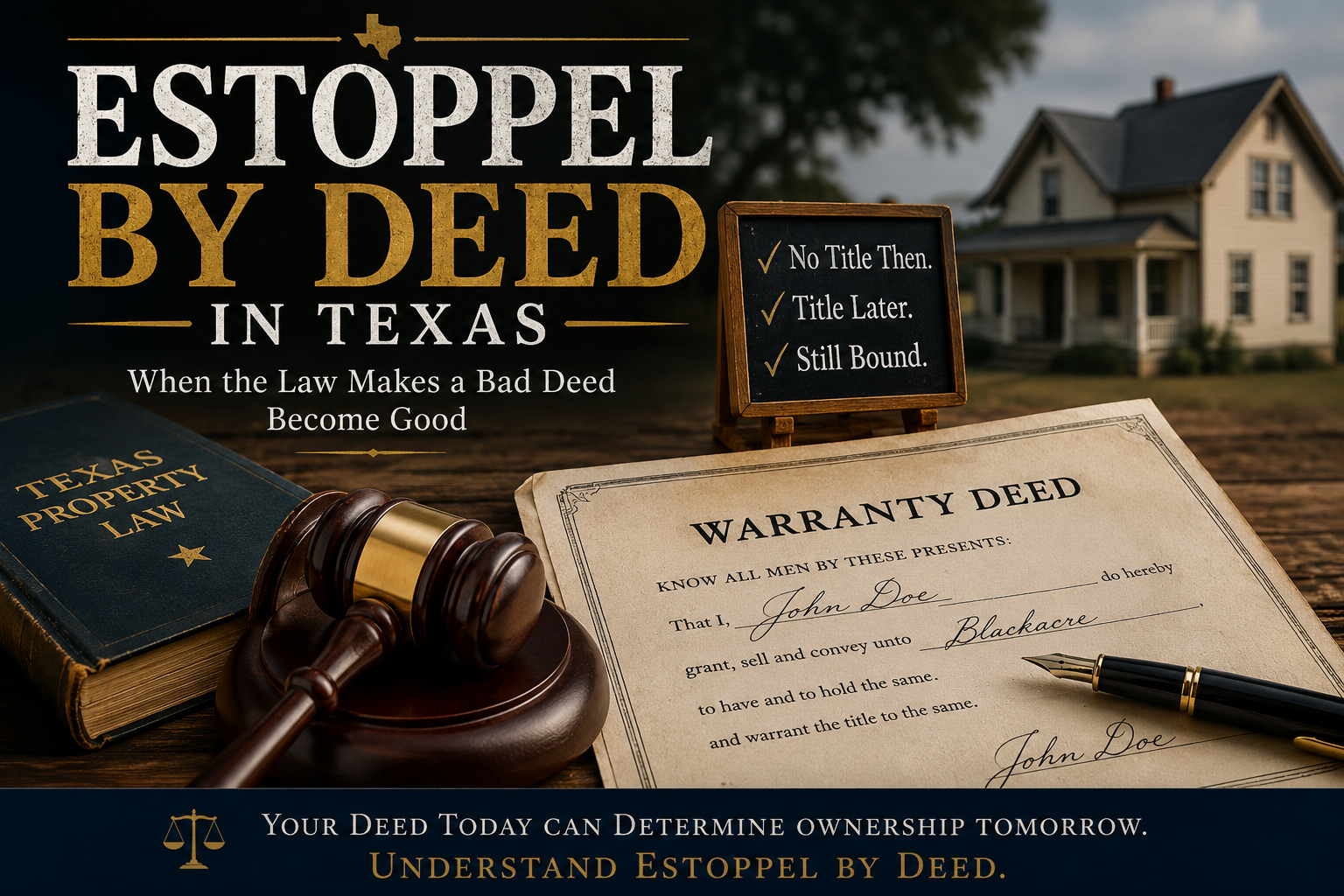
Suppose a seller signs and delivers a warranty deed conveying Blackacre to Buyer.
There is only one problem.
The seller does not actually own Blackacre.
Several years later, the seller inherits Blackacre from a relative.
Under the doctrine of estoppel by deed, the after-acquired title may automatically pass to the original buyer rather than remaining with the seller.
The law essentially says:
"You already represented that you owned it. You cannot later deny your own deed."
Texas Has Long Recognized the Doctrine
Texas courts have recognized estoppel by deed for generations.
Although largely developed through common law, the doctrine works hand-in-hand with the Texas recording system and warranty deeds.
The doctrine most commonly arises when:
- Property is mistakenly conveyed before ownership is perfected
- An heir conveys property before probate concludes
- Mineral interests are transferred before ownership is confirmed
- Boundary disputes are later resolved
- Title defects are cured after closing
Why Warranty Deeds Matter
The doctrine most commonly applies to general warranty deeds and special warranty deeds, because those deeds contain promises regarding title.
Texas Property Code § 5.023 provides:
"A covenant of warranty is not required in a conveyance."
Instead, Texas allows parties to create warranties through the use of statutory language contained in the deed.
This seemingly simple statute has enormous practical significance because warranty language often determines whether after-acquired title passes automatically.
After-Acquired Title
The doctrine is often called the after-acquired title doctrine.
Imagine this timeline:
2025
John signs a warranty deed selling Lot 10.
John actually owns nothing.
2027
John inherits Lot 10.
Because John already warranted title, ownership may immediately vest in the original purchaser rather than John.
John is "estopped" from arguing otherwise.
The Doctrine Does Not Apply Every Time
Not every mistaken conveyance triggers estoppel by deed.
Important questions include:
- What type of deed was signed?
- Did the grantor make warranties?
- What exactly did the deed represent?
- Was the later-acquired interest the same interest previously conveyed?
- Were innocent third parties involved?
Because every deed is different, the analysis can become surprisingly technical.
Quitclaim Deeds Are Different
One reason lawyers carefully distinguish quitclaim deeds from warranty deeds is that quitclaim deeds generally do not contain the same representations about ownership.
A quitclaim typically transfers only whatever interest the grantor currently possesses—if any.
Because there is no representation that title actually exists, estoppel by deed often does not arise in the same manner.
Why This Matters During Probate
This doctrine frequently appears in probate disputes.
For example, someone may believe they inherited family land and immediately execute a deed before ownership is legally established.
If they later acquire title through probate, questions arise regarding whether the earlier conveyance automatically becomes effective.
These issues can dramatically affect:
- Family farms
- Ranch property
- Mineral estates
- Commercial real estate
- Investment property
Litigation Can Become Complex
Estoppel by deed cases often involve multiple legal issues simultaneously, including:
- Chain of title
- Recording statutes
- Warranty language
- Probate administration
- Boundary disputes
- Mineral ownership
- Contract interpretation
The outcome frequently depends upon the precise wording of recorded instruments and the sequence in which title changed hands.
Practical Takeaway
Estoppel by deed is one of those unusual legal doctrines that surprises even experienced property owners. A deed signed years earlier can unexpectedly determine ownership after entirely different events occur.
Because Texas property rights often depend upon the exact language of recorded documents, anyone facing a disputed title, after-acquired ownership interest, or questionable deed should obtain legal advice before assuming they own—or no longer own—real property.
At David C. Barsalou, Attorney at Law, PLLC, we help clients navigate business, family, tax, estate planning, and real estate matters ranging from document drafting to litigation with clarity and confidence. If you’d like guidance on your situation, schedule a consultation today. Call us at (713) 397-4678, email barsalou.law@gmail.com, or reach us through our Contact Page. We’re here to help you take the next step.