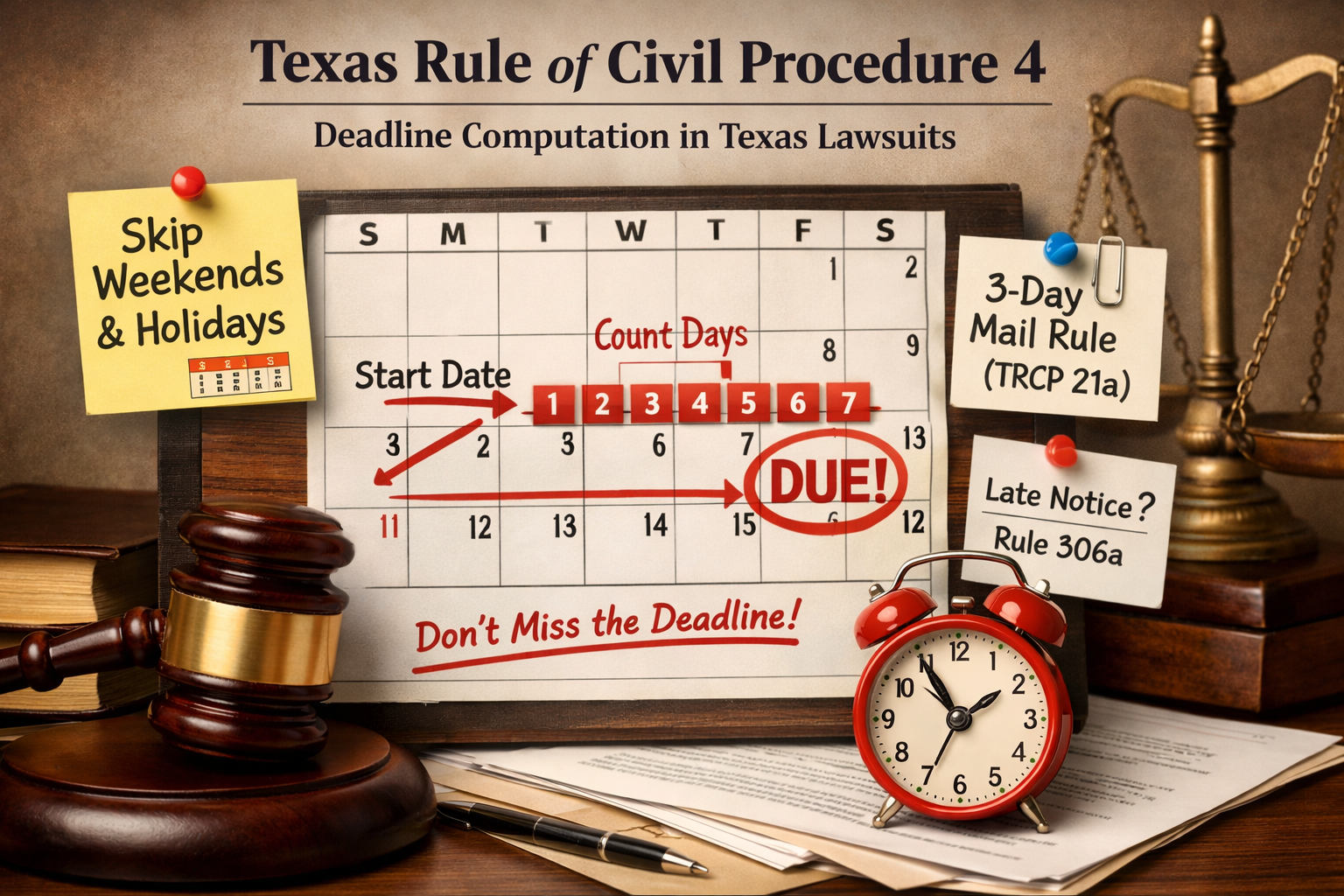
Why Deadline Calculation Can Win or Lose Your Case
In Texas litigation, missing a deadline by even one day can be fatal. But what many lawyers—and certainly most clients—don’t appreciate is that deadline calculation is not intuitive. It is governed by specific procedural rules that can extend, shorten, or entirely change when something is due.
At the center of this framework is Texas Rule of Civil Procedure 4 (“TRCP 4”), which governs how time periods are computed in civil cases.
The Core Rule: Texas Rule of Civil Procedure 4
The rule provides:
“In computing any period of time prescribed or allowed by these rules, by order of court, or by any applicable statute, the day of the act, event, or default… shall not be included.”
And further:
“The last day of the period so computed is to be included, unless it is a Saturday, Sunday, or legal holiday…”
— Tex. R. Civ. P. 4
Key Takeaways:
- You exclude the triggering day
- You include the last day
- If the last day falls on a weekend or holiday, it rolls to the next business day
The “Mailbox Rule” Overlay (TRCP 5)
TRCP 4 does not operate in isolation. It interacts critically with Texas Rule of Civil Procedure 5, which provides:
“If any document is sent to the proper clerk by first-class United States mail… and is received not more than ten days tardily, it shall be deemed filed in time.”
This creates a safe harbor—but only under strict conditions.
Strategic Insight:
- This rule saves late filings, but only if:
- Properly addressed
- Properly stamped
- Mailed on time
- It does not apply to e-filing mistakes
Service-Based Extensions: The 3-Day Rule (TRCP 21a)
Another trap: when service is made by certain methods, deadlines may extend.
Under TRCP 21a(c):
“Whenever a party has the right or is required to do some act within a prescribed period after the service of a notice… three days shall be added to the prescribed period…”
But—Important Limitation:
- This does NOT apply to e-service in Texas
- Many attorneys mistakenly add 3 days when they shouldn’t
Real-World Example (Where Lawyers Get Burned)
Scenario:
- Motion served on Monday
- Response due “within 10 days”
Proper Calculation:
- Exclude Monday (trigger day)
- Count forward 10 days
- If last day is Sunday → rolls to Monday
- If served electronically → no extra 3 days
A lawyer who incorrectly adds 3 days could file late—and lose the motion by default.
Deadlines Tied to “Notice” vs “Signing” (Rule 306a Interaction)
TRCP 4 also interacts with Rule 306a, which governs when deadlines begin if a party does not receive notice of a judgment.
Under TRCP 306a(4):
If a party does not receive notice within 20 days of judgment, deadlines may run from the date of notice (subject to strict proof requirements).
Why This Matters:
- Appellate deadlines can be reopened
- But only if you strictly comply with Rule 306a procedures
Common Litigation Mistakes
1. Including the Trigger Day
You never count the day the event occurred.
2. Misapplying the 3-Day Rule
Adding 3 days to e-service deadlines is wrong.
3. Ignoring Holidays
Texas recognizes legal holidays that extend deadlines.
4. Assuming E-Filing Equals “Filed”
Technical errors can result in rejection—and missed deadlines
Strategic Use of Deadline Rules
Good litigators don’t just follow these rules—they use them.
Examples:
- Timing filings to limit opponent response windows
- Leveraging Rule 306a to revive deadlines
- Using service methods strategically
Why This Topic Matters More Than It Seems
Unlike substantive law, procedural mistakes are unforgiving. Courts routinely dismiss claims, strike pleadings, or deny relief based purely on timing errors.
And yet, as your own blog index shows, while you’ve covered deadlines broadly, you have not yet tackled the mechanics of how time is actually computed—which is where the real risk lies.
Final Thought
Texas procedure is full of traps, but few are as quietly dangerous as deadline computation. Mastering TRCP 4—and its interaction with other rules—is not just technical competence; it is case survival.
At David C. Barsalou, Attorney at Law, PLLC, we help clients navigate business, family, tax, estate planning, and real estate matters ranging from document drafting to litigation with clarity and confidence. If you’d like guidance on your situation, schedule a consultation today. Call us at (713) 397-4678, email barsalou.law@gmail.com, or reach us through our Contact Page. We’re here to help you take the next step.