One of the most persistent myths about Texas family law is that a couple automatically becomes “common-law married” after living together for a certain amount of time.
Seven years. Ten years. Six months. People give different answers, often with remarkable confidence.
Under Texas law, however, there is no minimum period of cohabitation that automatically creates a marriage.
Texas recognizes what the Family Code calls an informal marriage, but simply sharing a home—even for many years—is not necessarily enough.
Understanding the difference can become extremely important when a relationship ends, when one partner dies, or when substantial property has accumulated during the relationship.
What Is Common-Law Marriage in Texas?
“Common-law marriage” is the familiar term, but the Texas Family Code generally calls it marriage without formalities or informal marriage.
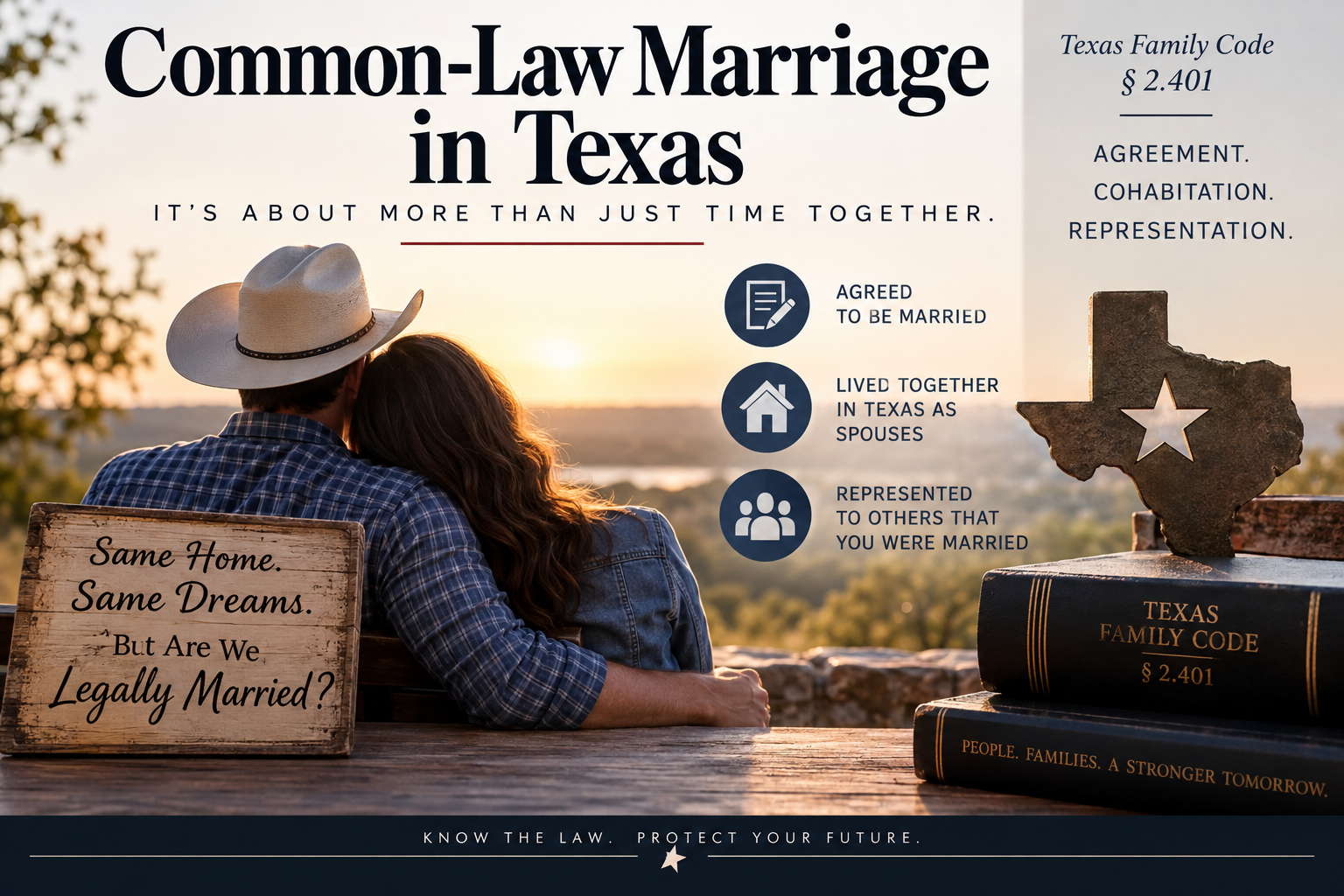
Texas Family Code § 2.401 provides two basic ways to prove an informal marriage.
One is relatively straightforward: the parties can sign and file a declaration of informal marriage as provided by the Family Code.
The second is the source of most disputes.
Section 2.401(a)(2) provides that an informal marriage may be proved by evidence that:
“the man and woman agreed to be married and after the agreement they lived together in this state as husband and wife and there represented to others that they were married.”
In practical terms, a person attempting to establish an informal marriage without a filed declaration generally must prove three things:
- the parties agreed to be married;
- after that agreement, they lived together in Texas as spouses; and
- they represented to other people that they were married.
The statute does not say that living together for a particular number of months or years creates a marriage.
There Is No “Seven-Year Rule” in Texas
This deserves emphasis because the misconception is so widespread.
Texas does not have a rule saying that people become married merely because they have lived together for seven years—or any other specified period.
Two people could conceivably satisfy the requirements of an informal marriage without living together for seven years.
Conversely, two people might live together for 15 or 20 years without establishing an informal marriage if the required elements are absent.
Cohabitation is relevant, but cohabitation alone is not marriage.
That distinction can have enormous financial consequences.
An Agreement to Marry Matters
The first element is an agreement to be married.
That is different from:
- an agreement to get married someday;
- an engagement;
- a long-term romantic relationship;
- sharing expenses;
- raising children together; or
- simply behaving like a committed couple.
The legal question is whether the parties actually agreed that they were married.
In a disputed case, there may be no single document saying, “We hereby agree that we are married.” Courts therefore may have to evaluate the parties' conduct and other evidence to determine what their relationship actually was.
That makes informal-marriage litigation unusually fact-intensive.
You Must Live Together in Texas After the Agreement
The statute also requires the parties, after agreeing to be married, to live together in Texas as husband and wife.
Again, there is no statutory minimum duration.
The important point is that merely having a romantic relationship or occasionally staying together is not necessarily the same thing as satisfying the statutory requirement.
The facts of the particular relationship matter.
You Must Represent to Others That You Are Married
The third requirement is particularly important.
The parties must have represented to others that they were married.
Lawyers sometimes refer to this concept as “holding out” as married.
Evidence bearing on that question could potentially include how the couple introduced one another, documents they completed, communications with family and friends, financial records, insurance paperwork, leases, employment documents, or other evidence showing how they publicly characterized their relationship.
This creates an interesting practical problem.
Imagine a couple who live together for years but consistently tell everyone:
“We're not married.”
That fact can be very important.
By contrast, repeatedly introducing one another as husband and wife and otherwise presenting themselves publicly as married may support the existence of an informal marriage when considered with the other required elements.
No single fact should automatically be treated as dispositive. Informal marriage is often proven—or defeated—by the overall evidentiary record.
Filing Taxes Together Does Not Magically Create a Marriage
People sometimes assume that one document can automatically establish common-law marriage.
The analysis generally is not that simple.
A tax return, insurance form, lease, beneficiary designation, social-media post, or other document may be evidenceconcerning the parties' relationship. But the statutory inquiry remains whether the requirements of Texas Family Code § 2.401 have been established.
The same principle works in the opposite direction. The absence of one particular document does not necessarily establish that no marriage existed.
This is why informal-marriage cases can become surprisingly complicated discovery disputes.
Why Does It Matter Whether You Were Married?
Because if an informal marriage exists, it is a marriage.
It is not merely a halfway status between dating and formal marriage.
That can dramatically change the legal consequences when the relationship ends.
For example, establishing a marriage may require the parties to address the characterization and division of marital property through divorce proceedings. Property acquired during a marriage may be subject to Texas marital-property rules even though the couple never held a wedding ceremony or obtained a traditional marriage license.
The issue can become especially significant when one person owns a business, retirement accounts, real estate, investment accounts, or other substantial assets acquired during the disputed period.
A disagreement that initially sounds like:
“We broke up.”
can therefore become:
“We need a court to determine whether we were married and, if so, divide the marital estate.”
Those are profoundly different legal situations.
Informal Marriage Can Matter After Death Too
The issue is not limited to divorce.
Suppose one partner dies without a will and another person claims to be the surviving spouse.
Whether an informal marriage existed can affect inheritance rights and other estate issues.
That can create particularly difficult litigation because one of the two people who supposedly entered into the marriage is no longer available to testify.
Family members may sincerely believe the couple was unmarried, while the surviving partner may sincerely maintain that they regarded themselves as husband and wife.
Records created during the deceased person's lifetime can suddenly become extremely important.
Texas Has an Important Two-Year Presumption
Texas Family Code § 2.401(b) contains another rule that many people do not know about.
If a proceeding to prove an informal marriage under the agreement/cohabitation/representation method is not commenced before the second anniversary of the date the parties separated and stopped living together, the statute provides a rebuttable presumption that the parties did not enter into an agreement to be married.
The word rebuttable matters.
The statute does not simply say that every informal-marriage claim disappears automatically after two years. Instead, the delay creates a statutory presumption against the existence of the agreement.
Still, someone who believes an informal marriage existed should not casually assume that the issue can sit unresolved indefinitely.
Can You Have an Informal Marriage While Already Married to Someone Else?
No.
Texas Family Code § 2.401(d) provides that a person may not be a party to an informal marriage if that person is presently married to somebody other than the purported informal spouse.
That makes sense because Texas law does not permit a person simply to create a second simultaneous marriage by satisfying the informal-marriage elements with somebody else.
Questions involving prior marriages, divorce dates, and allegedly overlapping relationships can nevertheless produce complicated factual and legal disputes.
Do Common-Law Spouses Need a Divorce in Texas?
If the parties actually entered into a valid informal marriage, simply moving apart does not function as a divorce.
The lack of a wedding ceremony does not make the marriage temporary.
Once a valid marriage exists, the parties generally need to address its dissolution through the same legal system that governs other marriages.
This is one reason people should be careful about assuming:
“We never went to the courthouse, so there is nothing to divorce.”
The absence of a traditional ceremony does not answer the legal question.
Living Together Is Not the Same as Being Married
The simplest way to understand Texas informal marriage is this:
Texas does not automatically convert a long relationship into a marriage merely because enough time passes.
The law instead asks what the parties agreed, whether they thereafter lived together in Texas as spouses, and whether they represented themselves to others as married.
That means two couples who have lived together for exactly the same length of time can have entirely different legal statuses.
One may be married.
The other may not be.
And when hundreds of thousands of dollars of property—or inheritance rights—depend upon the answer, that distinction is anything but academic.
Talk to a Texas Family-Law Attorney About Informal Marriage
Questions about common-law marriage often arise only after something has gone wrong: a breakup, a death, a property dispute, or disagreement over whether the relationship was ever legally a marriage.
By that point, documents, communications, witnesses, financial records, and the parties' prior representations can become important evidence.
If you believe that you may be informally married in Texas—or someone is claiming that you are—an attorney can evaluate the particular facts and explain how Texas Family Code § 2.401 may apply.
This article is for general informational purposes and does not constitute legal advice.
At David C. Barsalou, Attorney at Law, PLLC, we help clients navigate business, family, tax, estate planning, and real estate matters ranging from document drafting to litigation with clarity and confidence. If you’d like guidance on your situation, schedule a consultation today. Call us at (713) 397-4678, email barsalou.law@gmail.com, or reach us through our Contact Page. We’re here to help you take the next step.