Most people assume that the number of people who can live in a rental house or apartment is primarily a matter of the lease, local occupancy codes, or the landlord's preferences.
Texas law, however, contains a surprisingly specific statewide rule.
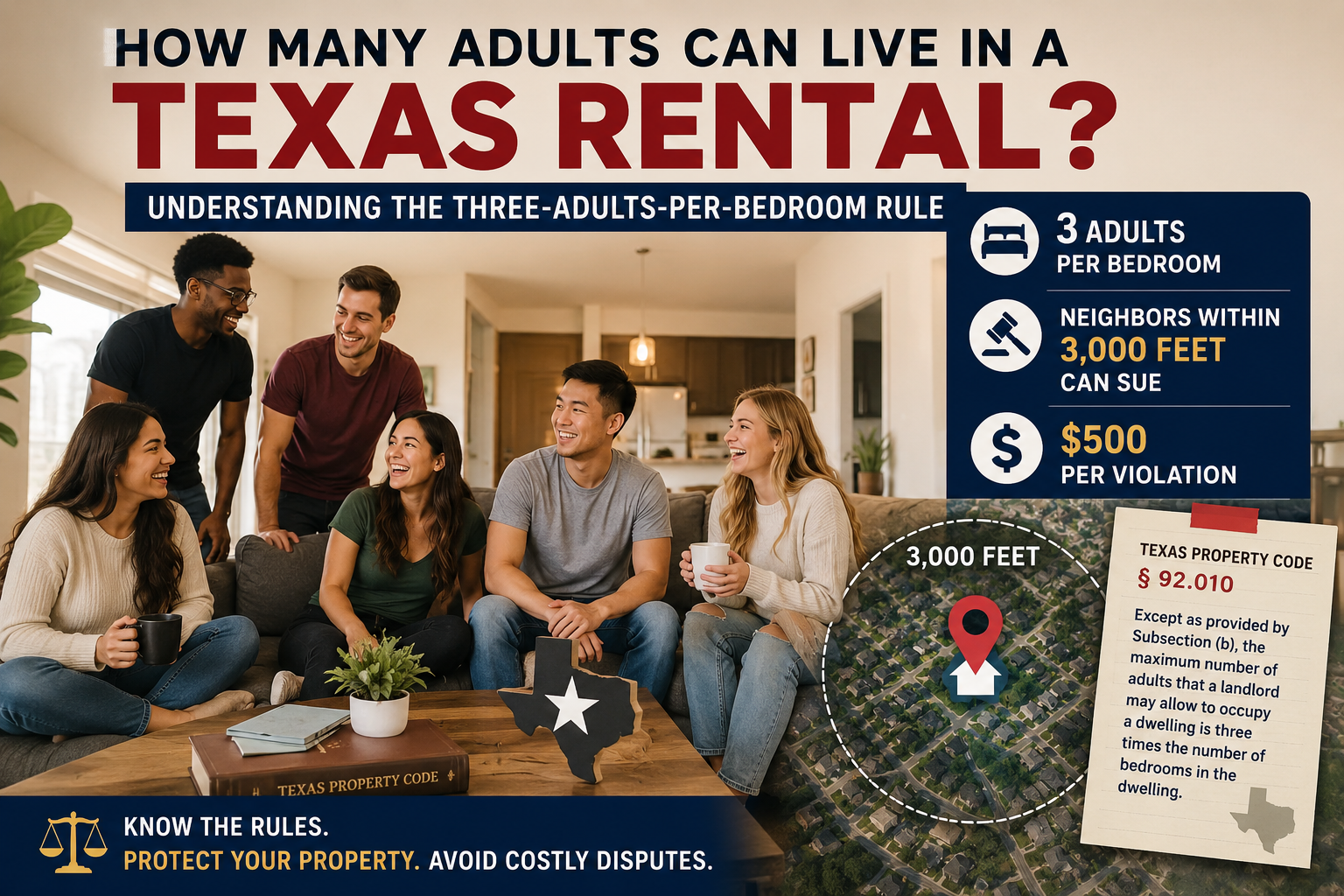
Under Texas Property Code § 92.010, a landlord generally may not allow more than three adults per bedroom to occupy a residential dwelling.
Even stranger, enforcement is not necessarily limited to the tenant, landlord, or government. In certain circumstances, someone who lives or owns property within 3,000 feet of the dwelling can sue the landlord to stop the violation—and potentially recover $500 per violation.
For landlords, tenants, property managers, and even neighbors, this obscure provision of the Texas Property Code is worth understanding.
Texas Generally Limits Occupancy to Three Adults Per Bedroom
Texas Property Code § 92.010(a) provides:
“Except as provided by Subsection (b), the maximum number of adults that a landlord may allow to occupy a dwelling is three times the number of bedrooms in the dwelling.”
Tex. Prop. Code § 92.010(a). (Texas Statutes)
The arithmetic is straightforward.
A one-bedroom dwelling generally has a statutory maximum of three adults. A two-bedroom dwelling generally has a maximum of six adults. A three-bedroom dwelling generally has a maximum of nine adults.
Importantly, the statute regulates the number of adults, not simply the total number of human beings living in the dwelling.
Section 92.010(d) defines an “adult” as an individual who is 18 years of age or older. (Texas Statutes)
That distinction matters for families with children.
No, the Living Room Does Not Magically Become Another Bedroom
The statute also defines what counts as a bedroom.
Under § 92.010(d)(2), a bedroom means:
“an area of a dwelling intended as sleeping quarters.”
But the statute expressly excludes several areas from that definition, including the kitchen, dining room, bathroom, living room, utility room, closet, and storage area. (Texas Statutes)
That creates an interesting practical consequence.
Suppose six adults occupy a one-bedroom apartment, with two sleeping in the bedroom, two in the living room, and two using some other portion of the apartment.
Calling the living room a “second bedroom” does not necessarily solve the statutory problem. The Texas Legislature specifically excluded a living room from the definition.
The legal question is therefore not merely how many places someone can physically put a mattress.
There Are Important Exceptions
The three-adults-per-bedroom rule is not absolute.
Texas Property Code § 92.010(b) permits a landlord to allow a higher occupancy rate in at least two circumstances.
First, a higher occupancy rate may be permitted when state or federal fair housing law requires it.
Second, Texas law contains a particularly humane temporary exception for family violence.
A landlord may permit an adult to exceed the ordinary occupancy limit when that person's occupancy results from seeking temporary sanctuary from family violence, provided the period does not exceed one month. (Texas Statutes)
That means the statute itself recognizes that emergency living arrangements sometimes require flexibility.
A person escaping family violence does not necessarily turn an otherwise lawful household into an illegal occupancy arrangement merely because another adult temporarily takes shelter there.
The Really Strange Part: Your Neighbor May Be Able to Sue
This is where § 92.010 becomes much more interesting than a typical occupancy regulation.
The statute does not leave enforcement solely to a city inspector or other governmental authority.
Section 92.010(c) permits an individual who owns or leases a dwelling within 3,000 feet of the allegedly overcrowded dwelling to bring suit against the landlord to enjoin the violation. A governmental entity or civic association acting on behalf of such an individual may also sue. (Texas Statutes)
Three thousand feet is more than half a mile.
So Texas law potentially gives people living a substantial distance away a statutory mechanism to challenge a landlord's violation of the occupancy rule.
That is unusual enough to surprise many property owners.
A Successful Plaintiff May Recover $500 Per Violation
The statute has some teeth.
A prevailing party in an action under § 92.010(c) may recover court costs and reasonable attorney's fees from the other party.
But a successful plaintiff may receive something more:
“$500 for each violation of this section.”
Tex. Prop. Code § 92.010(c). (Texas Statutes)
Thus, a landlord who knowingly permits excessive occupancy may face more than an administrative headache or a dispute over the lease.
The statute expressly creates a civil enforcement mechanism.
At the same time, because attorney's fees may be awarded to the prevailing party, filing a poorly supported lawsuit over alleged overcrowding can carry risk for the plaintiff as well.
What Does It Mean That a Landlord “May Allow” Three Adults Per Bedroom?
The wording of the statute deserves attention.
Section 92.010 does not simply declare it illegal for more than three adults per bedroom to be physically present in a dwelling. It states the maximum number of adults that a landlord “may allow to occupy” the dwelling. (Texas Statutes)
That distinction can matter.
For example, a landlord may discover that a tenant has secretly moved several additional adults into a property contrary to the lease. That factual situation is different from a landlord knowingly renting a one-bedroom dwelling to six adults and expressly permitting all six to reside there.
As with many landlord-tenant disputes, the documents, communications, landlord's knowledge, and actual living arrangement can therefore become important.
Can a Landlord Set a Lower Occupancy Limit?
Section 92.010 establishes a statutory maximum; it should not automatically be read as guaranteeing every tenant a right to house three adults in every bedroom.
Other legal rules can still matter, including the lease, applicable building and fire codes, and state and federal fair-housing requirements.
A landlord therefore should not assume that because Texas Property Code § 92.010 might theoretically permit six adults in a two-bedroom dwelling, six adults must always be permitted.
Likewise, landlords should be cautious about adopting arbitrary occupancy policies that could conflict with applicable fair-housing law.
The statute itself recognizes this interaction by expressly making an exception where state or federal fair-housing law requires a higher occupancy rate. (Texas Statutes)
What About Children?
The statute's definition of “adult” provides an important answer.
For purposes of § 92.010, an adult is someone 18 years old or older. (Texas Statutes)
Accordingly, the simple “three times the number of bedrooms” calculation is specifically an adult occupancy limitation.
That does not mean there can never be lawful limits involving children or total occupancy. Other laws and legitimate health and safety requirements may apply.
But landlords should be especially careful about occupancy policies affecting families with children because familial status is protected under fair-housing law. A landlord should not simply invent an unusually restrictive occupancy rule as a disguised means of excluding families.
Example: Six Adults in a One-Bedroom Apartment
Consider a simple example.
A landlord rents a one-bedroom apartment to two tenants. Several months later, four additional adults move into the apartment, and the landlord knowingly allows all six to remain indefinitely.
The statutory calculation is:
Six adults therefore exceed the general maximum established by § 92.010(a).
If no statutory exception applies, the landlord may have a problem even if every occupant is perfectly happy with the arrangement.
And because § 92.010(c) gives certain nearby residents, governmental entities, and civic associations standing to seek an injunction, the dispute need not originate with one of the occupants.
That is perhaps the strangest feature of the law: the tenants themselves may have no desire to complain, yet the landlord can still face litigation over the occupancy.
Landlords Should Pay Attention to Unauthorized Occupants
For landlords and property managers, § 92.010 is another reason to take unauthorized-occupant provisions seriously.
If a lease identifies two adults as tenants but six adults are actually residing in a one-bedroom property, simply ignoring the situation may create problems beyond ordinary lease enforcement.
Landlords should document who is authorized to occupy the property, investigate credible reports of substantial unauthorized occupancy, and avoid knowingly approving arrangements that violate applicable law.
At the same time, landlords should not react mechanically. Temporary guests, children, family-violence situations, reasonable accommodations, and other circumstances can materially change the legal analysis.
Tenants Should Understand the Difference Between Guests and Occupants
Tenants should likewise distinguish between having visitors and effectively adding residents to the household.
A friend spending the weekend is not ordinarily the same factual situation as an adult moving into the property, keeping belongings there, receiving mail there, and treating the rental as a permanent home.
The lease may also contain its own guest or unauthorized-occupant provisions.
Disputes about occupancy therefore frequently depend on the actual facts rather than simply the number of people found inside the property on a particular afternoon.
Texas Occupancy Law Is More Specific Than Many People Realize
Texas Property Code § 92.010 is a good example of how surprisingly detailed landlord-tenant law can become.
The statute defines an adult. It defines a bedroom. It establishes a mathematical occupancy limit. It creates exceptions. It gives certain people living within 3,000 feet standing to sue. And it authorizes a successful plaintiff to recover $500 per violation, along with court costs and potentially attorney's fees. (Texas Statutes)
For what sounds like the simple question—
“How many people can live in this apartment?”
—the legal answer can become considerably more complicated.
Landlords facing an unusual occupancy situation should review the lease, Texas Property Code, applicable local requirements, and fair-housing law before taking action. Tenants facing eviction or other lease enforcement based on alleged overcrowding should likewise determine which rule the landlord is actually relying upon and whether an exception or other legal protection applies.
At David C. Barsalou, Attorney at Law, PLLC, we help clients navigate business, family, tax, estate planning, and real estate matters ranging from document drafting to litigation with clarity and confidence. If you’d like guidance on your situation, schedule a consultation today. Call us at (713) 397-4678, email barsalou.law@gmail.com, or reach us through our Contact Page. We’re here to help you take the next step.
