Rent was due on the first. The tenant did not pay.
Can the landlord immediately add a $100 late fee? What about $25 per day? Could the lease impose a $500 late fee on a $1,500 monthly rent payment?
Texas law does not simply leave those questions entirely to the lease.
Texas Property Code § 92.019 regulates residential late fees and establishes requirements concerning when a landlord may collect them and how large they may reasonably be.
For both Texas landlords and tenants, the details matter.
A Late Fee Must Be Included in a Written Lease
A landlord cannot simply invent a late fee after rent becomes overdue.
Texas Property Code § 92.019(a) provides that a landlord may not collect a late fee unless:
“notice of the fee is included in a written lease”
The statute also requires the fee to be reasonable.
This makes the written lease particularly important. A landlord who expects to collect late fees should make sure the lease actually provides for them rather than assuming that Texas law automatically creates a right to charge whatever late fee the landlord considers appropriate.
When Can a Texas Landlord Start Charging a Late Fee?
Texas law provides tenants with a limited statutory waiting period.
Under § 92.019(a)(3), a landlord may not collect the late fee unless:
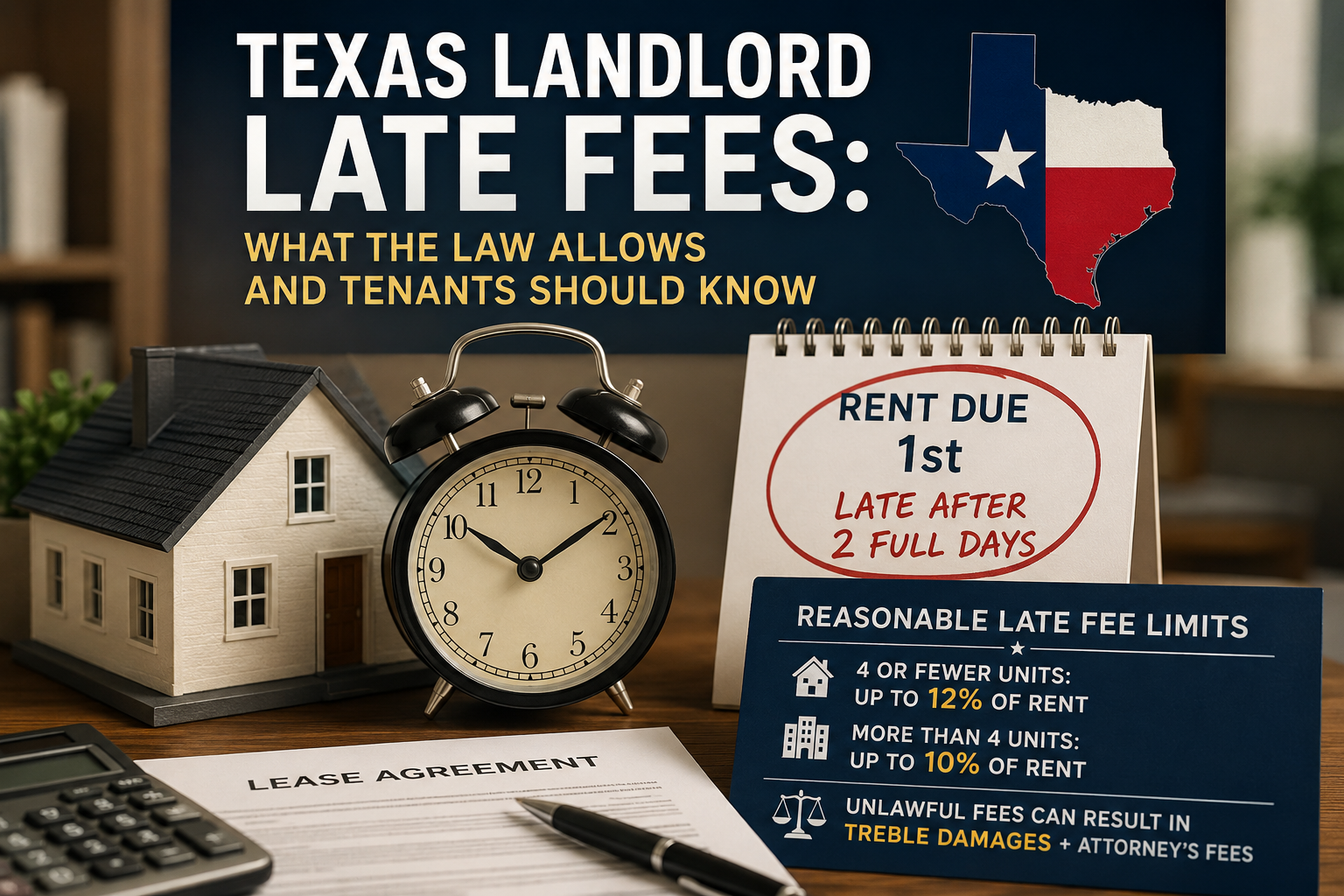
“any portion of the tenant's rent has remained unpaid two full days after the date the rent was originally due.”
The phrase “two full days” is important.
If rent is due on the first day of the month, the statute does not authorize collection of a late fee merely because the tenant wakes up on the second with unpaid rent.
Landlords should therefore distinguish between rent being contractually due and the point at which a late fee may legally be collected.
How Much Can a Texas Landlord Charge as a Late Fee?
This is where Texas law becomes unusually specific.
Section 92.019(a-1) establishes amounts that are considered reasonable.
For a dwelling located in a structure containing four or fewer dwelling units, a late fee is considered reasonable if it is no more than 12% of the rent for the rental period.
For a dwelling located in a structure containing more than four dwelling units, the corresponding amount is 10% of the rent for the rental period.
That distinction means the presumptively reasonable amount can depend upon the type of property being rented.
Example: Single-Family Rental
Suppose a tenant rents a single-family house for $2,000 per month.
Twelve percent of $2,000 is $240.
A late fee of no more than $240 would therefore fall within the statute's specified reasonable amount.
Example: Large Apartment Complex
Suppose instead that a tenant pays $2,000 per month for an apartment in a 200-unit complex.
Ten percent of $2,000 is $200.
The statute therefore treats a late fee of no more than $200 as reasonable under the percentage standard.
Does That Mean 10% or 12% Is Always the Absolute Maximum?
Not necessarily.
This is an important qualification.
Section 92.019(a-1)(2) allows a late fee exceeding the applicable percentage when the fee is nevertheless no greater than the landlord's uncertain damages associated with the late payment.
The statute expressly refers to matters including:
- direct or indirect expenses;
- direct or indirect costs; and
- overhead associated with collecting late payment.
In other words, the 10% and 12% figures provide relatively clear statutory safe territory for determining reasonableness, but the statute does not make them absolute ceilings in every conceivable case.
A landlord seeking to impose a larger fee, however, should be prepared to justify why that larger amount represents the landlord's actual uncertain damages related to late payment.
Simply writing an enormous late fee into the lease does not necessarily make it reasonable.
Can a Texas Lease Charge Both an Initial Late Fee and a Daily Late Fee?
Yes.
Texas Property Code § 92.019(b) expressly recognizes that a late fee may consist of:
“an initial fee and a daily fee”
for each day that some portion of the rent continues to remain unpaid.
There is an important catch.
The statute treats the initial fee and the accumulating daily fees as one combined late fee for purposes of § 92.019.
A landlord therefore cannot necessarily avoid the reasonableness requirement by dividing a large late charge into smaller pieces.
For example, calling one amount the “initial late fee” and additional amounts “daily late charges” does not make each charge legally independent for purposes of determining whether the overall late fee is reasonable.
What Happens If the Tenant Pays Only Part of the Rent?
The statute is written broadly.
Section 92.019 repeatedly refers to “any portion” of the tenant's rent remaining unpaid.
Accordingly, paying most—but not all—of the rent does not necessarily eliminate the contractual and statutory consequences of late payment.
The precise amount owed and the operation of the lease may depend upon the particular facts, but tenants should not assume that a partial payment automatically prevents a properly authorized late fee.
Can the Lease Waive Texas's Late-Fee Protections?
No.
Texas Property Code § 92.019(d) provides:
“A provision of a lease that purports to waive a right or exempt a party from a liability or duty under this section is void.”
That language is significant.
Ordinarily, leases contain numerous contractual provisions allocating rights and responsibilities between landlord and tenant. Section 92.019, however, establishes protections that cannot simply be eliminated by putting contrary language into the lease.
A tenant's signature does not automatically make an otherwise unlawful late-fee provision enforceable.
What Can a Tenant Recover If a Landlord Violates the Law?
The consequences can be substantially larger than the disputed late fee itself.
Under Texas Property Code § 92.019(c), a landlord who violates the statute may be liable for:
$100, plus three times the amount of the late fee collected in violation of the statute, plus the tenant's reasonable attorney's fees.
Consider a simplified example.
Suppose a landlord improperly collects a $300 late fee.
Three times $300 is $900. Adding the statutory $100 produces $1,000, before considering reasonable attorney's fees.
A relatively modest dispute over a late charge can therefore create significantly greater exposure.
Can a Tenant Ask the Landlord How Much Is Owed in Late Fees?
Yes.
Texas Property Code § 92.0191 gives a tenant an additional, relatively little-known right.
A tenant may request a written statement indicating whether the tenant owes a late fee and, if so, the amount.
The landlord must provide the statement using an established means regularly used for written communication between the landlord and tenant.
This can be useful when daily charges have accumulated or when the landlord and tenant disagree about the tenant's current balance.
Importantly, however, the statute also provides that the landlord's failure to respond does not eliminate a late fee that the tenant otherwise legally owes.
Does an Illegal Late Fee Prevent an Eviction?
Not necessarily.
Section 92.019(e) specifically provides that the late-fee statute does not affect a landlord's right to terminate the lease or take other action permitted by the lease or other law.
This distinction matters.
Whether a particular late fee is lawful and whether a tenant has failed to pay rent as required by the lease can be separate legal questions.
A tenant therefore should not assume that a dispute over a late fee automatically creates a right to remain in the property without paying rent.
Similarly, a landlord should not assume that a tenant's failure to pay rent permits the landlord to disregard the statutory limitations governing late fees.
Late Fees Are Not Simply Whatever the Lease Says
Texas residential leases are contracts, but landlord-tenant law places statutory limits on certain contractual provisions.
Late fees are a good example.
A Texas landlord generally needs a written lease providing for the fee, must wait until rent has remained unpaid for the statutory period, and must impose a reasonable fee. The Legislature has also provided specific percentage standards for determining reasonableness and meaningful remedies when a landlord violates the statute.
For landlords, carefully drafting and following the lease can prevent a relatively small late-payment dispute from becoming a larger legal problem.
For tenants, understanding § 92.019 can help distinguish between a legitimate late fee and a charge that Texas law may not permit.
When a dispute involves substantial late fees, an eviction, conflicting account balances, or repeated charges, either party may benefit from having the lease and payment history reviewed by a Texas landlord-tenant attorney.
At David C. Barsalou, Attorney at Law, PLLC, we help clients navigate business, family, tax, estate planning, and real estate matters ranging from document drafting to litigation with clarity and confidence. If you’d like guidance on your situation, schedule a consultation today. Call us at (713) 397-4678, email barsalou.law@gmail.com, or reach us through our Contact Page. We’re here to help you take the next step.
