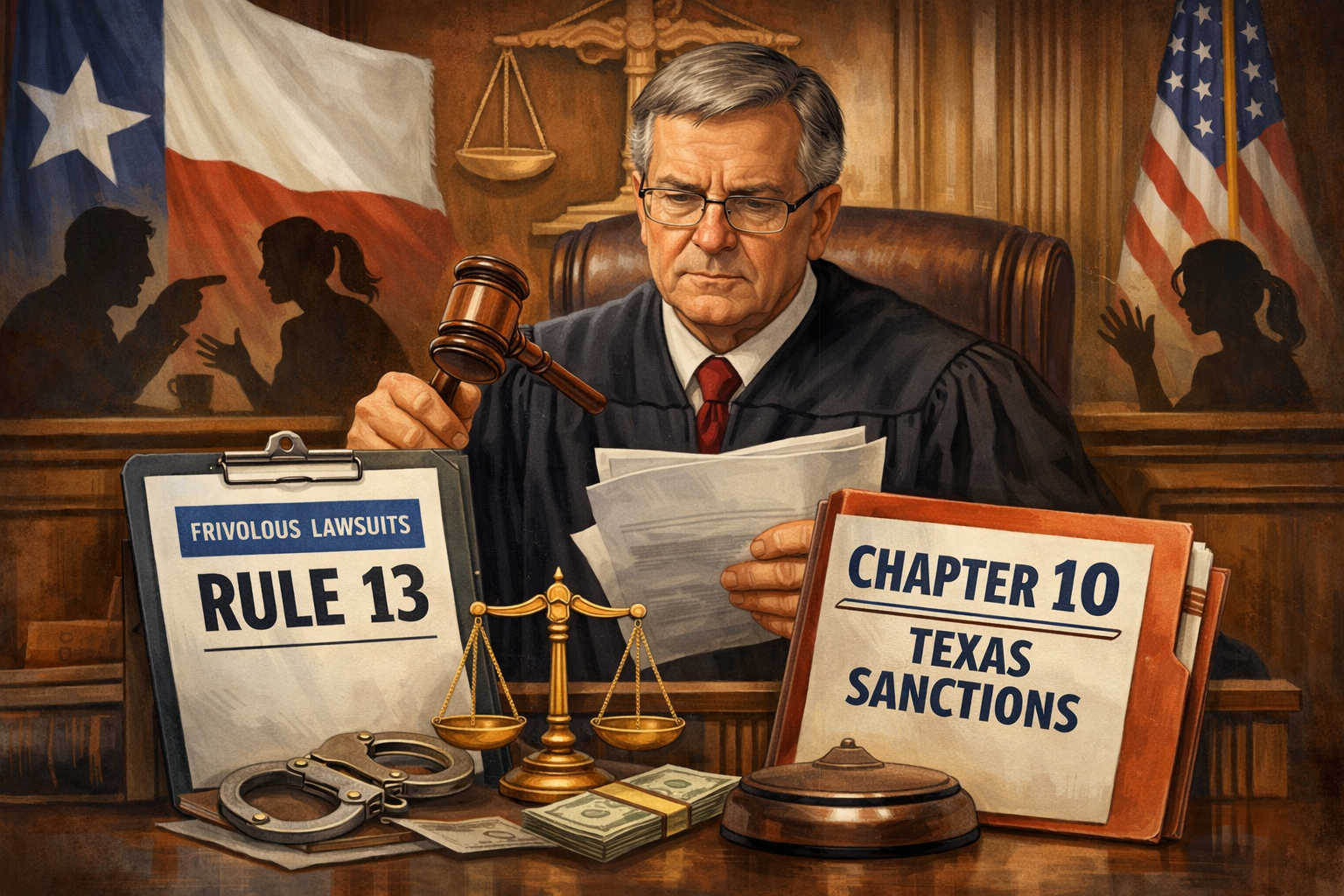
If you have ever been sued in Texas over a claim that made no sense, you are not alone. Every year, Texas courts see lawsuits filed for harassment, leverage, delay, or intimidation rather than legitimate legal disputes.
Fortunately, Texas law provides tools to discourage abusive litigation. Two of the most important are:
- Texas Rule of Civil Procedure 13, and
- Chapter 10 of the Texas Civil Practice and Remedies Code
These provisions allow judges to impose sanctions on parties and attorneys who file frivolous pleadings.
Understanding how these rules work can protect your finances, your reputation, and your time.
What Is a Frivolous Lawsuit in Texas?
A lawsuit is considered frivolous when it is filed:
- Without legal merit
- Without factual support
- For improper purposes such as harassment or delay
- Without reasonable investigation
Texas Rule of Civil Procedure 13 states in part:
“The signatures of attorneys or parties constitute a certificate that they have read the pleading… and that to the best of their knowledge, information, and belief formed after reasonable inquiry the pleading is not groundless and brought in bad faith or for the purpose of harassment.”
If this certification is false, sanctions may follow.
Sanctions Under Texas Rule of Civil Procedure 13
Rule 13 focuses primarily on bad-faith pleadings.
Under Rule 13, a court may sanction a party or lawyer who files pleadings that are:
- Groundless, and
- Brought in bad faith, or
- Filed to harass
A pleading is “groundless” if it has no basis in law or fact and is not supported by a good-faith argument for changing the law.
Possible Rule 13 Penalties
If Rule 13 is violated, a judge may order:
- Payment of the opposing party’s attorney’s fees
- Reimbursement of court costs
- Monetary penalties
- Other disciplinary measures
These sanctions are intended to deter abusive litigation practices.
Sanctions Under Chapter 10 of the Texas Civil Practice and Remedies Code
Chapter 10 provides even broader authority for courts to punish improper filings.
Section 10.001 provides that every pleading certifies that:
- It is not filed for an improper purpose
- Legal claims are warranted by law
- Factual allegations have evidentiary support
- Denials are reasonably based on evidence
If any of these are violated, sanctions may be imposed.
Statutory Authority
Texas Civil Practice and Remedies Code § 10.004(a) states:
“A court that determines that a person has signed a pleading in violation of Section 10.001 may impose a sanction.”
What Types of Sanctions Can Be Ordered?
Under Chapter 10, courts may impose:
- Attorney’s fees
- Litigation expenses
- Monetary penalties paid to the court
- Dismissal of claims
- Orders restricting future filings
The statute requires sanctions to be “limited to what is sufficient to deter repetition.”
In other words, punishment must fit the misconduct.
When Do Texas Judges Actually Impose Sanctions?
While sanctions are available, judges do not impose them lightly. Courts look for clear evidence of:
- Intentional abuse
- Reckless disregard for facts
- Repeated misconduct
- Clear harassment motives
Common situations include:
- Filing lawsuits with no evidence
- Re-filing dismissed claims
- Making knowingly false allegations
- Using litigation as leverage in divorce or business disputes
- Threatening baseless claims to force settlements
In practice, sanctions are most common in high-conflict family law, commercial disputes, and landlord-tenant litigation.
How to Seek Sanctions in Your Case
If you are facing a frivolous lawsuit, your attorney may pursue sanctions by:
- Documenting improper conduct
- Filing a motion for sanctions
- Requesting an evidentiary hearing
- Presenting proof of bad faith or lack of evidence
Courts require notice and an opportunity to be heard before sanctions are imposed.
Simply losing a case is not enough. There must be proof of abuse.
Why This Matters for Texas Businesses and Property Owners
Frivolous lawsuits cost real money.
They force defendants to:
- Hire lawyers
- Miss work
- Pay court fees
- Suffer stress and reputational harm
For landlords, business owners, and professionals, abusive litigation is often used as a negotiation tactic.
Sanctions law exists to discourage this behavior and restore fairness to the system.
Can Sanctions Be Used Against Attorneys?
Yes.
Both Rule 13 and Chapter 10 apply to:
- Parties
- Lawyers
- Law firms
Attorneys who repeatedly file baseless claims risk financial penalties and disciplinary consequences.
This encourages responsible advocacy.
Final Thoughts: Not Every Bad Case Is Frivolous
It is important to understand that:
- Weak cases are not automatically sanctionable
- Losing does not equal misconduct
- Good-faith legal disputes are protected
Sanctions are reserved for clear abuse.
If you believe you are being targeted by improper litigation, consult an experienced Texas civil litigation attorney before responding.
Early strategic decisions can make the difference between defending a case and turning the tables.
Need Help Defending Against a Frivolous Lawsuit?
If you are dealing with meritless claims, abusive filings, or litigation harassment in Texas, professional guidance matters.
An attorney can evaluate whether sanctions are appropriate and help protect your rights.
At David C. Barsalou, Attorney at Law, PLLC, we help clients navigate business, family, tax, estate planning, and real estate matters ranging from document drafting to litigation with clarity and confidence. If you’d like guidance on your situation, schedule a consultation today. Call us at (713) 397-4678, email barsalou.law@gmail.com, or reach us through our Contact Page. We’re here to help you take the next step.
