How Texas Allocates Fault in Civil Lawsuits
Many people assume that if they are found negligent in a lawsuit, they must pay all of the plaintiff's damages. In Texas, that often is not true.
Texas follows a proportionate responsibility system in many civil actions. Rather than automatically holding one defendant responsible for all damages, Texas courts frequently determine each person's percentage of responsibility and allocate liability accordingly.
These rules are found primarily in Chapter 33 of the Texas Civil Practice and Remedies Code, and they can dramatically affect both plaintiffs and defendants in litigation.
What Is Proportionate Responsibility?
Chapter 33 requires the jury (or judge in some cases) to determine the percentage of responsibility attributable to various persons whose conduct contributed to the claimant's injury.
The statute provides in part:
"The trier of fact, as to each cause of action asserted, shall determine the percentage of responsibility... for the following persons with respect to each person's causing or contributing to cause in any way the harm for which recovery of damages is sought..."
Instead of asking only whether a defendant was negligent, Texas courts often ask:
- How much fault belongs to the plaintiff?
- How much belongs to each defendant?
- Was a responsible third party involved?
- Should liability be divided among multiple people?
A Simple Example
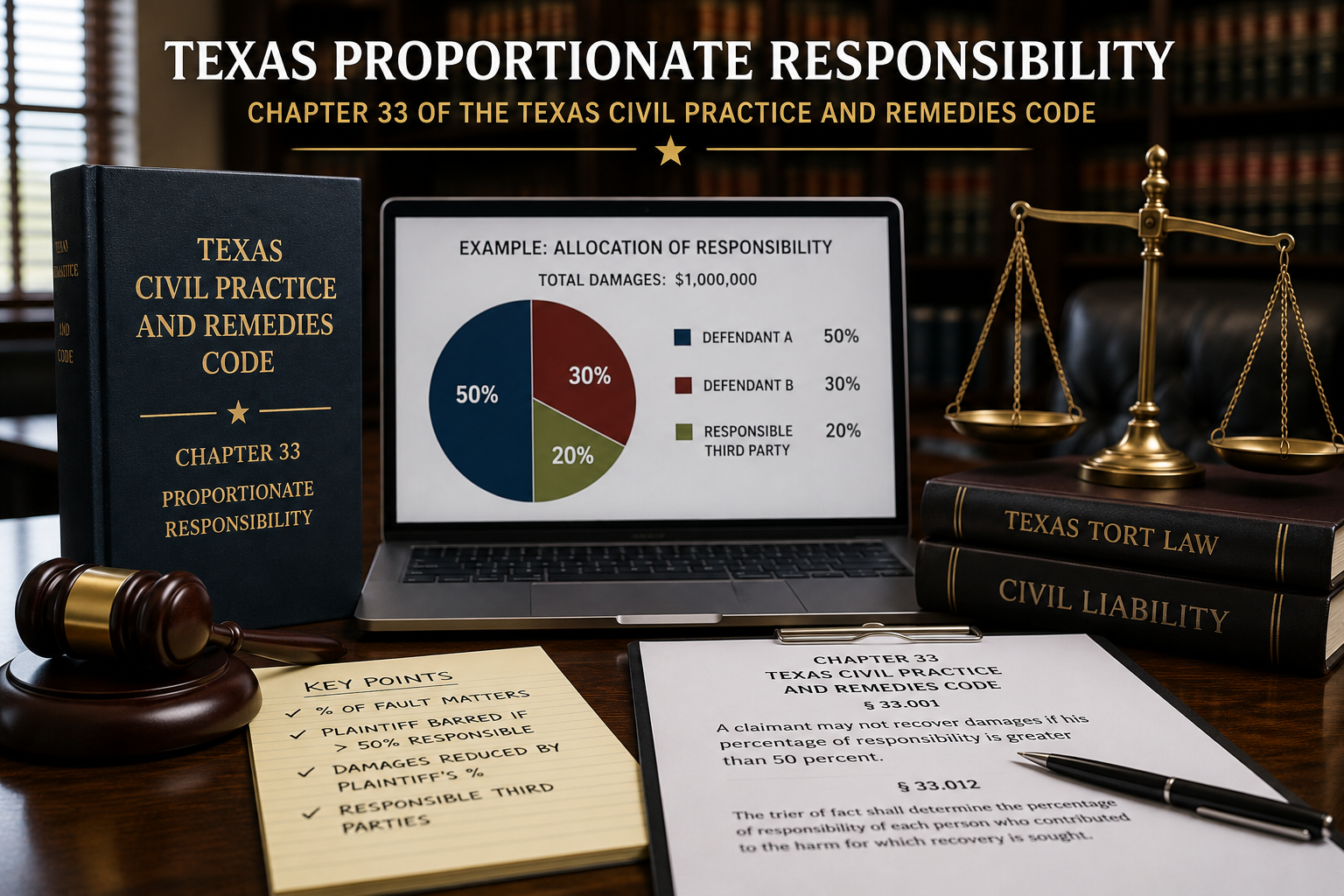
Suppose a construction accident causes $1,000,000 in damages.
The jury finds:
- General contractor: 50% responsible
- Subcontractor: 30% responsible
- Property owner: 20% responsible
Under Chapter 33, liability may be allocated according to each party's percentage of responsibility, subject to the statute's rules governing joint and several liability.
Plaintiff's Own Negligence Matters
Texas follows a modified comparative responsibility system.
If the plaintiff's own negligence contributed to the accident, the recovery may be reduced.
For example:
A jury awards $500,000 in damages.
If the plaintiff is found 25% responsible, the award is generally reduced by 25%.
Instead of recovering $500,000, the plaintiff may recover $375,000before considering any other legal limitations.
The 50 Percent Bar
One of the most important provisions of Chapter 33 appears in Texas Civil Practice and Remedies Code § 33.001, which provides:
"A claimant may not recover damages if his percentage of responsibility is greater than 50 percent."
This means that if a plaintiff is found 51% responsible, the plaintiff generally recovers nothing.
That single percentage point can determine whether a lawsuit succeeds or fails.
Responsible Third Parties
One unique feature of Texas law is the ability to designate certain responsible third parties.
Sometimes a defendant argues that another person—not currently a party to the lawsuit—caused all or part of the damages.
If properly designated under Chapter 33, the jury may assign responsibility to that person even if the person is not ultimately liable in the lawsuit.
This can significantly reduce a defendant's percentage of fault.
Why Chapter 33 Matters
Proportionate responsibility frequently becomes one of the most important issues in cases involving:
- business disputes involving multiple actors,
- construction litigation,
- premises liability,
- commercial negligence,
- property damage claims,
- personal injury lawsuits,
- fraud claims involving multiple participants.
Even when liability appears obvious, the allocation of percentages may dramatically affect the ultimate judgment.
Litigation Strategy Often Focuses on Fault Allocation
Experienced litigators often spend substantial effort developing evidence regarding who caused what rather than simply arguing whether someone acted negligently.
Witness testimony, expert opinions, contracts, maintenance records, photographs, emails, and business records may all become critical in persuading the jury to allocate responsibility differently.
A shift of only a few percentage points may substantially change the amount ultimately recoverable.
Need Help With a Texas Civil Lawsuit?
Whether you are bringing a claim or defending one, understanding Texas's proportionate responsibility system is essential. Liability is not always an all-or-nothing question. In many cases, the allocation of fault among multiple parties determines the outcome just as much as the underlying facts.
If you are involved in a Texas civil dispute involving multiple potentially responsible parties, consulting with an experienced Texas attorney can help protect your rights and develop an effective litigation strategy.
At David C. Barsalou, Attorney at Law, PLLC, we help clients navigate business, family, tax, estate planning, and real estate matters ranging from document drafting to litigation with clarity and confidence. If you’d like guidance on your situation, schedule a consultation today. Call us at (713) 397-4678, email barsalou.law@gmail.com, or reach us through our Contact Page. We’re here to help you take the next step.