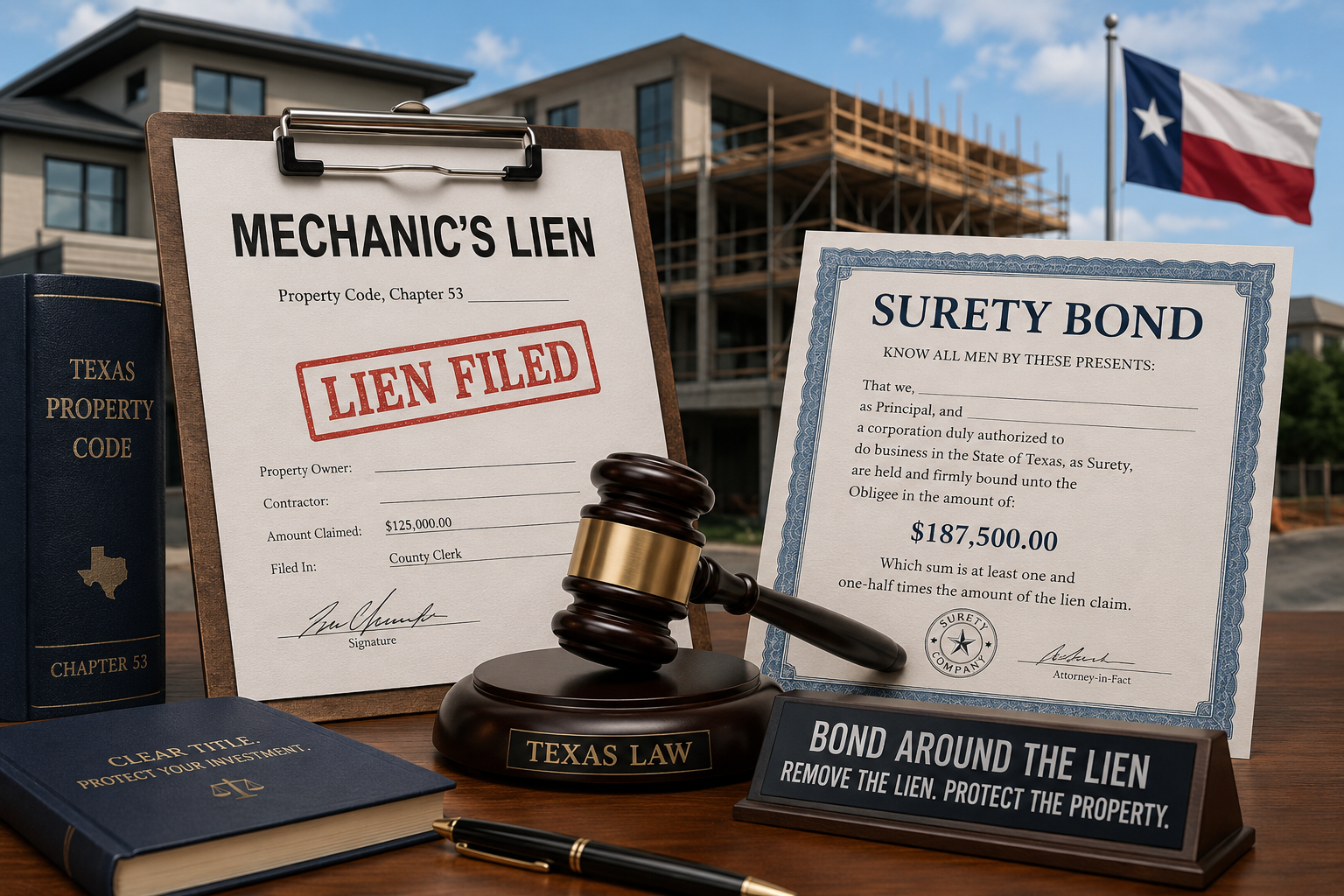
When a mechanic's lien is filed against Texas real property, many property owners assume they must immediately pay the contractor or wait until litigation concludes before they can sell, refinance, or otherwise deal with the property. In many cases, that is not true.
Texas law provides a powerful remedy known as bonding around a lien, which allows the property owner to effectively remove the lien from the property while preserving the claimant's rights against a substitute bond.
For homeowners, investors, developers, and business owners, understanding this process can mean the difference between a stalled transaction and moving forward with confidence.
What Is a Mechanic's Lien?
A mechanic's lien is a statutory lien that may be asserted by contractors, subcontractors, laborers, and material suppliers who have not been paid for work or materials furnished to improve real property.
Texas mechanic's liens are governed primarily by Chapter 53 of the Texas Property Code.
When properly perfected, a mechanic's lien can cloud title to real estate and may ultimately be foreclosed through court proceedings.
What Does It Mean to "Bond Around" a Lien?
Texas law permits an owner to substitute a surety bond for the lien itself.
The effect is significant: the lien is removed from the property records as an encumbrance on the real estate, and the claimant's security interest transfers to the bond.
The governing statute provides:
"An owner of property subject to a lien may file a bond with the county clerk in the county in which the property is located."
Tex. Prop. Code § 53.171(a).
Once the statutory procedures are followed, the property is generally released from the lien, and any future litigation concerning the claim proceeds against the bond rather than the real estate.
Why Would a Property Owner Use a Bond?
There are several common reasons:
1. Sale of the Property
A pending lien can derail a real estate closing. Buyers and title companies are often unwilling to proceed while a mechanic's lien remains of record.
2. Refinancing
Lenders frequently require liens to be cleared before funding a refinance transaction.
3. Disputed Claims
The owner may genuinely believe the contractor's claim is invalid but still needs the property to remain marketable.
4. Business Continuity
Commercial owners and developers often need to maintain clear title for financing and operational purposes.
How Large Must the Bond Be?
Texas law requires the bond to exceed the amount claimed.
Section 53.172 provides in relevant part:
"The bond must be in an amount that is at least one and one-half times the amount of the lien claim."
This means a claimant asserting a $100,000 lien generally requires a bond of at least $150,000.
The bond must typically be issued by a licensed surety company authorized to conduct business in Texas.
What Happens After the Bond Is Filed?
The bond is filed with the county clerk where the property is located.
The clerk then provides notice procedures specified by statute.
Once the statutory requirements are satisfied, the lien claimant's security interest attaches to the bond rather than the property.
The owner may then be able to proceed with transactions involving the real estate without the mechanic's lien serving as an encumbrance on title.
Does Bonding Around the Lien Mean the Owner Wins?
No.
This is a common misconception.
Bonding around a lien does not determine whether the contractor, subcontractor, or supplier is ultimately entitled to payment.
Instead, it changes the collateral securing the claim.
The parties may still litigate issues such as:
- Whether the lien was properly perfected;
- Whether notice requirements were satisfied;
- Whether the work was completed;
- Whether the work was defective;
- Whether payment was owed; and
- The amount of damages, if any.
The bond simply removes the property itself from the dispute.
Can an Invalid Lien Still Be Challenged?
Absolutely.
A property owner may still attack the validity of the lien through various legal procedures even after bonding around it.
For example, defects involving statutory notices, filing deadlines, constitutional lien requirements, or underlying contract disputes may still provide grounds to defeat the claim entirely.
In many cases, bonding around a lien is merely the first step in a broader litigation strategy.
Practical Considerations
Property owners should understand that obtaining a bond typically requires:
- A surety application;
- Financial disclosures;
- Payment of a premium to the bonding company;
- Coordination with the title company when a transaction is pending; and
- Careful compliance with Chapter 53 procedures.
Mistakes in the bonding process can create unnecessary complications and delay the intended release of the property.
Conclusion
A mechanic's lien does not always have to remain attached to Texas real estate while a dispute is resolved. Through the bonding procedures found in Chapter 53 of the Texas Property Code, property owners can often free their property from a recorded lien while preserving the claimant's right to pursue recovery against a substitute bond.
For property owners facing a disputed mechanic's lien, bonding around the lien may provide a practical solution that protects both marketability and leverage while the underlying dispute is litigated.
Disclaimer: This article is provided for educational purposes only and does not constitute legal advice. Every mechanic's lien dispute involves unique facts, deadlines, and procedural requirements. Property owners should consult qualified legal counsel regarding their specific circumstances.
At David C. Barsalou, Attorney at Law, PLLC, we help clients navigate business, family, tax, estate planning, and real estate matters ranging from document drafting to litigation with clarity and confidence. If you’d like guidance on your situation, schedule a consultation today. Call us at (713) 397-4678, email barsalou.law@gmail.com, or reach us through our Contact Page. We’re here to help you take the next step.