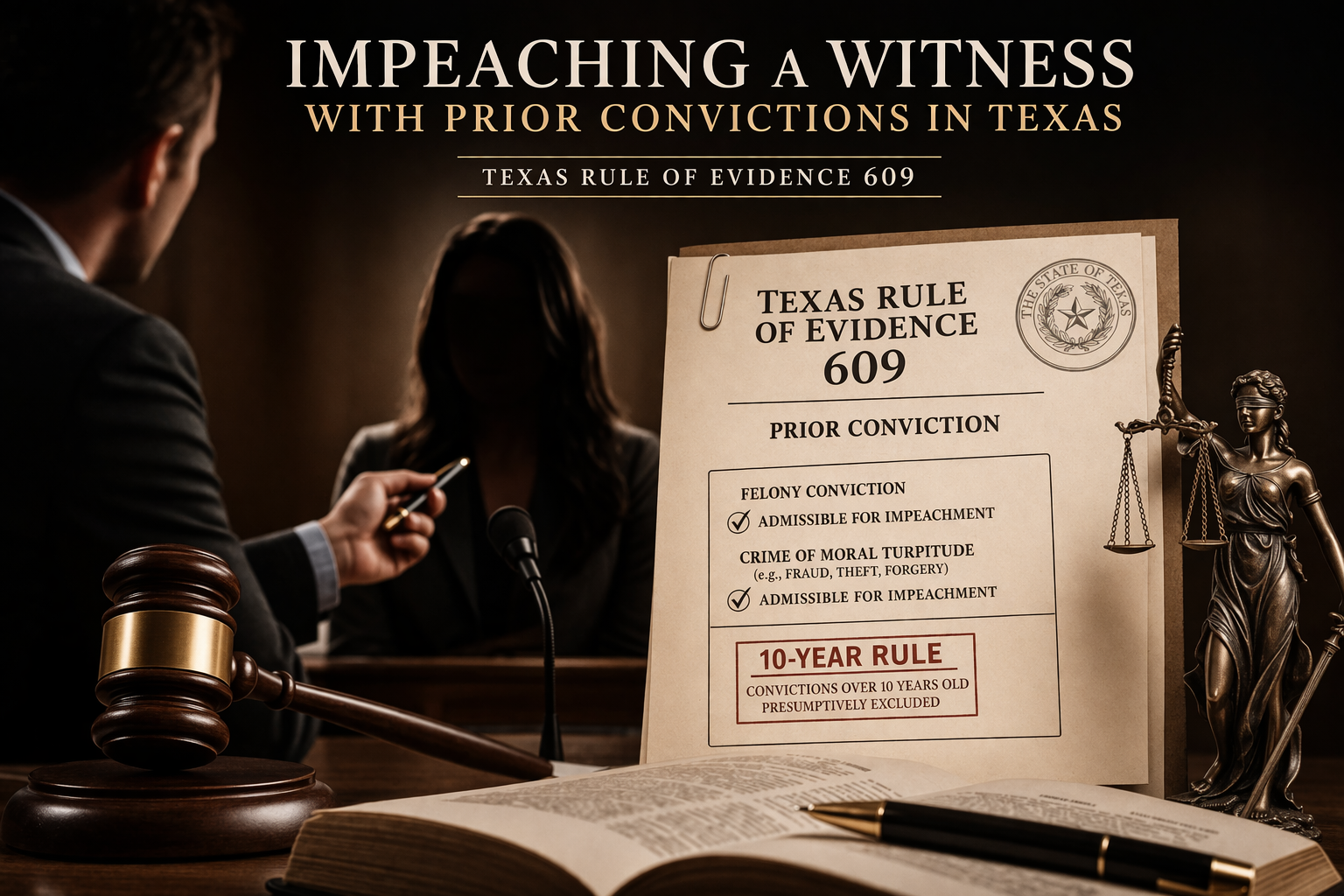
When a case turns on credibility—and most do—Texas Rule of Evidence 609 becomes one of the most powerful (and dangerous) tools in your litigation arsenal. Used correctly, it can dismantle a witness. Used poorly, it can backfire or get excluded entirely.
This post breaks down how impeachment by prior conviction actually works in Texas courts, with strategy baked in.
The Rule: What TRE 609 Actually Says
Texas Rule of Evidence 609 governs when a witness may be impeached with a criminal conviction:
“Evidence of a criminal conviction offered to attack a witness’s character for truthfulness must be admitted if: (1) the crime was a felony or involved moral turpitude; (2) the probative value of admitting this evidence outweighs its prejudicial effect to a party; and (3) the evidence is elicited from the witness or established by public record.”
— Tex. R. Evid. 609(a)
That sounds simple, but the real fight is almost always over balancing probative value vs. prejudice.
What Counts: Felonies and Crimes of Moral Turpitude
Not all convictions are created equal.
1. Felonies
Any felony conviction may be admissible—but only after the balancing test.
2. Crimes of Moral Turpitude
These are crimes that reflect dishonesty or bad character for truthfulness, such as:
- Fraud
- Theft
- Forgery
These are often more powerful than generic felonies because they go directly to credibility.
The Balancing Test: Where Cases Are Won or Lost
Even if a conviction qualifies, the court must still determine whether:
“the probative value outweighs its prejudicial effect”
— Tex. R. Evid. 609(a)
Texas courts typically consider factors like:
- How recent the conviction is
- How similar it is to the current case
- The importance of the witness’s testimony
- The centrality of credibility in the case
Strategic Insight
If you’re attacking the other side’s key witness, emphasize credibility as the central issue.
If your own client has the conviction, minimize its relevance and argue unfair prejudice.
The 10-Year Rule: Old Convictions Are Usually Out
There is a strong presumption against using stale convictions:
“If more than 10 years have passed… evidence of the conviction is admissible only if its probative value, supported by specific facts and circumstances, substantially outweighs its prejudicial effect.”
— Tex. R. Evid. 609(b)
That “substantially outweighs” language is a much higher bar than the normal balancing test.
Practical Takeaway:
Old convictions are rarely admitted unless:
- The case is heavily credibility-driven, and
- The conviction is highly probative (e.g., fraud in a fraud case)
Juvenile Adjudications: Almost Always Excluded
Texas strongly disfavors impeachment with juvenile adjudications:
“Evidence of a juvenile adjudication is admissible only if: (1) it is offered in a criminal case; (2) the adjudication was of a witness other than the accused; and (3) admitting the evidence is necessary to fairly determine guilt or innocence.”
— Tex. R. Evid. 609(d)
For civil practitioners, this is basically a non-starter.
Method of Proof: How You Actually Get It In
You have two main options:
- Ask the witness directly on cross-examination, or
- Introduce a certified record of conviction
But beware—if the witness denies it and you don’t have the record ready, you’ve just lost credibility with the court.
Strategic Use in Texas Litigation
1. Depositions
Lock the witness in early. If they admit the conviction, trial becomes much easier.
2. Motions in Limine
Expect pretrial fights. Judges often want to decide Rule 609 issues before trial begins.
3. Trial Timing
Do not rush it. Impeachment is often more powerful:
- After the witness has committed to a version of events
- When credibility is already in question
Common Pitfalls
- Failing to analyze moral turpitude (not all crimes qualify)
- Ignoring the 10-year rule
- Overreaching (judges hate when impeachment feels like character assassination)
- Not having certified records ready
Why This Rule Matters More Than You Think
Rule 609 is not just about criminal history—it’s about controlling the narrative of credibility.
In many Texas cases:
- The law is clear
- The facts are disputed
- The outcome depends on who the jury believes
And Rule 609 is one of the few tools that directly attacks that question.
Final Thought
Most lawyers know Rule 609 exists. Far fewer know how to use it surgically.
If credibility is your battlefield—and it usually is—this rule is not optional. It’s decisive.
At David C. Barsalou, Attorney at Law, PLLC, we help clients navigate business, family, tax, estate planning, and real estate matters ranging from document drafting to litigation with clarity and confidence. If you’d like guidance on your situation, schedule a consultation today. Call us at (713) 397-4678, email barsalou.law@gmail.com, or reach us through our Contact Page. We’re here to help you take the next step.
