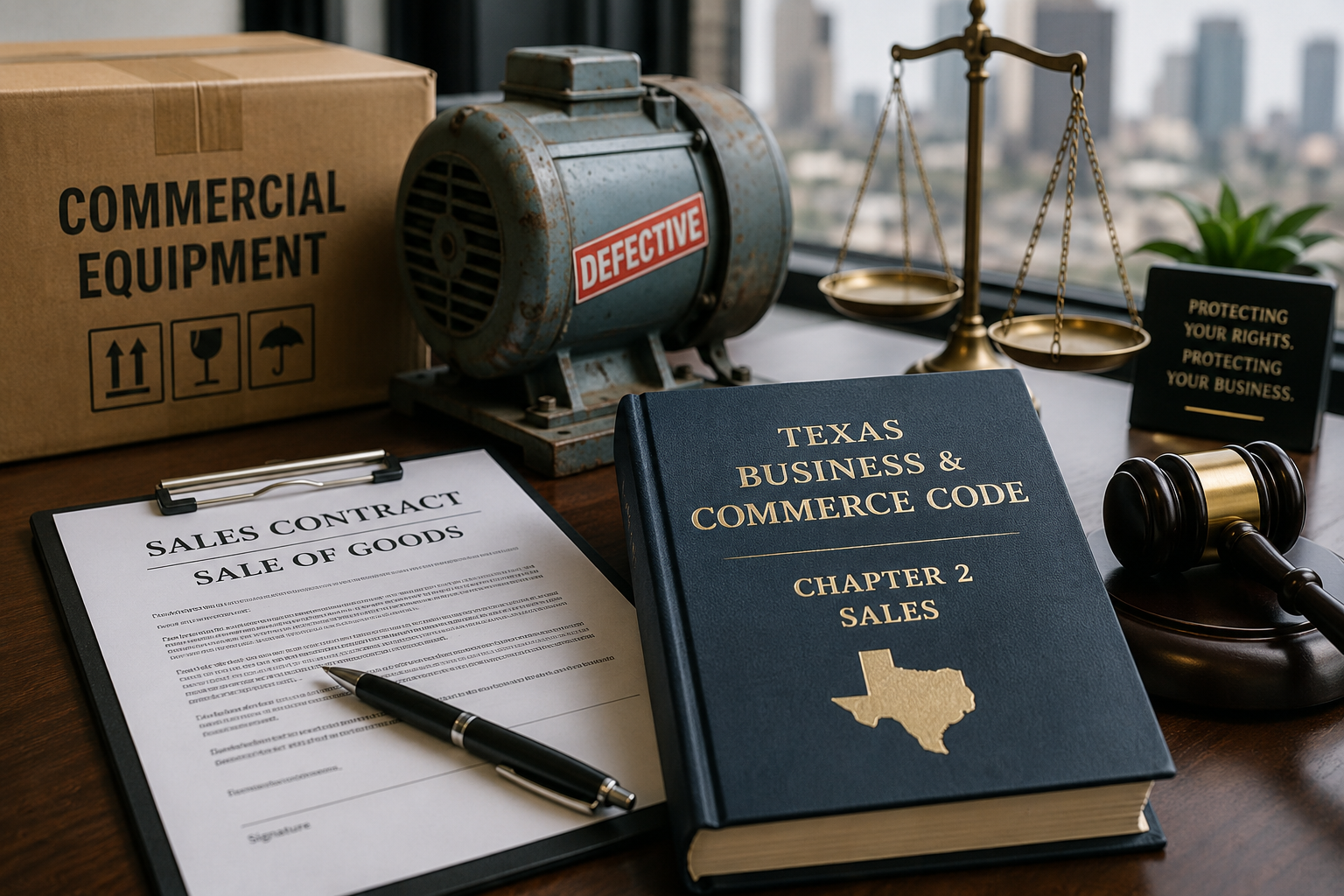
Whether you operate a small business, purchase equipment for your company, or simply buy goods from a merchant, Texas law may provide protections that exist even if they are never written into your contract. These protections are known as implied warranties.
Many business owners assume that if a written contract does not mention warranties, none exist. In reality, the Texas Business & Commerce Code automatically implies certain warranties into many transactions involving the sale of goods unless they are properly excluded.
Understanding these rules can help businesses avoid costly disputes—and may determine whether you have a legal claim when purchased goods fail.
What Is an Implied Warranty?
Unlike an express warranty, which is created by specific promises or descriptions made by the seller, an implied warranty arises automatically under Texas law.
The most common implied warranties involve:
- Merchantability
- Fitness for a particular purpose
These warranties apply primarily to transactions governed by Chapter 2 of the Texas Business & Commerce Code, which adopts much of the Uniform Commercial Code (UCC).
The Implied Warranty of Merchantability
One of the most important provisions is Texas Business & Commerce Code § 2.314, which provides:
"Unless excluded or modified... a warranty that the goods shall be merchantable is implied in a contract for their sale if the seller is a merchant with respect to goods of that kind."
In simple terms, if a merchant sells goods, those goods generally must be of ordinary quality and reasonably fit for the ordinary purposes for which they are used.
For example:
- A commercial freezer should actually freeze food.
- A new water pump should pump water.
- Office computers should perform basic computing functions.
The law does not guarantee perfection, but it generally requires that the goods perform as ordinary purchasers would reasonably expect.
What Makes Someone a Merchant?
Not every seller is considered a merchant.
Generally speaking, a merchant is someone who regularly deals in the type of goods being sold or otherwise possesses specialized knowledge regarding those goods.
For example:
- A dealership selling automobiles is typically a merchant.
- A retailer selling appliances is generally a merchant.
- A homeowner selling an old lawn mower at a garage sale usually is not.
This distinction often determines whether the implied warranty of merchantability applies.
The Warranty of Fitness for a Particular Purpose
Texas Business & Commerce Code § 2.315 provides another important implied warranty.
If:
- the seller knows the buyer's particular purpose for purchasing the goods; and
- the buyer is relying upon the seller's expertise to select appropriate goods,
then the law may imply a warranty that the goods will be suitable for that specific purpose.
For example:
A contractor tells a supplier that he needs paint capable of withstanding continuous exposure to saltwater.
If the supplier recommends a product that immediately fails in marine conditions, the buyer may have a warranty claim even if the paint would have been acceptable for ordinary residential use.
Can Sellers Disclaim These Warranties?
Yes—but only if they follow the requirements of the Texas Business & Commerce Code.
Section 2.316 provides that, to exclude the implied warranty of merchantability, the disclaimer generally must:
- specifically mention merchantability, and
- if in writing, be conspicuous.
Likewise, many contracts effectively disclaim implied warranties by using language such as:
"AS IS"
or
"WITH ALL FAULTS,"
provided the disclaimer satisfies applicable legal requirements.
Whether a disclaimer is enforceable often becomes one of the central issues in commercial litigation.
What Damages May Be Available?
If an implied warranty has been breached, available remedies may include:
- repair costs;
- replacement costs;
- refund of the purchase price;
- consequential damages in appropriate cases;
- incidental damages; and
- other remedies authorized under the Texas Business & Commerce Code or the parties' agreement.
The available remedy depends upon the facts, the contract language, and whether any contractual limitations on remedies are enforceable.
These Cases Often Become Contract Disputes
Many business lawsuits begin as simple contract disputes but evolve into warranty litigation.
Common examples include:
- defective commercial equipment;
- manufacturing defects;
- defective building materials;
- industrial machinery failures;
- restaurant equipment failures;
- agricultural equipment defects; and
- disputes between wholesalers and retailers.
Because warranty claims often overlap with breach of contract claims, careful review of the purchase agreement, invoices, disclaimers, and communications between the parties is critical.
When Should You Speak With an Attorney?
If you purchased expensive equipment that failed shortly after delivery—or if your business is facing a claim involving allegedly defective goods—it is wise to have the contract reviewed before assuming either side is legally correct.
The Texas Business & Commerce Code contains numerous provisions governing warranties, disclaimers, notice requirements, and available remedies. Small differences in contract language can significantly affect the outcome of a dispute.
Contact David C. Barsalou, Attorney at Law, PLLC
Commercial disputes often involve more than simply asking whether a product worked. Questions about implied warranties, contract interpretation, disclaimer language, and available remedies can substantially affect both liability and damages.
If you are involved in a Texas business or contract dispute, David C. Barsalou, Attorney at Law, PLLC represents businesses and individuals in commercial litigation, contract disputes, and related civil matters throughout Texas.
At David C. Barsalou, Attorney at Law, PLLC, we help clients navigate business, family, tax, estate planning, and real estate matters ranging from document drafting to litigation with clarity and confidence. If you’d like guidance on your situation, schedule a consultation today. Call us at (713) 397-4678, email barsalou.law@gmail.com, or reach us through our Contact Page. We’re here to help you take the next step.